
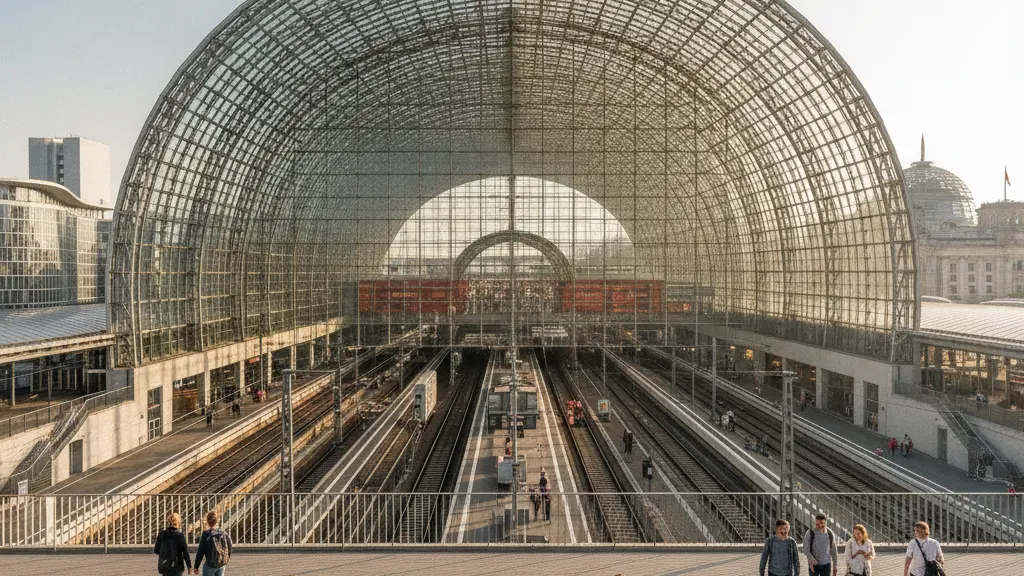
Overview: Berlin Hauptbahnhof as a Symbol and Hub
When the new central station in Berlin opened in May 2006 it arrived as more than a transportation node. Built on the site of the former Lehrter station after more than a decade of planning and construction and an investment of well over 700 million euros, the project was conceived as a visible statement for a reunited Germany. The station combined major long distance lines on east-west and north-south axes in a single location and reshaped the city’s rail concept from the start.
Designed by the architectural office led by Meinhard von Gerkan, the station was intended as a prestige project that would show 21st century mobility and position Berlin again as a major European rail hub. Two days after the official opening ceremony on 26 May 2006, regular operations began and a new chapter in Berlin transport and urban symbolism started.
Architecture and Design
Design and spatial concept
The building presents itself as a glass and steel tower station that stacks several levels of traffic on top of each other. Large transparent facades, a broad glass roof spanning the halls, and long visual axes were used not only for function but also as deliberate images. The station makes movement visible and frames passenger flows as an urban spectacle.
Turmbahnhof form, materials and notable features
As one of the largest tower stations in Europe the project highlights the use of glass and steel to create light, openness and visual connections between levels. Glass lifts moving slowly through a hall up to 46 meters high and long escalators that link levels are signature elements that dramatize the steady stream of people and trains.
- Multi-level platform layout that separates regional and long distance flows
- Extensive use of glass for natural light and transparency
- Long sightlines and framed circulation routes
Architectural forums acknowledged the station as an important example of contemporary transport architecture and it received international recognition shortly after completion, reinforcing its image as a modern icon of mobility.
Role in the Transport Network
Opening the station and the new north-south long distance route reorganized Berlin’s traffic concept and brought most major long distance services together in one place for the first time. This consolidation created a central distribution point for national and international routes and strengthened Berlin’s role as a rail crossroads connecting north, south, east and west.
| Characteristic | Value |
|---|---|
| Opening year | 2006 |
| Approximate construction cost | Over 700 million euros |
| Tracks | 14 |
| Trains per day | About 1,300 |
| Passengers and visitors per day | Approximately 300,000 to 330,000 |
| The station functions as a major national long distance hub and a busy urban interchange. | |
Symbolism and Political Context
The station’s location near the seat of government and on land that once hosted the former Lehrter station gives it strong symbolic weight. Placed close to the former inner city border, the new hub was widely read as an infrastructural answer to division, a place where previously separated networks now cross and connect.
Political figures at the opening emphasized the site’s symbolic meaning and described the moment as one rich in symbolism and significance. For the city, the station became a tangible sign that Berlin had reasserted itself as a political and transport center after the era of provisional arrangements following German reunification.
Everyday Life, Services and Urban Role
Beyond trains and tracks the station has grown into a small urban center. Several levels host dozens of shops, restaurants and service providers, while hotels and bars in the surrounding area add to its mixed use character. The building serves commuters, travelers, tourists and local residents, making it a daily crossroads where different social worlds meet.
- Retail and dining spread across multiple levels
- Integration with city streets and nearby public institutions
- Function as both transport hub and urban meeting place
The visible movement of people and trains turns the station into a public stage. The architectural idea of transparency was meant to make mobility accessible and observable, turning the circulation of the city into a democratic, shared experience.
Criticism, Practical Issues and Ambivalence
With its rise in importance came scrutiny. The station has been associated with a number of technical and operational problems over time, from lift and escalator breakdowns to other technical faults and organizational challenges. These issues have at times punctured the initial image of flawless prestige.
- Technical faults and maintenance incidents reported over the years
- Perceived mismatch between monumental design and everyday efficiency
- Public debates about cost, performance and long term reliability
Critics point out that some dramatic architectural elements serve spectacle more than speed. For travelers seeking the most direct and intuitive routes, the grand spatial choreography can sometimes feel cumbersome. In winter the large hall can be drafty and some circulation paths can appear long for people in a hurry.
Legacy and Long Term Perspective
Despite setbacks and public debate, many planners and commentators stress the long term value of the design: the station is a lasting example of modern transport architecture and a key piece of city and national infrastructure. Its ability to combine symbolic meaning with practical capacity has helped shape how Berlin presents itself on the European map.
The station remains layered with meaning. It stands as a national symbol of reunification and connectivity, as a city gateway to the government quarter, and as an architectural statement about transparency and mobility. Its ambivalence between spectacle and everyday use makes the place interesting and relevant, showing how built form can reflect both aspiration and reality.
