
1. Overview: Pentecost as the Church’s Birthday
Pentecost is widely understood in Christian tradition as the “birthday of the church.” It marks the moment, fifty days after Easter, when a frightened group of disciples gathered in Jerusalem experiences a dramatic outpouring of the Holy Spirit. Scripture describes a sudden sound like a rushing wind and tongues of fire resting on each of them. They begin to speak in other languages, and people from many lands hear the message in their own mother tongue. This event turns inward grief into public proclamation and sets the early church on a mission to the world.
Key elements of the Pentecost story
- A powerful wind like a storm fills the place.
- Appearances of tongues of fire resting on each disciple.
- The disciples speak in different languages and are understood by listeners from many regions.
- The event is interpreted as the outpouring of the Holy Spirit.
- Peter preaches and about 3,000 people are baptized, signaling the birth of the first Christian community.
The name itself points to timing and continuity: Pentecost derives from the Greek pentekosté, the fiftieth day after Easter, concluding the fifty-day Easter season. As one of the three great feasts of the church year—alongside Christmas and Easter—Pentecost combines Christian reinterpretation with older Jewish traditions of a fifty-day festival after Passover. Historically, the festival sits at a hinge between private faith and public community, the moment when the followers of Jesus move from hidden mourning to visible witness.
2. The Biblical Before‑After Effect
Theological reading of the Pentecost account often emphasizes a clear before‑and‑after contrast. Before Pentecost the Gospels and Acts depict the disciples as grieving, confused, fearful and gathered behind closed doors. After Pentecost they are energized, speak openly about Jesus, and embark on public mission. This shift is frequently called the “before‑after effect,” meaning that the experience of the Spirit brings a qualitative change in identity and action.
From grief to proclamation
The story shows how sorrow and uncertainty can be transformed into courage and speech. A modern description of this change speaks of disciples who were withdrawn and unsure before the Spirit came, and then opened all doors and shared their story with enthusiasm afterward. The narrative frames Pentecost as the turning point when private faith becomes an outward, communicative force.
Luke presents Peter as a pivotal figure in that turning point: after the Spirit comes, he addresses the crowd and calls people to baptism, and thousands join. That narrative moment supports the long-standing church interpretation: Pentecost is the beginning of a publicly visible Christian movement and the start of mission in the world.
3. Theology: Holy Spirit, Mission, and Community
Theologically, Pentecost centers on the gift of the Holy Spirit, understood not as an abstract doctrine but as a present, empowering force. The Spirit enables the disciples to remember, speak, teach and take responsibility. Pentecost therefore links inner renewal with outward mission: the same Spirit who comforts and guides also equips people for service, peacemaking and creative new beginnings.
- Spirit as empowerment for mission and witness.
- Spirit as the source of communal life and mutual responsibility.
- Spirit as universal gift that breaks exclusivity and reaches many nations.
Pentecost as the birth of the church
Because the event produces a community that proclaims the gospel and baptizes thousands, many churches call Pentecost their birthday. This language highlights that church is first and foremost a gathered, speaking and missioning people made possible by the Spirit. The Spirit is given not to a private elite but to the community and to every believer, making mission inclusive and universal from the start.
4. Symbols and Images of Pentecost
Symbols in the Pentecost story capture the idea of external power entering a community and causing change. Fire and wind are the main images: fire as transforming energy and love, wind as movement and breath. The dove and the liturgical color red have become associated with the Spirit, with red suggesting flame, passion and the life of prayer.
- Fire: transformation, zeal, purification.
- Wind: movement, breath, life.
- Dove: peace and the Spirit’s presence (borrowed image from baptismal accounts).
- Red: liturgical color for Pentecost, signaling flame and passion.
Language, Babel and reconciliation
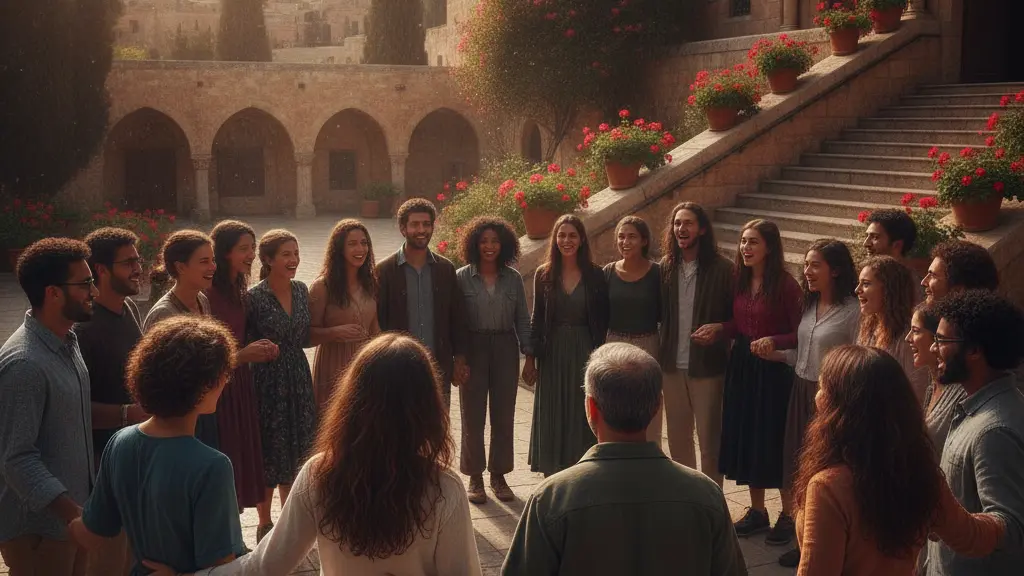
Pentecost is often read as an intentional contrast to the Babel story. At Babel, language diversity leads to confusion and dispersal; at Pentecost, language diversity becomes a means of understanding and unity. That contrast turns the before‑after theme into a social and cultural message: divisions can be overcome, and communication across boundaries becomes possible through listening and the Spirit’s enabling.
5. Traditions, Customs and Cultural Impact
Pentecost has both religious and cultural dimensions. In many places it is a public holiday, often observed with a long weekend, travel, outdoor services, processions and community festivals. Compared with Christmas and Easter, worship attendance can be lower, and local customs or leisure activities sometimes dominate the weekend.
Local customs and seasonal practices
Traditional rural customs and seasonal symbols are woven into Pentecost celebrations. One historical custom is the decorated ‘Pentecost ox,’ linked to driving cattle to pasture after winter. Flowers associated with the season—like the peony, sometimes called a ‘rose without thorns’—also appear in decorations and folk imagery. These practices connect the festival’s spiritual meaning of new life and movement with agricultural rhythms and community life.
At the same time, popular or secular uses of Pentecost emphasize rest, short vacations, outdoor activities and sport. Some modern voices even use Pentecost imagery outside of church life to describe personal adventures, new starts and a sense of stepping into fresh challenges. This crossover shows how the ‘before‑after’ idea of Pentecost resonates beyond strictly religious settings.
6. Personal and Contemporary Relevance
Spiritually, Pentecost invites people to practice waiting, expectation and openness. The biblical image of the disciples gathered in the upper room encourages reflection on how inner prayer and communal presence prepare us for change. Many Christian communities speak of Pentecost not only as a one‑time event but as an ongoing condition: the church is most alive when it allows the Spirit to renew and transform it.
Practical ways to live Pentecost today
- Make space for silence and expectation: set aside time to listen rather than immediately act.
- Practice bold listening: seek to understand people from different backgrounds and languages.
- Engage in small acts of service that connect faith with public life.
- Celebrate renewal: use community gatherings to encourage creativity, reconciliation and steps toward new initiatives.
7. Conclusion
Pentecost combines biblical narrative, theological depth and cultural practice in a single festival that marks a radical change of direction. As the church’s birthday, it celebrates the Spirit’s power to turn fear into courage, silence into speech, and division into understanding. Whether experienced liturgically, culturally or personally, Pentecost continues to invite communities and individuals into movement, mission and renewed relationship with one another.
