
1. Zwickau at a crossroads: the current picture
The Volkswagen site in Zwickau faces deep and immediate change. Weak production numbers in the early months of 2026, ongoing overcapacity across the group and intense cost pressure have exposed structural problems. The plant is currently running on a single production line, reducing utilization and driving factory costs above €4,000 per vehicle, well above the target of €3,000. Group CEO Oliver Blume summed it up: ‘The Volkswagen Group has a strong substance. However, today we do not earn enough money with our vehicles to sustainably finance our future.’
Key facts at a glance
- Production in early 2026 is weak and the Zwickau plant has missed internal cost targets.
- Factory cost per vehicle is above €4,000 versus a target of €3,000.
- From 2027, production in Zwickau is planned to be focused on a single line, creating further uncertainty.
- The Volkswagen Group plans to cut European capacity by 1 million vehicles by 2028 and a further 500,000 by 2030.
- Strategic options include a new 2030 target picture developed with BCG, cuts in model complexity and potential cooperation to build China models in Europe.
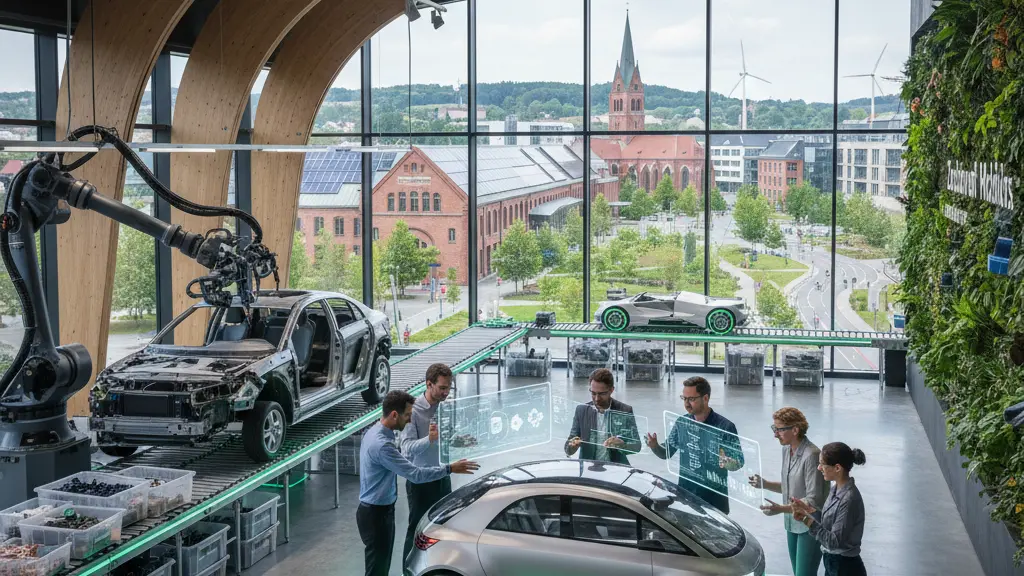
- An alternative growth route for Zwickau is a circular economy approach, with a planned center for automated dismantling and recycling of electric vehicles.
- Regional risks include potential reviews with job impacts: South West Saxony supports around 20,000 supplier jobs that could be affected.
2. The financial and production challenges
Zwickau’s problems are not isolated: they reflect group-wide difficulties in matching production capacity to demand, cutting costs and finding profitable business models for the transition to electrification and new mobility. The company has set a far-reaching goal to fundamentally change its business model by 2030 to restore profitability and competitiveness.
Production and cost details
| Metric | Target / Plan | Current (early 2026) |
|---|---|---|
| Factory cost per vehicle | €3,000 | Over €4,000 |
| Production lines in Zwickau | Focus on one line from 2027 | One line (reduced utilisation) |
| European capacity cuts | -1,000,000 by 2028; -500,000 by 2030 | Ongoing restructuring |
| Source: internal summaries and leadership statements from 2026 | ||
Leadership view
Oliver Blume has been frank about the gap between current margins and the financing needs for future investments, and CFO Arno Antlitz warns that ‘it is still a long way to go.’ Internal papers note that if targets are missed, reviews could come by the end of 2026, increasing regional uncertainty.
3. Strategic options on the table
Faced with the financial stress and structural overcapacity, Volkswagen is pursuing multiple, sometimes contrasting strategies. These range from deep cost cutting and product simplification to diversification into recycling, autonomous mobility and—even potentially—defence and joint production with Chinese partners.
Cost-cutting, model simplification and BCG plan
One major route is aggressive cost reduction. A new 2030 target picture developed with BCG aims to reduce complexity and costs, including cutting at least 10% from 150 model variants, simplification of platforms and tighter procurement. Zwickau has already shown progress with roughly 20% savings in some areas, but internal warnings remind that more is required.
- Reduce model variants to cut tooling, logistics and manufacturing complexity.
- Standardise components and platforms across regions.
- Seek partnerships to share development and production costs.
China cooperation and product sourcing
Another possibility under consideration is deeper cooperation with Chinese partners, including the option to build China-designed models in Europe. Oliver Blume has said the idea is being examined but no decision has been made. Such a move could lower development costs and broaden the product range for local markets, but it raises questions on brand positioning and supply chain dependence.
Defence and new sectors
Elsewhere in the group, talks with the defence sector are underway—Osnabrück has engaged defence conversations and projects like components for missile defence systems have been discussed. For Zwickau this remains hypothetical today, but success in other locations shows diversification into defence manufacturing could be possible in future, offering another revenue stream.
4. Circular economy and new industrial roles for Zwickau
As Volkswagen reshapes its business model, Zwickau is being positioned for a pivot toward circular economy activities. The planned centre for automated dismantling of electric vehicles aims to build recycling expertise, secure material flows and create new local jobs tied to battery and material recovery.
Automated dismantling and recycling competence
The proposed centre would focus on automated disassembly of end-of-life EVs, safe and efficient battery handling and recovering high-value materials. Developing these competencies can make Zwickau a regional hub for sustainable vehicle lifecycle management and reduce reliance on pure vehicle production volumes.
Autonomous public transport and Vision 2030
Saxon initiatives, including an intention statement around Vision 2030 for autonomous driving in public transport (ÖPNV), position Zwickau as a potential hub for intelligent mobility. The region’s strengths in automotive engineering, IT and research could be combined to develop pilot projects and attract public-sector mobility contracts.
- Develop pilots for autonomous buses and fleet services in local public transport.
- Use local research institutions and IT firms to support software and systems development.
- Link recycling operations with new mobility services for closed-loop supply chains.
5. Regional impact, jobs and masterplans
The stakes for the wider region are high. South West Saxony’s supply chain supports around 20,000 jobs that could be exposed if reviews lead to further capacity reductions. Local and regional policymakers are already drawing up masterplans to diversify the economy and support workers through retraining and new investment.
What this means for workers and suppliers
- Short term: manage production stability, protect viable jobs and communicate transparently with suppliers.
- Medium term: invest in retraining for recycling, battery refurbishment and software-related roles tied to autonomous mobility.
- Long term: attract investment into circular economy facilities and smart mobility projects to create sustainable regional employment.
6. Outlook: balancing risk and opportunity
Zwickau is shifting from a pure electric-vehicle manufacturing site to a hybrid model that mixes production with recycling, autonomous mobility initiatives and potentially other diversified products. This transition is driven by geopolitics, market pressures and the clear need to create new revenue streams by 2030. Internal reviews and potential capacity cuts create urgency: decisions taken in the months ahead will determine whether Zwickau secures a renewed industrial role or faces deeper contraction.
Key takeaways
- Zwickau faces immediate cost and utilization challenges, with factory costs above targets and production reduced to one line.
- The Volkswagen Group is pursuing deep cost cuts, product simplification (150 variants reduced), and strategic partnerships developed with BCG.
- Building China-designed models in Europe is being considered but not decided, and could reshape supply chains.
- Circular economy initiatives—an automated dismantling centre and battery recovery—offer a concrete new direction for Zwickau.
- Autonomous ÖPNV and smart mobility pilots could position Zwickau as a regional hub if public and private actors cooperate.
- Significant regional job risks exist; masterplans for diversification and reskilling will be critical to protect the local economy.
As CFO Arno Antlitz put it: ‘It is still a long way to go.’ The path forward will require balancing rapid cost discipline with strategic investments in recycling, software and new mobility—choices that will determine both the future of the Zwickau plant and the wider industrial landscape in South West Saxony.
