
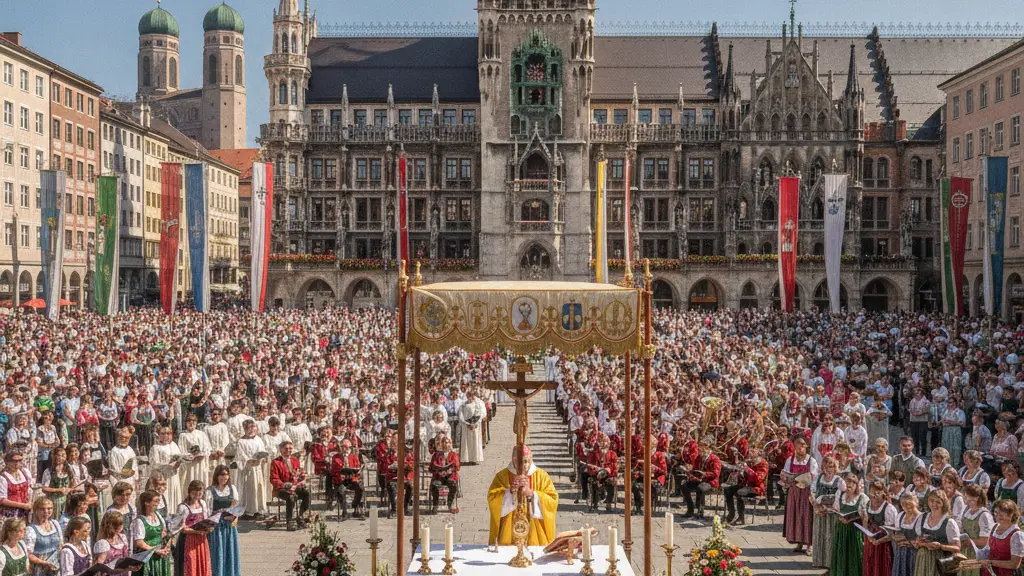
1. Marienplatz transformed into an altar
Early on the morning of Fronleichnam, Munich’s Marienplatz changed from a busy city square into a large open‑air liturgy space. A stage placed in front of the New Town Hall became a visible altar, complete with cross, flowers, a baldachin and the monstrance. At 9:00 a.m. Cardinal Reinhard Marx celebrated the festive Mass, an event the archdiocese had publicly announced and that drew people from across the city and surrounding region.
The square filled quickly. Reports from the archdiocese and church media describe attendance figures well into the five digits, with estimates of over 10,000 and even around 15,000 participants. Announcements and social posts had mobilized thousands in advance, and the crowd on the day reflected that broad turnout.
2. Atmosphere and participants
The mood was both festive and focused. Under a clear sky, clergy in striking yellow soutanes stood alongside altar servers, choirs and brass ensembles. Banners and flags moved in the light breeze; many people wore traditional trachten, while others came in simple Sunday clothes. The scene turned the city centre for a few hours into a public expression of faith.
- Parishioners from Munich and the suburbs
- Religious orders and the Ritterorden vom Heiligen Grab
- Youth groups, choirs and liturgical musicians
- Devotional movements and local church associations
- Passersby, tourists and onlookers who stopped to watch or joined the procession
3. Cardinal Marx’s message and key themes
A Eucharist that goes into the public square
In his homily Cardinal Marx emphasized the core meaning of Fronleichnam: the Eucharist is not meant to be confined to the interior of church buildings but is to be carried into public life. He framed the celebration as a sign that the church should be visible and present in the city, summarised by his succinct line often quoted that if people need the church, ‘we are there for you.’ The Mass and procession were presented as both worship and public witness.
Public concerns: democracy and artificial intelligence
Marx also used the gathering to address contemporary social themes. Speaking to the packed square he linked faith to civic responsibility, calling for a commitment to democratic life. He noted that new technologies, including artificial intelligence, bring both opportunities and risks and therefore need ethical guidance. He referred to recent church teaching that places such technologies within a wider framework of human dignity, justice and solidarity, urging careful ethical reflection on technological change.
4. The procession: route and ritual
After the Mass the traditional Fronleichnamsprozession set out from Marienplatz. The procession moved along Diener‑ and Residenzstraße toward Ludwigstraße and reached a large blessing altar at the Ludwigskirche before returning to the city centre. The consecrated host in the monstrance was carried under a baldachin, accompanied by song, prayer and the steady steps of clergy, religious and lay faithful.
- Begin at the stage‑altar on Marienplatz with the concluding rites of the Mass.
- Process along Dienerstraße and Residenzstraße toward Ludwigstraße.
- Pause at the segensaltar outside the Ludwigskirche for a solemn blessing.
- Return to the city centre with continuing prayer and hymnody.
- Conclude with a final sacramental blessing and the dispersal of the faithful.
The procession drew the attention of passersby and was widely documented on social media. Videos and photos captured the golden shine of the monstrance in sunlight, the packed ranks of participants and the mixture of onlookers and those who joined along the route. For many, the visual and musical elements made the ritual tangible and accessible.
5. Community meaning and presence in the city
The archdiocese described Fronleichnam as a festival that makes community visible. People of many nationalities, ages and spiritual backgrounds came together, showing the diverse face of Munich’s Catholic life. The event connected downtown congregations and suburban parishes, traditional societies and newer spiritual movements, and created a shared moment of public faith that also invited reflection on common social responsibilities.
6. After the celebration and lasting impressions
At the end of the procession Cardinal Marx gave the solemn sacramental blessing over the city. Slowly the liturgical space returned to its everyday functions: the altar stage was dismantled, trams resumed their routes and cafés filled again. Yet many participants and observers left with the clear impression that, for a morning, the Marienplatz had truly become an altar — a place where faith, public life and current debates briefly met.
By holding a visible public liturgy and procession, the celebration underlined the church’s desire to be present in public discourse, to encourage democratic participation and to engage ethically with issues such as artificial intelligence. The Marienplatz event in 2026 will be remembered as a day when ritual, community and civic reflection came together in Munich’s central square.
