
1. Overview: Fronleichnam 2026 in Neuss
Fronleichnam 2026 in Neuss combines public liturgy, local tradition and the Landesgartenschau (Laga). The central celebration begins on Thursday, 4 June 2026 at 9:00 on the Sparkassen-Bühne inside the Laga grounds. Admission is free for all visitors, and the event is presented as “Fronleichnam on the LAGA and in the city centre,” explicitly linking liturgy, city life and the horticultural show.
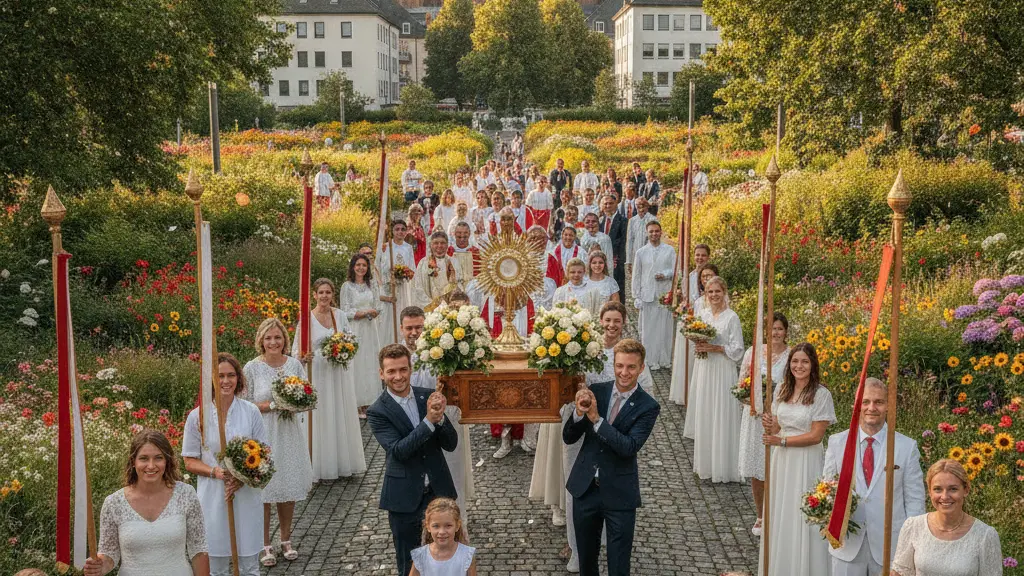
This day is both a religious high point in the Quirinus-Oktav and a visible public celebration: a festive Holy Mass in the open air followed by a procession that moves from the park into the historical heart of Neuss via the Obertor, ending by connecting to the Quirinusbasilika and other city landmarks.
2. Central celebration on the LAGA and the morning Mass
The main Mass will be celebrated outdoors on the Sparkassen-Bühne at 9:00. As part of the Quirinus-Oktav 2026, the service speaks both to regular parishioners and to visitors of the Landesgartenschau. The format is designed to make the eucharistic celebration accessible and visible in a public park setting.
Mass format and audience
The Mass will follow traditional elements of a Fronleichnamsgottesdienst, adapted for an outdoor, large-audience context. Organizers aim to include clear preaching, communal singing and musical accompaniment so that Laga visitors and local faithful alike can participate. The celebration foregrounds the Eucharist—the belief in the real presence of Christ in the consecrated bread.
Connection to the Quirinus-Oktav
Fronleichnam on the Laga is explicitly part of the Quirinus-Oktav week honoring the city patron. That link emphasizes Neuss’s long tradition of public religious celebrations and ties the temporary festival landscape of the Laga to the permanent religious life of the city.
3. The procession: route, public presence and symbolism
After the Mass, the procession will set out from the Sparkassen-Bühne and proceed “over the Obertor” into the city centre. While precise turn-by-turn details are not all published, the intent is clear: to carry the Eucharist from the garden show into the historic core of Neuss and to link park, city gate and Quirinusbasilika in a visible act of devotion.
Route and public places
The procession follows a familiar pattern seen across the region and in larger centers like Cologne: it passes known public spaces and stops at stations for prayer and blessing. In Neuss the pathway through the Obertor toward the historic centre intentionally brings the sacramental presence of Christ into everyday public routes.
Symbolic meaning
Carrying the Eucharist through streets and squares is a public statement of faith: it makes the theological claim of the real presence of Christ visible in the city. The procession connects liturgy with civic identity and invites citizens to witness or join a ritual that blends prayer, blessing and communal belonging.
4. Theology and significance of Fronleichnam
Fronleichnam (Corpus Christi) celebrates the real presence of Jesus Christ in the Eucharist. The feast dates back to Pope Urban IV in the 13th century and is described in church materials as the “solemnity of the Body and Blood of Christ.” In Neuss the theological focus remains central even as the celebration moves into public spaces.
The local messaging for 2026 highlights an invitation to live faith beyond church walls: “The feast invites us not only to live our faith inside the church but to make it visible in the world.” That spiritual aim explains why the procession and public liturgy are core elements of the day.
5. Music, liturgy and participation
Music is a prominent part of Fronleichnam in Neuss. Choirs, instrumental ensembles and congregational singing support the Mass and the procession. Traditional hymns such as “Tantum ergo Sacramentum” and modern eucharistic songs are likely to feature, reflecting the mix of liturgical tradition and contemporary parish life.
Role of musicians and congregational singing
Local church musicians, choir members and brass bands typically provide music at the outdoor Mass and at the procession’s station stops. Music helps shape the prayerful character of the event while also making it accessible and engaging for visitors and families attending the Laga.
6. Local celebrations across the Rhein-Kreis Neuss
Fronleichnam in the Rhein-Kreis Neuss is not limited to the central event. Many parishes mark the feast with their own Masses and processions, creating a network of local observances that together form the county’s celebration of the day.
- St. Stephanus, Grefrath: Festive Mass at 9:30 followed by a procession.
- St. Elisabeth, Reuschenberg: Festive Mass at 10:00 with subsequent procession toward St. Martinus in Holzheim.
- Zons (St. Martinus / St. Michael parish area): Traditional procession and local displays, often with a picture gallery of past celebrations.
Families, children and First Communions
Children, and especially First Communion groups, are frequently integrated into Fronleichnam rituals: wearing white, carrying banners, or laying out flower carpets. Parishes make special invitations to families and hold family-oriented services in connection with the procession.
Examples from the local overview include parish celebrations in Grefrath, Reuschenberg and other communities. Some places keep long-standing traditions such as altars along the route, children forming flower carpets, and a concluding Agape or communal meal.
7. Practical information: holiday status, traffic and weekend events
Fronleichnam is a legal holiday in North Rhine-Westphalia, including Neuss, which affects travel and local schedules. In states where Fronleichnam is a public holiday there is commonly an Lkw-driving restriction from 0:00 to 22:00. These rules apply in Nordrhein-Westfalen and several other western German states.
| Time | Event |
|---|---|
| 09:00 | Holy Mass on the Sparkassen-Bühne (Laga) |
| After Mass | Procession via Obertor into the city centre and Quirinusbasilika |
| 09:30–10:00 | Other parish Masses in the Rhein-Kreis Neuss (examples: Grefrath, Reuschenberg) |
| Note: Times may vary by parish. Check local parish announcements for exact schedules. | |
Tips for visitors
- Arrive early for the 9:00 Mass on the Sparkassen-Bühne to find seating and to join in music and prayer.
- Be prepared to walk with the procession if you wish to follow it into the city centre; routes may include historic gates like the Obertor and end near the Quirinusbasilika.
- If attending with children, look for family-friendly services or designated family Masses in nearby churches.
- Expect music, communal singing and an opportunity for a shared Agape or communal gathering after the procession in some parishes.
Visitors should expect a public, city-centred programme and plan for pedestrian traffic and temporary route changes. The Fronleichnam long weekend often continues with community events such as Schützenfeste in surrounding towns, so the festival atmosphere can extend through the weekend.
