
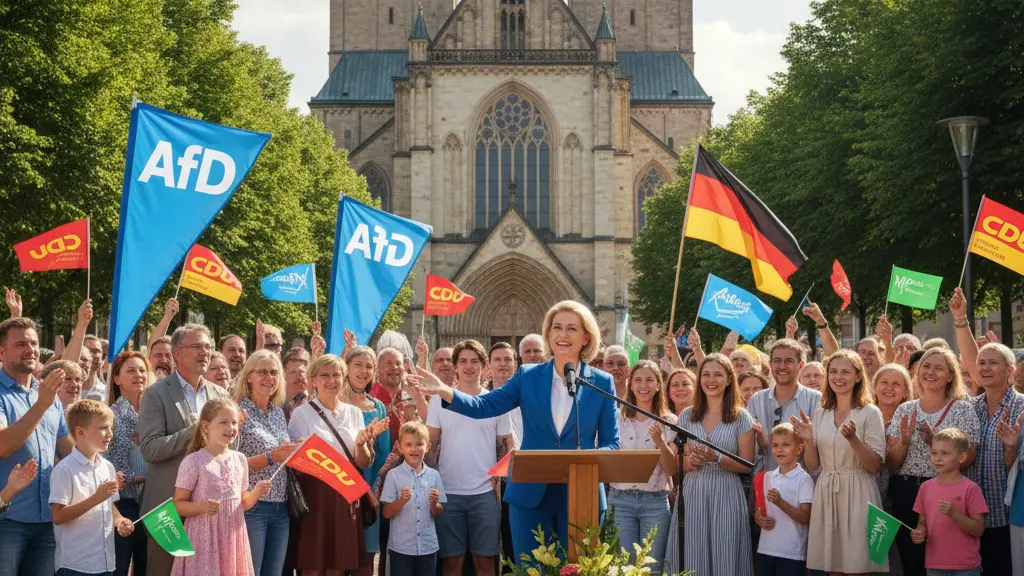
Overview of the poll: AfD leads with 41% in Sachsen-Anhalt
A recent survey conducted from 29 April to 5 May 2026 shows the AfD as the clear frontrunner ahead of the Sachsen-Anhalt state election on 6 September 2026. The polling results give the AfD 41 percent of the vote, an increase of 2 percentage points compared with a survey from September 2025. The CDU is placed second at 26 percent (down 1 point). Other results in the same survey put The Left at 12 percent (down 1), the SPD at 7 percent (unchanged), and both the Greens and BSW at 4 percent each. The FDP would also miss the five-percent threshold under these numbers, while other parties collectively reach about 6 percent. Taken together, these figures would produce a four-party parliament in which the AfD would be dominant and only a few percentage points short of an absolute majority.
Survey background and key facts
- Polling institute: Infratest dimap (survey period: 29 April–5 May 2026).
- Sample: 1,164 eligible voters across Sachsen-Anhalt.
- Timing: snapshot of voter intentions ahead of the Landtag election on 6 September 2026.
- Public mood: the survey highlights unusually high unease among residents, with a large share reporting concern about the political situation.
How the parties compare and what changed
The AfD’s result in this survey represents a marked rise compared with its performance in the 2021 state election, when it received 20.8 percent. By contrast, the CDU’s current standing of 26 percent would leave it behind its earlier result of 37.1 percent. Small shifts appear across the rest of the spectrum: The Left and the Greens see modest declines or stagnation, the SPD remains steady, and smaller groups collectively fall short of the five-percent threshold required for representation. These trends reshape the likely parliamentary arithmetic and raise questions about coalition options if the election were held today.
| Party | Survey result | Change vs Sep 2025 |
|---|---|---|
| AfD | 41% | +2 pp |
| CDU | 26% | -1 pp |
| The Left | 12% | -1 pp |
| SPD | 7% | 0 |
| Greens | 4% | stagnant/− |
| BSW | 4% | stagnant/± |
| FDP | <5% (would miss threshold) | — |
| Others | 6% | — |
| Note: figures are from one poll taken 29 April–5 May 2026 and reflect a snapshot of voter intention. | ||
Leadership preferences and competence ratings
The survey also measured preferences for government and for a potential Minister-President. When asked which party they would prefer to lead the government, respondents put the CDU at 44 percent and the AfD at 43 percent—almost neck and neck. In a hypothetical direct choice for Minister-President, Sven Schulze (CDU) led with 36 percent, followed by Ulrich Siegmund (AfD) at 32 percent, while 32 percent were undecided. On perceived competence, respondents overall assigned more credibility to the AfD (31 percent) than to the CDU (18 percent) on issues such as immigration and integration. Public evaluation of the current CDU–SPD–FDP government is low: only 33 percent rate it positively.
Reactions and what the numbers mean
Leading candidates and party officials reacted quickly to the survey. AfD candidate Ulrich Siegmund described the result as confirmation that many citizens desire political change. Minister-President Sven Schulze (CDU) framed the AfD’s surge as an expression of dissatisfaction with federal-level politics. Observers caution that polls are a snapshot and that much can change before September. The high level of public unease recorded in the survey underscores volatility: a large majority reported feeling worried about the political situation, while only a small share expressed optimism.
- AfD’s rise increases pressure on mainstream parties to respond to voter concerns.
- The apparent closeness in government preference suggests fluid voter loyalties between CDU and AfD.
- High undecided rates for the Minister-President choice (about one third) mean outcomes could shift as campaigns progress.
- Missing the five-percent threshold would keep several smaller parties out of the Landtag, concentrating seats among the larger groups.
What to watch between now and the election
Polls are indicators, not predictions. Between the survey and the 6 September election, several factors could influence voter preferences: campaign messages, national political developments, shifts in public concern on key issues like immigration and integration, and efforts by parties to mobilize supporters. The number of undecided voters and the level of public unease highlighted in the poll will be particularly important to monitor.
- Campaign developments and debates on major issues, especially immigration and integration.
- Changes in national political dynamics or events that could shift voter sentiment.
- Mobilization efforts by parties to convert polling support into actual votes.
- Tracking of undecided voters and whether they lean toward CDU, AfD, or other parties.
- Subsequent polls to confirm whether the AfD’s lead is sustained, grows, or falls back.
Methodology and limitations
The survey provides a clear snapshot of public opinion at the end of April and start of May 2026, with a sample of 1,164 eligible voters. As with any single poll, results are subject to sampling variation and the specific questions and timing used by the polling institute. Polls capture voter intentions at a moment in time and cannot fully predict final turnout or how undecided voters will decide. The institute that conducted the survey highlights these limitations and notes that political mood is currently characterized by unusually high levels of concern among the public.
| Poll detail | Information |
|---|---|
| Field dates | 29 April – 5 May 2026 |
| Sample size | 1,164 eligible voters |
| Polling institute | Infratest dimap |
| Context | Snapshot ahead of the 6 September 2026 Sachsen-Anhalt Landtag election |
| Interpretation: useful for trend and mood analysis but not a final forecast. | |
