
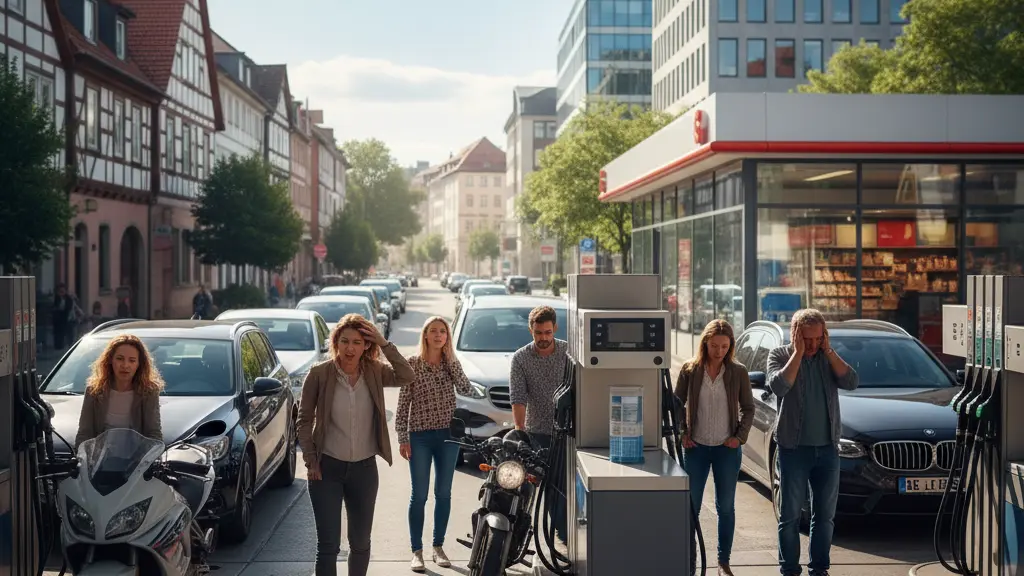
New measures to ease pressure from rising fuel prices
In response to a sharp rise in fuel prices driven by geopolitical tensions, Germany’s black-red coalition passed a package of measures that took effect on April 1, 2026. The Bundestag approved rules aimed at limiting rapid price swings at petrol stations, strengthening market transparency, and increasing penalties for violations. The move was supported by the Greens, opposed by Die Linke and AfD, and welcomed by the Bundesrat.
Key rules and legal changes
The new measures set clear operational limits for petrol stations and adjust competition rules to make price behavior more transparent and easier to challenge. Central elements include restrictions on how and when stations may change prices, stronger sanctions for violations, and changes to cartel and competition law to help prove unjustified hikes.
- Price change windows: petrol stations may increase pump prices only once per day, at 12:00. Price reductions may be made at any time.
- Fines: breaches of the new rules can be punished with fines of up to €100,000.
- Competition law: the cartel framework was tightened to allow a partial reversal of the burden of proof when sharp price increases occur, making it easier for authorities to investigate suspicious price movements.
Immediate market impact and price levels
Despite the new rules, fuel prices remained at record highs immediately after implementation. ADAC data showed diesel reaching €2.327 per liter and petrol (gasoline) €2.129 per liter. Early indicators suggested that these steps had limited short-term effect while markets continued to be volatile.
| Fuel | Price (per liter) |
|---|---|
| Diesel | €2.327 |
| Petrol (gasoline) | €2.129 |
| Source | ADAC data (2026) |
Reactions from economists, industry and the public
Economists and market experts
Some economists welcomed parts of the package for improving price transparency. For example, Justus Haucap noted that limiting rapid intraday price changes should make price comparisons easier for consumers, since stations had been adjusting prices up to dozens of times a day.
Industry voices and regulatory concerns
Industry groups expressed caution. The BDI warned that interventions into competition law carry risks for market functioning. At the same time, experts like Andreas Mundt from the Bundeskartellamt praised any move that increases transparency around pricing behavior, while Christoph Schröder of the IW put the current burden on consumers into a longer historical perspective.
Public sentiment
Public dissatisfaction remained high. Polls cited in the debate showed roughly 75–80% of citizens felt the measures were not enough and demanded tax cuts to lower pump prices. A common argument was that fuel taxes in Germany are higher than in neighboring Austria (about 65.45 cents per liter in Germany versus 48.2 cents in Austria), which many see as a key driver of higher retail prices.
Further policy options under consideration
The government set up a taskforce to evaluate additional measures to relieve drivers. Options under review include temporary cuts to energy taxes, adjustments to the commuter allowance (pendlerpauschale), or targeted levies on excess producer margins. The proposal for a windfall profits tax was explicitly rejected by Economy Minister Katherina Reiche, while other measures remain on the table for political debate.
- Energy tax reduction: a direct tax cut on fuels to lower the per-litre tax burden.
- Commuter allowance: increases or targeted adjustments to help regular commuters offset higher fuel costs.
- Windfall profits tax: considered by some but rejected by the Economy Minister.
How Austria approached the problem — a brief comparison
At the same time, neighboring Austria implemented a targeted measure to dampen fuel prices. Austria reduced the mineral oil tax by 5 cents per liter (with the stated goal of reaching about a 10-cent relief) and introduced a temporary margin limitation if prices rose more than 30% over two months. The package is time-limited until the end of the year and was described by Austrian Minister Hattmannsdorfer as a targeted dampening of crisis margins rather than a supply-threatening price cap.
| Measure | Germany | Austria |
|---|---|---|
| Mineral oil tax (approx.) | 65.45 cents per liter | 48.2 cents per liter |
| Recent tax change | Under review (taskforce) | -5 cents per liter (temporary) |
| Margin control | Cartel law tightened for evidence | Margin limit if >30% increase in two months (temporary) |
| Evaluation | Government to evaluate after one year | Planned review; short-term effect observed |
Austria saw a noticeable drop in median prices after its steps, though critics questioned the long-term effectiveness of such temporary measures. German policymakers said they would observe neighboring approaches while continuing to monitor domestic markets closely.
What drivers can do now and what to expect next
While political decisions play out, drivers still face high pump prices. Practical steps can help reduce costs in the short term, and the government has signaled ongoing monitoring with a formal evaluation after a year to judge effectiveness and potential follow-up action.
- Compare prices: use available price comparison tools to find the cheapest nearby stations—transparency measures should make comparisons easier.
- Plan trips: combine errands and adopt fuel-saving driving habits to reduce consumption.
- Watch for policy updates: the taskforce’s findings could lead to temporary tax relief or other targeted measures.
In the months ahead, authorities will watch market developments and consumer pressure closely. Despite a temporary ceasefire easing some geopolitical risks, the Chancellor warned that markets could remain tight, so consumers and industry should expect continued scrutiny and possible further interventions depending on how prices evolve.
