
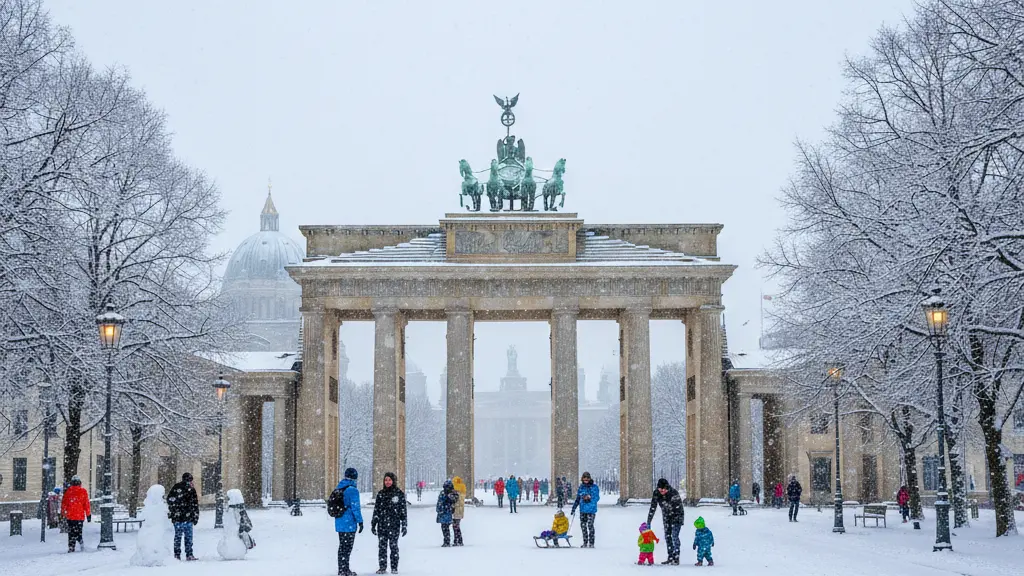
Overview: A winter event moves across Berlin and Brandenburg
A broad winter system driven by the low-pressure area often referred to as “Elli” is bringing persistent frost, snowfall and notable snowdrift risk to large parts of northeastern Germany. Forecasts indicate a wide band of snowfall stretching from Dresden through Berlin toward northwestern regions, with locally significant accumulations. For Berlin and Brandenburg the situation is especially sensitive: many models show only light, long-lasting snowfall, while others forecast heavier amounts combined with strong easterly winds that will redistribute loose snow and produce hard-to-predict drifts.
Snow forecast for Berlin and Brandenburg
The main snow and wind event is expected on Friday, 9 January 2026. Forecasters indicate regional variations in snowfall totals. In many parts of Berlin and Brandenburg forecasts mention up to 15 centimetres of new snow for the day, with the greatest amounts tending to fall in the southwest of the region and smaller amounts in the northeast. Along the eastern flank of the low a broader snow band may bring 10–20 centimetres locally, and orographic or staulagen areas could see as much as 40 centimetres.
Expected snowfall amounts
Typical guidance for the region is: up to 15 cm for most of Berlin and Brandenburg, locally higher in sheltered or windward terrain. A larger, more intense stripe of snow is possible farther south and west of the capital, while the northern and northeastern parts of the state often receive less. Exact totals depend strongly on the final track of the low.
Timing and wind-driven snowdrifts
Current timing suggests snowfall will begin in Berlin mid-to-late morning, roughly around 9–10 a.m., so early commuters may initially avoid the worst. From then on, light but persistent snow combined with strong easterly wind is expected for much of the day. Winds are forecast to gust at storm-strength levels (roughly Beaufort 7–8), which increases the likelihood of drifting, uneven snow deposits and sudden reductions in visibility.
- Start in Berlin: around 9–10 a.m.; continued light snow during the day.
- Wind: strong easterly gusts up to Beaufort 7–8, leading to snowdrifts.
- Snow amounts: commonly up to 15 cm locally; 10–20 cm along the broader band; up to 40 cm in staulagen.
- Southwest of the region (e.g. around Potsdam): tendency for slightly more snow; northeast: generally less.
Impacts on transport, schools and services
The combination of continuous snow, freezing temperatures and strong wind will affect public transport, regional rail services and road traffic. Rail operators are already preparing for cancellations and delays because snowdrifts, iced switches and possible ice on overhead lines can disrupt services. Local authorities have stepped up winter service measures and warned of restricted visibility and difficult driving conditions.
- Rail: cancellations and reduced timetables likely on many regional lines; expect delays and disruptions.
- Roads: main routes may remain passable, but secondary roads can become icy or blocked by snowdrifts; visibility may fall in heavy snow and blowing snow.
- Schools and childcare: some municipalities will give parents discretion to keep children home; closures or late starts are possible depending on local conditions.
- Emergency and municipal services: winter maintenance fleets will run extended shifts in some districts; local warnings and adjustments to services are expected.
Authorities recommend planning for travel disruption throughout Friday and possibly beyond, as persistent frost and further snowdrifts can prolong difficult conditions even after the main snowfall ends.
Practical safety advice for residents
Residents in Berlin and Brandenburg should prepare for limited mobility and increased risk from icy surfaces and drifting snow. Small changes to routine can reduce risk and help keep you and others safe during the event.
- Avoid non-essential travel on Friday; work from home if possible.
- If you must travel, allow extra time, drive slowly and watch for black ice and sudden snowdrifts.
- Keep an emergency kit in vehicles: warm clothes, blankets, water, food, phone charger and a shovel.
- Parents: follow municipal guidance and use discretion about school journeys when local authorities permit parental decision-making.
- Listen to local warnings and updates from municipal authorities and transport providers during the event.
- Check on neighbours and vulnerable people who may need help with heating or clearing paths.
Clear small amounts of snow from exits and pathways where you can do so safely, and avoid overexertion while shovelling. Take care near roads where drifting can reduce visibility for drivers.
Meteorological and climate context
Meteorologists characterise the current event as a strong, spatially limited winter incursion rather than a historic all‑time storm. Experts note that the situation is tricky because of the combination of prolonged, light snowfall and strong easterly winds that redistribute snow locally. While dramatic maps and headlines sometimes use terms like “blizzard,” specialists emphasise that the event is not a classic North American blizzard in scale or structure.
Long-term trends and what this means
Climate specialists point out that, on average, the number of days with continuous snow cover in Germany has decreased compared with mid-20th-century baselines, even as individual strong winter events still occur. Blocking weather patterns can intermittently interrupt milder Western flows and produce cold, snowy spells. In short: warming trends reduce overall snow days, but they do not eliminate the chance for impressive winter episodes when the large-scale circulation aligns to bring cold air and snow.
Outlook and uncertainty after the event
Model forecasts still show a wide range of outcomes for the days following the main snow event. In the south and southwest, milder Atlantic air is expected to push in from the west during the day and may change snow to rain there. By contrast, much of Brandenburg and the northern approaches to Berlin are likely to remain in the cold sector longer and keep snow and persistent frost. Nighttime temperatures are forecast to fall well below freezing in places, which will prolong hazards from ice and drifting snow.
Given this uncertainty, residents should follow updates from local authorities and the national meteorological service, prepare for extended cold and limited mobility, and be ready for rapidly changing conditions over the weekend.
Sources and further information
Key information for this report is based on official weather service analyses, regional news coverage and statements from municipal and transport authorities in the Berlin and Brandenburg area, including local municipal notices and regional transport advisories. Consult official local warnings and municipal announcements for the most current, location-specific guidance.
