
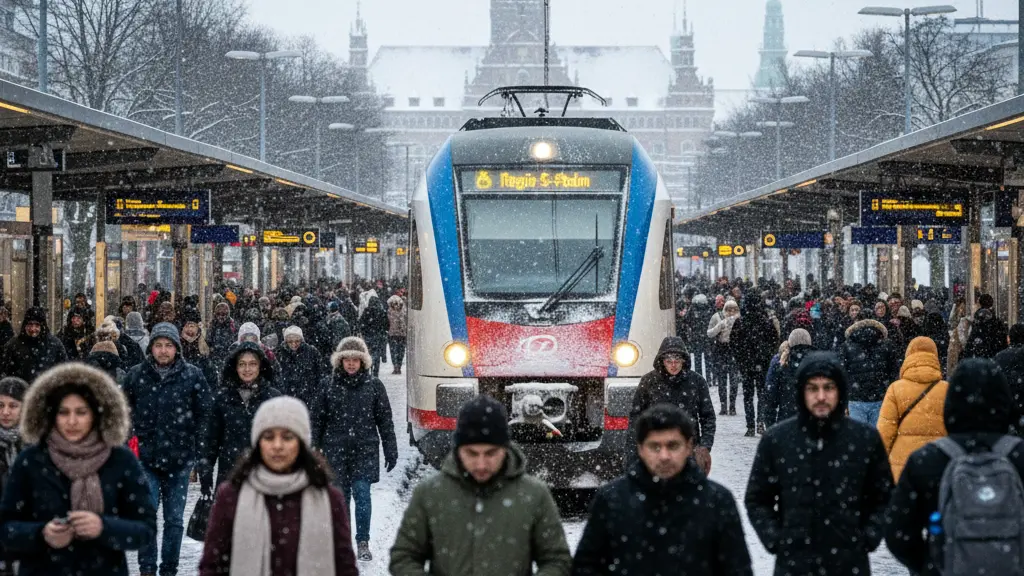
1. Winter outbreak affects Regio-S-Bahn around Bremen and Oldenburg
A cold snap with heavy snow, ice and strong winds has disrupted regional rail services in northwest Germany. The electric Regio-S-Bahn network serving Bremen and Oldenburg is particularly vulnerable: frozen points, iced overhead lines and snowdrifts can lead to delayed or cancelled trains and to sections operating only partially.
Why railway infrastructure is sensitive to winter weather
Rail systems rely on many exposed components that are susceptible to snow and ice. When switches freeze or overhead lines ice up, trains cannot run safely. Even when rolling stock is operational, blocked or unsafe sections of track force partial suspensions or rerouting.
- Frozen switches (points) block track changes and sidings.
- Iced overhead lines reduce or cut power to electric trains.
- Snowdrifts can cover tracks and platforms.
- Signals and trackside equipment may malfunction in extreme cold.
Operators warn that infrastructure problems, not only the trains themselves, are the main cause of trouble. Signals, switches and access roads to stations are all affected by the winter conditions, making reliable train operation difficult in many places.
2. How services are affected and why buses sometimes step in
In the current situation some rail lines continue to run in a reduced timetable, others operate only on parts of their route, and some services are cancelled entirely. Replacement buses are possible in many cases, but not guaranteed: their feasibility depends on road conditions, vehicle and staff availability, and the reachability of stations.
Rail services: delays, partial runs and cancellations
Expect irregular service patterns. Timetables are thinned out, connections may be lost, and sections of lines can be taken out of service at short notice. Travelers should assume longer journey times and prepare for altered routes or forced transfers.
Bus and tram services: city networks vs rural lines
Urban bus and tram systems often remain operational longer because city streets are cleared faster and shorter routes are easier to manage. In the countryside, narrow and wind-swept roads can become impassable, forcing bus cancellations. This explains why a bus replacement works in the city but may be impossible in rural areas.
- City networks: more resilient if snow clearance keeps up.
- Rural routes: high risk of cancellation due to drifts and icy roads.
- Replacement buses: useful but dependent on road safety and resources.
3. What nearby regions show us
Experience in neighboring regions under the same weather patterns shows how quickly conditions can change. In some places local commuter rail was suspended entirely because frozen switches and deep drifts made safe operation impossible, while city buses and trams continued with delays.
Complete suspensions and the limits of substitution
When rail operators halt services completely, they sometimes continue running a few trains only to reach major hubs. Even then, replacement bus services are not always feasible. Limited vehicle fleets, staff availability and unsafe roads can prevent setting up an effective rail replacement service.
4. What this means for commuters and travelers
Commuters around Bremen and the surrounding region should be prepared for disruption. The combination of unreliable rail infrastructure and variable road conditions means that journeys can take much longer or may not be possible at all. Planning and flexibility are essential.
- Check current travel information shortly before departure.
- Postpone non-essential trips when possible.
- Allow extra time for necessary journeys and expect alternative routes.
- Prepare for mixed transport: if a train runs only to a certain station, further travel by local bus or taxi may be needed.
5. Practical tips and safety advice
Simple preparations can reduce stress and keep you safer in winter travel. Assess the necessity of each trip and make contingency plans. Remember that safety of passengers and staff is the priority for transport operators when services are adjusted.
| Situation | Recommended action |
|---|---|
| Train delayed or cancelled | Check live service updates and consider later travel; if urgent, look for city bus options or book a taxi. |
| Replacement bus announced | Expect longer travel time and possible changes in pick-up points; arrive early at the designated boarding area. |
| Rural bus cancelled | Seek alternative arrangements such as car-sharing, remote working, or postponing travel. |
| Always prioritise personal safety and allow extra time. | |
What to carry and how to prepare
- Charged mobile phone and power bank to receive updates.
- Warm clothing and water in case of long waits.
- Printed timetable extracts or planned alternatives if mobile reception is poor.
- Flexible work or meeting arrangements communicated in advance.
6. Summary
The winter weather shows how fragile regional rail services can be when switches freeze, overhead lines ice and roads to stations become difficult to use. While city bus and tram networks can often provide a partial safety net, rural routes may lose both rail and bus options. Travelers should check live updates, allow extra time, and avoid non-essential journeys until conditions improve.
