
1. What happened during the extreme weather
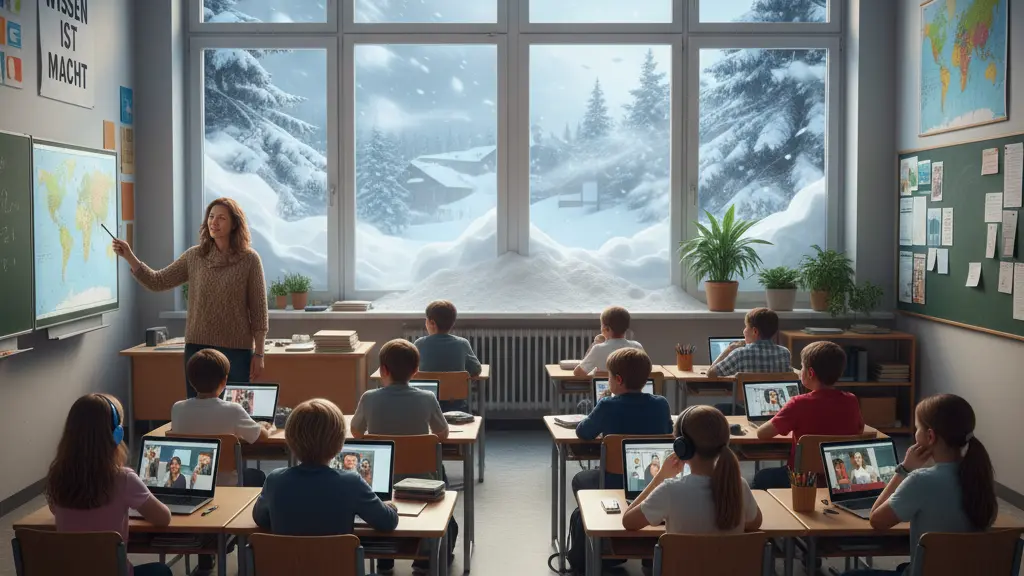
When the German Weather Service (DWD) issued a statewide pre-warning for 12 January 2026, many people expected schools to switch quickly to online learning or full distance learning. Instead, most schools in Germany either continued with in-person lessons, canceled lessons without switching to systematic remote teaching, or asked pupils to stay home as a safety measure without activating full online instruction. In North Rhine-Westphalia (NRW) the school ministry instructed students to remain at home for safety reasons, while the Bezirksregierung Detmold clarified the line: the official warning meant “in-person lessons should not take place; pupils stay at home.” At the same time, School Minister Feller underlined that this was a safety measure communicated mainly to parents and not an automatic school holiday.
Key facts from the 2026 warning
- The DWD issued a statewide severe-weather warning for 12 January 2026 (ice rain, storms, slippery conditions).
- The NRW ministry advised students to stay at home as a safety measure rather than ordering uniform online learning.
- There is no automatic legal obligation under current NRW rules to switch immediately to full distance learning.
- Responses varied: some schools prepared remote plans, others asked families to wait for clear instruction or treated the day as a cancellation.
2. Why most schools did not switch to online learning
The decision not to move wholesale to online learning during severe weather was not primarily a sign of indifference. It reflects a mix of legal, technical and practical considerations. Schools and authorities operated in a gray zone where safety, feasibility and fairness had to be balanced. Key reasons include legal discretion for schools, uneven digital infrastructure, and anxiety about repeating the most difficult aspects of pandemic-era remote teaching.
Legal framework and discretion
Under the current NRW legal framework, distance learning is an option in the school law but not an automatic duty. The ministry has repeatedly emphasized that the decision to order distance learning lies within the discretion of schools and school supervision. That discretion depends on factors such as available equipment, an established pedagogical concept for remote teaching, and whether a switch is reasonable and bearable for families.
Technical and infrastructure differences
Digital infrastructure still differs widely between schools and households. Some schools have well-rehearsed video conferencing schedules, learning platforms and clear online timetables. Others still report that short-notice distance learning is “only possible to a limited extent” because of missing end devices, patchy internet connections, or overloaded platforms. Those practical limits make an immediate, uniform transition to online learning difficult.
3. Safety, pedagogy and practical trade-offs
Authorities and schools face three overlapping concerns when deciding whether to switch to remote teaching during extreme weather: protecting pupil safety, maintaining pedagogical continuity, and ensuring equity. A safety-first instruction to stay home can be clear and protective, but it raises the question whether that day counts as instruction on distance learning or as a canceled day. Schools worry that declaring a spontaneous remote-teaching day could disadvantage families without adequate devices or overwhelm teachers and platforms.
Concerns about repeating pandemic weaknesses
Many decision-makers recalled the pandemic experience: overwhelmed families, heavy teacher workloads, and pedagogical gaps in remote lessons. There is a real concern that an automatic, short-notice shift to online teaching could re-open those problems rather than solve the immediate safety risk. That caution shaped the preference for measured, conditional approaches in many schools.
4. Example: Green-Gesamtschule approach
The Green-Gesamtschule illustrates a cautious middle path. On 10 January 2026 the school sent a cautious interim message to its community: parents were asked to monitor the situation because it was still unclear whether the warning for Monday would be confirmed. The school stated that it would move to distance learning only if the ministry issued a clear directive and the school received appropriate confirmation. Importantly, the message made clear that distance learning is not automatic: “If you DO NOT receive any further message from the school, lessons on Monday will take place as usual on site.”
What this shows
The Green-Gesamtschule’s approach shows how schools try to balance safety and continuity: they prepare remote-teaching options, communicate early, and activate them only when the weather situation and ministry guidance provide sufficient clarity. This conditional strategy aims to avoid unnecessary disruption while keeping pupils safe.
5. Practical recommendations for schools and parents
Recommendations for schools
- Prepare simple, tested distance learning plans that can be activated quickly (short, clear tasks and priority learning goals).
- Maintain clear communication routines so parents know who will announce decisions and where messages appear.
- Invest in lightweight, resilient tools (stable learning platforms and basic video-conference plans) and practice them so staff and students are familiar.
- Consider equity: plan alternatives for pupils without devices or stable internet—phone calls, printable materials or asynchronous tasks can help.
Recommendations for parents and families
- Watch official school messages and local authority announcements after an emergency warning; follow the school’s defined channel for updates.
- Prepare a simple at‑home routine for short remote-teaching days (a quiet workspace, charged device if available, and a morning check-in).
- Inform the school about connectivity or device problems early, so staff can arrange alternative learning options.
- Remember that a request to stay home for safety does not always mean a full day of online lessons; expect mixed solutions and ask the school for clarification when in doubt.
6. Conclusion
The limited shift to online learning during the severe weather of January 2026 was shaped by a combination of legal discretion, uneven digital infrastructure, and a desire to avoid repeating pandemic-era problems that harmed families and teachers. Moving forward, clearer rules, realistic distance-learning plans, targeted investment in digital infrastructure, and simple communication routines can help schools make faster, fairer decisions when severe weather strikes. For now, many schools continue to seek a middle way: preparing remote teaching as an option and activating it only when safety, clarity from authorities, and practical feasibility align.
