
1. Quick overview
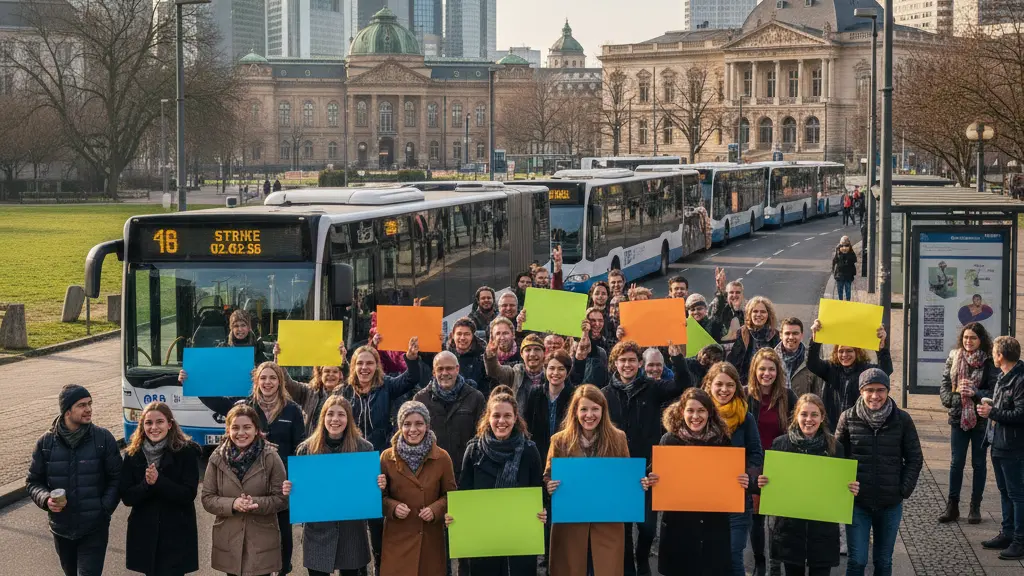
On Monday, 2 February 2026, the trade union Verdi called a large warning strike in the municipal public transport sector (ÖPNV) that strongly affects Frankfurt, Kassel and Wiesbaden in Hesse. Around 100,000 employees across roughly 150 transport companies stopped work, causing massive cancellations and interruptions of buses, U-Bahn and trams so that operations in many cities largely came to a standstill.
2. What to expect: city-by-city impact
Frankfurt
In Frankfurt the strike began with the early shift. Many U-Bahn and tram services were suspended. S-Bahn services operated by the national rail company and private buses continued to run more or less normally, but overall local public transport service was heavily reduced and commuters faced large gaps in service.
Kassel
In Kassel, employees of the local transport company (KVG) participated in the strike. Buses and trams were affected, with significant service reductions and many cancelled trips across the day.
Wiesbaden
Wiesbaden saw most local buses affected as employees of the municipal operator joined the action. Passengers experienced strong limitations in regular bus connections and should expect disruptions throughout the strike day.
Gießen and Marburg (partial operation possible)
Some nearby cities such as Gießen and Marburg could see only partial impact and in some cases more regular operation, depending on the local companies and staffing. Travelers were advised to check specific local timetables before traveling.
3. Background: why the strike is happening
The strike is a pressure measure in ongoing collective bargaining over the general terms agreement (Manteltarifvertrag TV‑N) that regulates working conditions in municipal public transport. Verdi is negotiating for broad changes to working hours, rest times, pay supplements and other conditions.
- Reduce weekly working time from 38.5 to 35 hours with wage compensation
- Minimum rest times of 11 hours between shifts
- Higher pay supplements (for example a 30% Sunday surcharge)
- Shorter shifts and better night and weekend compensation
- Additional vacation days and allowances for working in densely populated areas
Verdi negotiators want a reduction of weekly working hours from 38.5 to 35 with full wage compensation and a set of stronger protections and pay improvements for shift workers. Union leader Jan Bleckert criticized the employers, saying: “Wir akzeptieren nicht, dass die kommunalen Arbeitgeber die Beschäftigten mit der ständigen Androhung von Leistungskürzungen und Preiserhöhungen für Fahrgäste erpressen wollen.” (“We will not accept that the municipal employers try to blackmail employees with repeated threats of service cuts and fare increases for passengers.”)
The employers, represented by the municipal employers association (KAV), responded by pointing to the very difficult financial situation of many municipalities, citing a municipal deficit of 24.8 billion euros. The employers warned that the union demands would cause cost increases of more than 30 percent in some calculations. In some regional rounds the employers offered smaller increases (for example a two-step 5% offer in one region), while Verdi has demanded a monthly increase equivalent to +668.75 euros in its wage claim.
Negotiations continue: the next scheduled round between the parties was set for 9 February 2026 after earlier rounds such as the 21 January 2026 talks did not produce satisfactory offers for the union.
4. Practical advice for travelers and commuters
Commuters, students and anyone who relies on local transport should plan ahead. Strikes in public transport can disrupt routines and make journeys much longer. The following steps can help reduce surprise and delay.
- Check emergency or reduced timetables before you leave—many operators publish a contingency schedule for strike days.
- Consider alternative transport: carsharing, taxis, cycling, walking or long‑distance trains where appropriate.
- Allow plenty of extra travel time and plan flexible arrival times where possible.
- If you must be at school or work, prepare for possible delays—employers and schools may only excuse lateness when you can prove a documented service disruption.
Ticket rules: regular tickets generally remain valid on strike days and operators may offer refunds or exchange options for cancelled services. Check with the local operator for exact rules on refunds and ticket validity for specific journeys.
Note: some companies were explicitly not affected by the action—regional services such as HLB Hessenbus and Hessenbahn continued to operate normally during this warning strike.
5. Timeline and key facts at a glance
| Date / Item | Details |
|---|---|
| 2 February 2026 | Verdi warning strike in municipal public transport affecting Frankfurt, Kassel and Wiesbaden; roughly 100,000 employees in about 150 companies participated. |
| 21 January 2026 | Earlier negotiation round where employers did not present offers considered sufficient by Verdi. |
| Offer examples | Employers cited smaller regional offers (for example a two‑step 5% offer in one region); Verdi demands included +668.75 euros per month. |
| Municipal finance note | Employers referenced a municipal deficit figure of 24.8 billion euros when arguing financial limits. |
| 9 February 2026 | Next scheduled negotiation round. |
| Total affected | About 100,000 employees / ~150 companies (national level warning strike affecting many local networks) |
6. Sources and final notes
This article is based on the available reporting and official statements around the warning strike called by Verdi and on summaries of the negotiations in early 2026. Primary coverage drew on several consistent news reports and union and operator announcements. If you travel in the affected region, check your local operator’s updates and the status of services for the day of travel.
