
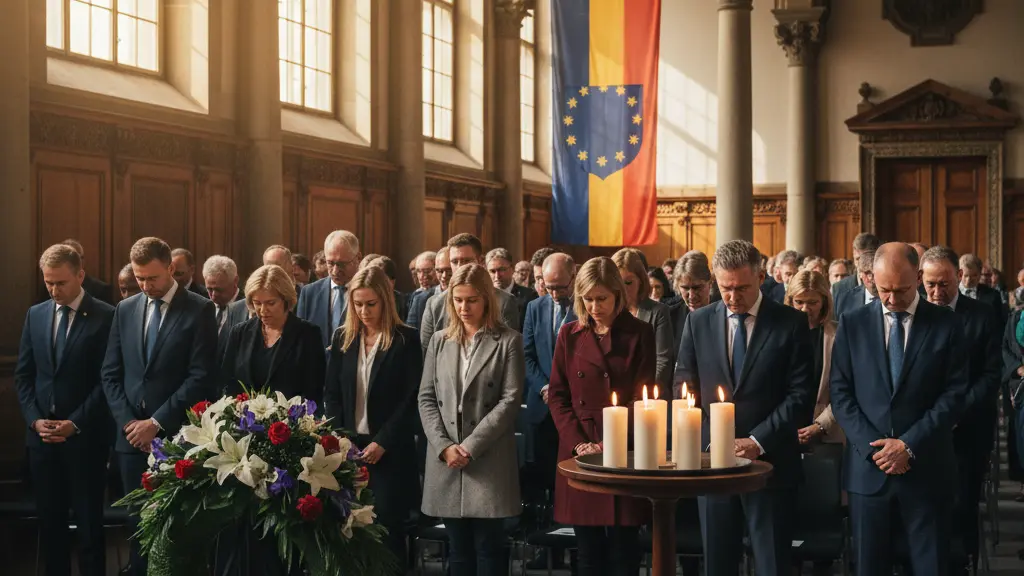
1. Central Commemoration in Magdeburg
On 27 January 2026, the official day of remembrance for the victims of National Socialism and the anniversary of the liberation of Auschwitz-Birkenau, the Landtag of Saxony-Anhalt together with the state government held a central memorial hour in the plenary hall in Magdeburg. The program placed special emphasis on the role of women in the resistance against the Nazi regime and on remembering the victims of Nazism in Saxony-Anhalt.
Key speech: Why people resisted
Historian Dr. Frauke Geyken delivered the commemorative address and posed the question, “Why did people resist?” She quoted Magdeburg resident Erna Blencke, who said, “I wanted to remain an upstanding person.” Geyken highlighted the scale and variety of resistance: roughly half a million people opposed the regime in different ways, many women acting in private as a form of rescue resistance. She warned that resistance matters because “they knew that each one of them could ultimately bring down their unjust regime, then as now.”
Landtag President Dr. Gunnar Schellenberger welcomed guests from politics, church and civil society and summed up the day’s purpose succinctly: “This day of remembrance is a day to take a stand against racism and anti-Semitism and for freedom and democracy.” The gathering underlined the connection between Holocaust remembrance, democratic values and active civic responsibility.
Morning wreath laying and evening film screening
Earlier in the morning, at 9:30 a.m., there was a wreath-laying ceremony at the memorial for the former satellite camp “MAGDA” in Magdeburg-Rothensee. Speeches were given by Mayor Simone Borris and Dr. Schellenberger, connecting local memorial sites to the broader commemoration.
In the evening a full house watched the film “In Love, Yours Hilde,” about resistance fighter Hilde Coppi of the Rote Kapelle (Red Orchestra). The screening at the OLi cinema was followed by a discussion with the director Andreas Dresen, actor Johannes Hegemann, Dr. Frauke Geyken and Dr. Andrea Genest. The event was streamed live so that people who could not attend in person could follow the program.
2. Regional activities across the region
Beyond the central event in Magdeburg, numerous regional activities marked the day of remembrance. These regional commemorations show how Holocaust remembrance and local memorial work connect communities across Saxony-Anhalt and nearby regions.
Examples of regional events
- Church services and liturgical commemorations, such as an Evensong service in Jena.
- Ecumenical memorial services in places like Erfurt that brought together different faith communities.
- Stolperstein cleaning and small civic acts of remembrance in Magdeburg, where citizens cared for individual memorial stones.
- Commemorations at memorials in towns such as Wittenberg and Eilenburg.
- Remembrance at the site of the former synagogue in Halle, recognizing the local Jewish community and the victims of Nazi persecution.
Across these events a common, united message emerged: a firm call to “never again” and a public stance against racism and anti-Semitism. Artists and speakers in neighboring federal states echoed similar themes, reinforcing the shared duty to remember and to protect democratic values.
3. Why this remembrance matters today
Remembering the victims of Nazism in Saxony-Anhalt is not only about honoring those who suffered and resisted; it is also about learning lessons for the present. The commemoration highlights the human cost of hatred, exclusion and dictatorship, and it underscores the responsibility of citizens and institutions to defend human dignity.
The role of women and private rescue
The 2026 commemoration drew special attention to women who resisted in less visible but crucial ways—helping people in private, providing shelter, sharing information, and preserving dignity under threat. Recognizing these forms of rescue resistance expands our understanding of courage and civic responsibility.
Practical ways to engage
- Attend or support local memorial services and church commemorations.
- Take part in community acts such as cleaning Stolpersteine or caring for local memorials.
- Watch historical films and join post-screening discussions to deepen understanding of resistance and persecution.
- Talk with family, friends and schools about the history and the ongoing importance of fighting racism and anti-Semitism.
4. Conclusion and continuing commitment
The day of remembrance in Saxony-Anhalt on 27 January 2026 brought together political leaders, historians, artists and citizens in a shared effort to honor victims of Nazism and to reflect on the courage of those who resisted. From formal speeches in the plenary hall to memorial ceremonies, film discussions and local acts of care, the events emphasized memory, education and vigilance against intolerance.
Organizers reported a consistent message across events: a united commitment to “never again,” to stand against racism and anti-Semitism, and to protect democratic freedoms. The central program and regional activities reached many people, including through a live stream of the evening program, making the commemoration accessible beyond the venues themselves.
As communities in Saxony-Anhalt and beyond continue to remember, the challenge remains to translate remembrance into action: protecting vulnerable groups, teaching the history of the Holocaust and Nazi persecution, and encouraging civic responsibility so that the lessons of the past serve a safer, more just future.
