
1. Overview: What the data shows
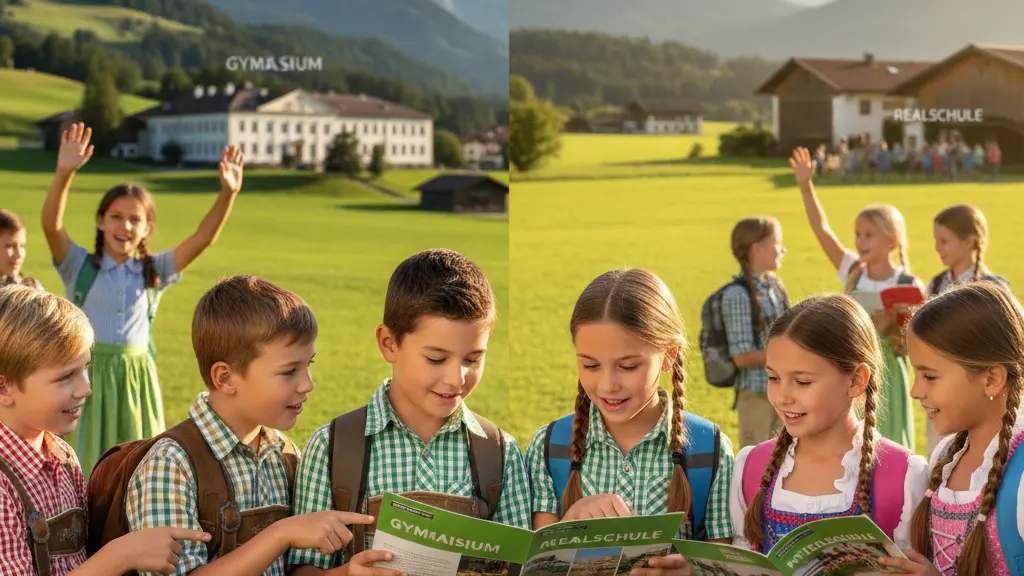
The 2024/25 school transition data for Bavaria highlights clear regional disparities in the move from primary school to secondary education. Overall, about 40% of pupils across Germany go to Gymnasium, while roughly 28% go to Realschule and 28% to Mittelschule. In Bavaria, these averages mask strong local differences that affect students’ educational paths and long-term opportunities.
These differences are important for parents, educators, and policymakers who care about equal access to opportunity and about how early decisions shape later schooling and careers. Key related terms include regional disparities, school transitions, educational inequality, early selection, and permeability of the school system.
2. Regional patterns within Bavaria
Not all Bavarian regions follow the state average. In some areas Gymnasium attendance is much higher, while in others Mittelschule or Realschule remain strong options. These patterns reflect local preferences, infrastructure, and social background.
Oberbayern and Niederbayern: contrasting choices
Oberbayern stands out with almost 45% of primary school pupils choosing Gymnasium, one of the highest shares in the state. By contrast, Niederbayern sees only about 32% heading to Gymnasium and a stronger share—around 34%—choosing Mittelschule. These contrasts show how neighboring regions can produce very different school landscapes.
Realschule and regional variation
Realschule rates also vary noticeably. Schwaben and Niederbayern report Realschule shares near 32%, while Oberbayern and Oberfranken report lower Realschule shares, about 26%. Such variation makes Realschule a dominant option in some regions but a smaller one in others.
3. Reasons behind the disparities
Experts point to a mix of social, geographic, and practical reasons for these differences. Even when teachers recommend Gymnasium, some families—particularly in rural areas—choose Realschule instead. The choice can be shaped by parental education, commuting times, local school availability, and infrastructure.
Family background and parent education
Parental education and family background strongly influence school choice. Children from families with higher educational resources are more likely to attend Gymnasium, while families with less educational capital may opt for Realschule or Mittelschule even when a Gymnasium recommendation exists.
Education expert Marcel Helbig has described how these local realities turn Realschule into a strong local school form: family preferences, logistics, and the broader educational environment combine to shape the collective choice patterns seen across regions.
Accessibility and local infrastructure
In rural areas, distance to Gymnasium, fewer transport options, and the practicalities of daily travel make closer schools—often Realschule or Mittelschule—more attractive. Local school supply and the cultural status of certain school types can make those options appear safer or more convenient.
4. The debate: selection, tests and fairness
Bavaria’s system uses early selection based on grades in subjects such as German, mathematics and Sachkunde (general studies). This practice is controversial: researchers critique early, grade-based selection for entrenching inequality, while authorities point to the system’s permeability and opportunities to change pathways later.
Proposed solutions from teacher associations
One proposal from the state philologists’ association (bpv) is to introduce a statewide pool of standardized tasks for transition tests. The aim would be greater uniformity and comparability across districts, potentially reducing local variation in testing practices.
Criticism and defence
Researchers warn that relying heavily on early test results and a few subject grades risks selecting too early and reinforcing social inequalities. In response, the ministry emphasizes the system’s high permeability—meaning students can and do move between school types later on—but the tension between early selection and fairness remains central to debates on reform.
5. Social inequalities highlighted by the ifo-Chancenmonitor 2026
Complementary evidence from the ifo-Chancenmonitor 2026 underlines the role of social background: around 80% of Gymnasium students come from families with a history of achieving the Abitur. This concentration shows how educational advantage is often transmitted across generations.
Calls for more early support and diverse teaching staff
Against this backdrop, the president of the major teachers’ association (BLLV), Simone Fleischmann, calls for expanded early childhood support to reduce disadvantage and for efforts to recruit more male teachers. Both measures aim to make primary education and transition guidance more responsive to diverse children’s needs.
Gender gaps are also visible: girls attend Gymnasium more often (about 43.5%) than boys (about 36.9%). Such differences point to intersections of gender and class in shaping educational trajectories.
6. Conclusion: next steps and policy implications
Regional disparities in school transitions in Bavaria reflect a complex mix of parental choices, local infrastructure, social background and school policy. Keywords for action include educational inequality, early childhood support, school accessibility, teacher recruitment, standardized assessment, and system permeability.
Possible steps to address disparities include better early learning support, measures to make Gymnasium more accessible where appropriate, more uniform testing procedures to ensure fairness, and policies that strengthen mobility between school types. Any reform should keep the goal of fair, high-quality opportunities for all children in mind.
Understanding and addressing these regional differences matters because the choices made at the primary-to-secondary transition can have lasting effects on educational pathways and social equality across Bavaria.
