
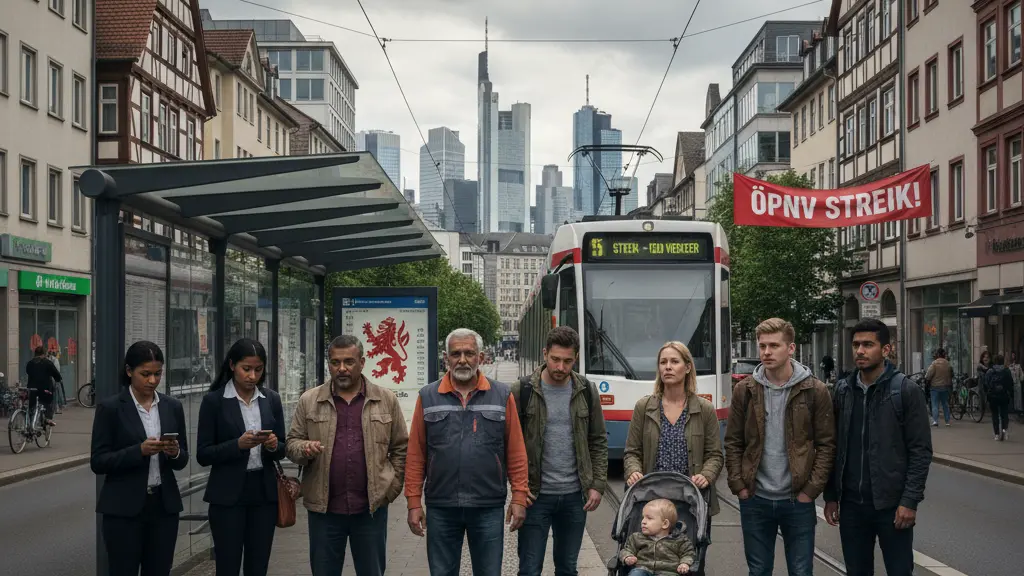
Overview: Public transport strike in Hessen on Monday, 2 February 2026
On Monday, 2 February 2026, the trade union Verdi called a full-day warning strike in the municipal public transport sector that affects many cities across Hessen. The strike hits buses, trams and underground (U-Bahn) services especially hard in places such as Frankfurt, Kassel, Wiesbaden, Gießen and Marburg. The action starts with the beginning of scheduled service (around 3:30 a.m.) and runs through the end of service for the day.
The stoppage is part of the TV-N 2026 collective bargaining talks for the municipal transport sector and involves about 100,000 employees across roughly 150 transport companies nationally. In Hessen alone, around 5,200 staff are expected to join the strike. S‑trains and regional or long‑distance rail services operated by the national rail provider are not part of this action and should run as usual, though local disruptions and replacement arrangements may apply.
Commuters, students and people with limited mobility can expect major disruptions, with many U‑bahn, tram and bus routes reduced or cancelled. Authorities estimate a significant economic impact from the stoppage, and passengers are advised to plan alternatives early.
Why the strike is happening: workers’ demands and background
The strike is driven by negotiations in the TV‑N 2026 round, which focus mainly on changes to the framework (mantel) agreements: working hours, shift lengths, guaranteed rest periods and pay supplements for unsocial hours. Verdi says these changes are needed to address extreme workloads, unfavourable shift patterns and constant time pressure that lead to high staff turnover in public transport.
Key demands from employees
- Reduction of the standard weekly working time from 38.5 to 35 hours with full compensation of wages.
- Minimum rest period of 11 hours between shifts to improve safety and recovery.
- Increase of the Sunday pay allowance by 5 percentage points to 30 percent.
Verdi representatives stress that better working conditions and fairer allowances are necessary to retain staff and secure reliable public transport in the long term. The union describes the move as a pressure measure in a tense round of bargaining.
Employers’ response
The municipal employers’ association (KAV) rejects the demands as unrealistic, pointing to strained municipal budgets and warning that the requested changes could increase costs by over 30 percent. So far, negotiations have stalled: no formal offer was presented in the first round, and the second round did not produce an agreement.
Which services and areas are affected
The strike mainly disrupts municipal and local public transport: underground (U‑bahn), trams (streetcars) and local buses. Major urban areas in Hessen expecting heavy impacts include Frankfurt, Kassel, Wiesbaden, Gießen and Marburg. Local transport operators report widespread cancellations and heavily reduced timetables.
| City / Region | Mainly affected services | Notes |
|---|---|---|
| Frankfurt | U‑bahn, trams, many city buses | Major disruptions; expect near‑standstill on local routes |
| Kassel | Trams, buses (KVG) | Significant cancellations; many lines out of service |
| Wiesbaden | Buses, some tram services | Local replacements or partner lines may run partially |
| Gießen | Buses and local tram connections | Reduced network and service frequency |
| Marburg | Local buses | Partial or full cancellations on many routes |
| S‑trains and regional / long‑distance rail services remain outside the strike but local connections to them may be affected. | ||
Some operators may run emergency timetables or partner lines, but services will be far below normal levels. Ticket refunds are rarely offered for strikes in the municipal transport sector, so travellers should check the specific rules of their local operator before assuming compensation.
What passengers should do: planning and alternatives
If you rely on public transport in Hessen on the strike day, plan ahead. Expect longer travel times, limited service and crowded replacement options where available. Consider changing the timing of your trip or working from home if possible.
Practical alternatives and tips
- Allow extra time and check schedules early in the morning before you travel.
- Consider carpooling or private car use with colleagues or neighbours.
- Use bike, e‑bike or walking for shorter distances if feasible.
- Look for organised replacement shuttle services or partner lines where operators have arranged them.
- If you cannot reach school because of the strike, many schools will excuse absence caused by lack of transport—confirm local rules.
Keep essential items with you in case journeys take longer, and inform employers or teachers about travel disruptions in advance. Purchase flexible or day tickets only if you plan to use available substitute transport options.
Accessibility and vulnerable passengers
People with reduced mobility, older passengers and those who rely on public transport for essential trips face particular challenges during strikes. Operators warn that assistance services may be limited and replacement vehicles may not always be accessible.
If you need assistance, contact your local transport company ahead of time to check available options. Community services, neighbours or care providers may be able to help with essential travel on the strike day.
Negotiation timeline and possible next steps
This warning strike follows a series of bargaining sessions in late January 2026 that did not produce an agreement. Verdi has announced the strike as a pressure tactic in the TV‑N negotiations. A new round of talks is scheduled for 9 February 2026; depending on progress, further actions cannot be ruled out.
The conflict highlights a broader tension: the need to improve working conditions to keep crucial transport staff versus tight municipal budgets that make large pay or schedule changes difficult. Both sides have signalled a willingness to continue negotiations, but a compromise has not yet been reached.
Summary and final advice
The nationwide warning strike on Monday, 2 February 2026, will severely disrupt municipal public transport in Hessen, particularly U‑bahn, trams and buses in several cities. Passengers should plan alternatives, expect limited services and allow extra travel time. Keep updated via your local operator’s usual communication channels and prepare for the next negotiation round on 9 February.
While the immediate impact will be inconvenience and financial loss for some sectors, the strike underlines the broader struggle to secure safer working conditions, reasonable hours and fair compensation for public transport workers—issues that affect service reliability for everyone in the long run.
