
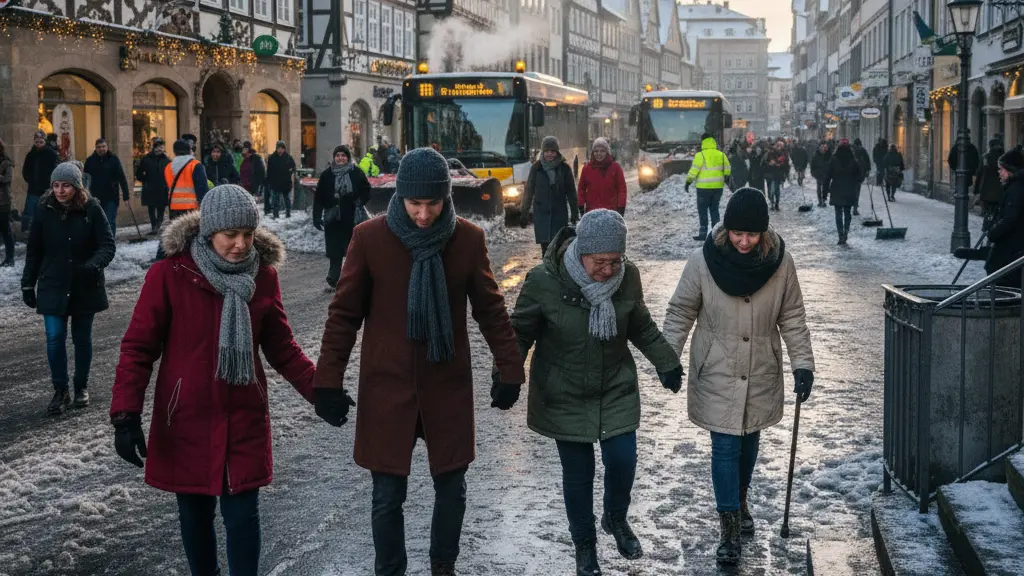
Current situation: ice chaos after recent storms
After the recent storms ‘Elli’ and ‘Gunda’, many official severe-weather warnings in Germany have been lifted and parts of the country have warmed to mild temperatures above ten degrees. Still, the aftermath of ice and freezing rain continues to cause serious problems: emergency rooms remain busy with injured pedestrians, and road accidents persist, including a mass pile-up of around 20 vehicles on the B173 in Upper Franconia. Authorities and rescue services warn that slippery conditions remain dangerous for life and limb.
Recent impacts on people and transport
Hospitals report large numbers of fall and collision injuries. The Deutsche Bahn is seeing reduced but ongoing delays in regional northern services. Emergency doctors and hospital managers describe the situation as heavily strained; Gerald Gaß of the German Hospital Federation said that ice and snow have placed extreme pressure on emergency departments. There were also deadly consequences earlier in the month: hundreds of accidents and three fatalities on 13 January caused by ice rain were reported.
Why danger continues despite milder weather
Temperatures differ across Germany: mild pockets in the west contrast with persistent frost in the east and southeast. These transition zones create a high risk for freezing rain, sleet and black ice. Even brief drizzle that then freezes can make roads instantly mirror-smooth and treacherous. Conflicting model runs (for example from GFS and EZWF) suggest a possible Vb-type low that could bring fresh snow to parts of the country, so the situation remains uncertain and dynamic.
Regions most at risk this weekend
Private meteorologists and local warnings highlight certain regions as particularly vulnerable to renewed glatteis (black ice) and freezing drizzle. People in the northwest, including the Münsterland, the Emsland and parts of the Rhineland, should be especially cautious. Other risk areas include transition zones between mild and freezing air — these can form anywhere where temperatures hover around the freezing point.
- Northwest Germany (Münsterland, Emsland)
- Rhineland and adjacent areas
- Transition zones between mild west and cold east/southeast
- Low-lying northern plains if a Vb-low brings snow
Advice for drivers: reduce risk on slippery roads
Road users should follow widely recommended safety measures. The ADAC urges anticipatory driving, keeping large following distances and using suitable winter tyres. Even small amounts of freezing drizzle can create instant black ice — adjust speed and expectations accordingly. If you must travel, plan extra time and drive defensively.
- Reduce speed and avoid sudden steering or braking
- Keep a large safety distance from the vehicle ahead
- Use winter tyres and check their condition
- Carry a charged mobile phone and an emergency kit (blanket, water, flashlight)
- Avoid unnecessary trips during warnings and during the worst hours
- Expect delays on trains and give rail services extra time to recover
Advice for pedestrians and cyclists
Pedestrians and cyclists face high risk from hidden ice. Wear sturdy, slip-resistant shoes where possible, use handrails on steps, avoid shortcuts over untreated surfaces, and make yourself visible in poor weather. If you fall or are hit, seek medical attention quickly — emergency departments remain busy, so report significant injuries immediately.
- Wear good footwear with grip and consider ice grips for shoes
- Use public sidewalks and well-lit routes where surfaces may be treated
- For cyclists: reduce tyre pressure slightly for better traction and avoid fast turns
- When walking, keep hands free to help balance and to break a fall
Transport, hospitals and emergency services: what to expect
Expect continuing strain on regional rail services and hospital emergency departments. The Deutsche Bahn has reported declining but persistent delays in the north. Emergency services ask the public to call only for urgent cases and to delay non-essential travel. Hospitals warn that continued ice-related injuries can quickly overload capacity, and that staff are working under significant pressure.
What to do if you are involved in an accident
Stop safely if you can, switch on hazard lights, and move to a safe place if it is possible and safe to do so. Call emergency services for medical attention in the event of injuries. Exchange details with other parties and document the scene with photos, but avoid standing on icy roadways. Report severe road hazards to local authorities so they can prioritize treatment.
Weather outlook and warnings — stay informed
The national meteorological service (Deutscher Wetterdienst) does not currently forecast a full return to winter conditions, but private meteorologists warn of ongoing glatteis risk from freezing rain and drizzle, especially over the coming weekend. Conflicting model forecasts mean a Vb-type low could bring snow into the north or south starting Sunday, with up to 10 cm possible in some scenarios and impacts on the Monday morning commute. Monitor local warnings and updates frequently.
Key phrases to watch in forecasts
- Freezing rain / freezing drizzle (risk of black ice)
- Glatteis warnings or advisories
- Local snow showers or sleet in transition zones
- Model updates mentioning a Vb-low and expected snowfall amounts
Notable expert warnings
Private forecasters such as Jörg Kachelmann and Kai Zorn have emphasized that even light drizzle can immediately create mirror-smooth ice: as Kachelmann noted in his 23 January update, ‘a little drizzle falls, then it becomes immediately mirror-smooth.’ Because models disagree, keep checking trusted bulletins and local advisories.
Quick safety checklist
Take these simple steps now to reduce risk for you and your family. Small precautions can prevent life-threatening incidents on suddenly slippery surfaces.
- Check local weather and warnings before travel.
- Fit and inspect winter tyres; drive slower if conditions are uncertain.
- Increase following distance and brake gently.
- Avoid using cruise control on wet or icy roads.
- Keep phone charged and carry basic supplies in the car.
- Wear suitable footwear and take extra care as a pedestrian.
- If you see a serious road or footpath hazard, report it to local authorities.
