
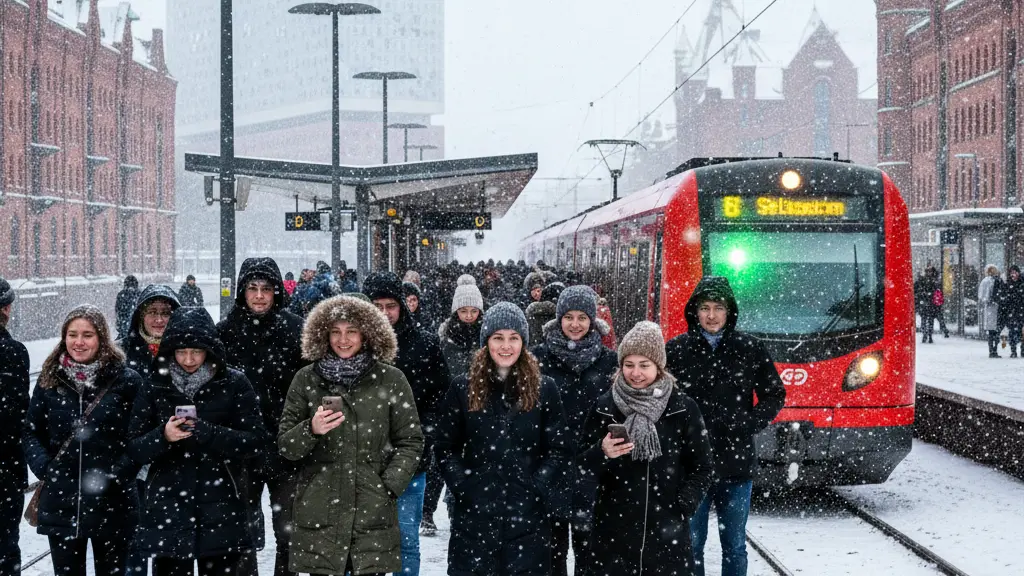
1. A winter wake-up call for Hamburg’s S-Bahn
When winter arrived in early 2026, the city’s suburban rail network quickly became one of the most visible signs that an urban transport system can struggle badly with snow and ice. Passengers were asked to avoid travel where possible as services slowed, turned back early, or were cancelled entirely. Communication to passengers described “significant snow-related operational restrictions” and stressed that reliable alternative bus services were often impossible because road conditions had deteriorated.
- Emergency intervals were established on key corridors to keep a backbone service running.
- Certain lines were suspended altogether because of safety and availability problems.
- Reroutes and temporary schedules became common as the situation evolved.
The operational response tried to preserve a minimum level of service, but it felt like controlled retreat rather than resilience. Timetables were reset in an ad hoc way, core routes ran on long intervals, and many branches were shortened or rerouted. For commuters the result was a sense of unpredictability and daily changes to which trains would run or stop.
2. Why the network trips over snow and ice
Design and capacity limits
The network is highly loaded and, in places, physically constrained. Many services share narrow corridors, so a single failure quickly cascades through the system. Because there is little spare capacity or spare rolling stock, operators have few options to absorb disturbances. This lack of operational slack turns moderate disruption into network-wide unreliability.
Infrastructure sensitive to winter weather
The rail electrification uses a side-contact direct-current power rail that is particularly vulnerable to wet snow, ice and freezing. When the contact surface or collectors ice up, trains lose power or cannot draw current reliably. Historically, winter routines such as deploying diesel snow-clearing units or other mechanical measures helped keep the rails clear; today those routines are less common, leaving the system exposed when conditions worsen.
Mixed signalling systems and centralised control
Control systems across the network range from mechanical and electro-mechanical interlockings to relay and newer electronic interlockings. The central operations centre oversees all of this, but the heterogeneous landscape complicates responses. Upgrades are planned, yet during ongoing work the network becomes more fragile: single-track sections, temporary turnbacks and constantly changing rules make winter incidents harder to manage.
3. Modernization plans: promise and paradox
Planned upgrades include extending electronic interlockings, building new controlled areas and eventually introducing digital signalling for the central core. The official goal is to densify train sequences, cut knock-on delays by a large margin, and expand the overall suburban offer substantially. Those investments are significant and intended to make the service more frequent and reliable in normal conditions.
| Planned measure | Expected effect | Notes |
|---|---|---|
| Electronic and digital interlockings | Denser train sequences, fewer delays | Phased rollout across the network |
| New rolling stock | Increased capacity and reliability | Opportunity for design improvements (winter kits) |
| Network expansion | 30% larger service offer | Requires major investment and construction |
| Total planned investment | About €800 million (estimated) | |
But the modernization process also introduces short- and medium-term risks. Construction work creates temporary single-track sections, forced rerouting and provisional timetables that reduce redundancy. During those transition periods, even small weather events can lead to major disruption because the system temporarily lacks flexibility.
4. What riders and experts propose
Public discussion and expert commentary have produced a range of concrete ideas. Some proposals focus on train design, like equipping new vehicles with a small battery reserve to bridge a short powerless section. Others look at operational practice, such as restoring winter-specific snow-clearing routines and keeping specialised vehicles on standby. Technical measures include changing the power-rail concept to a less exposed arrangement similar to what the city metro uses, which is widely seen as less sensitive to snow and ice.
- Short term: establish a clear, published winter emergency plan that defines priorities, staffing and equipment deployment.
- Medium term: equip rolling stock with targeted winter features (e.g., heater elements, protective skirts, small battery reserves) and restore dedicated snow-clearing trains.
- Long term: consider infrastructure adaptations such as a more winter-proof power rail design on the busiest corridors and complete signalling modernization to digital interlockings.
- Governance: improve coordination between local authorities and the national operator so responsibilities, funding and priorities are clear.
5. A realistic path to winter resilience
Recovering reliable winter service will require a mix of operational discipline, targeted technical upgrades and political commitment. That means defining and funding a binding winter-resilience program: keep a dedicated fleet and crews for snow duty, retrofit new trains with modest battery backup, accelerate winter-proofing of critical infrastructure and plan modernization work so it minimises simultaneous loss of redundancy.
Passengers want predictability. To deliver it, the network must turn ideas that now live in comment threads and technical reports into clear, staged actions: protect key routes first, communicate realistic expectations during works, and measure progress against winter performance targets. If those steps are taken, the system can “relearn” to handle winter — but only if strategy, funding and execution are aligned.
