
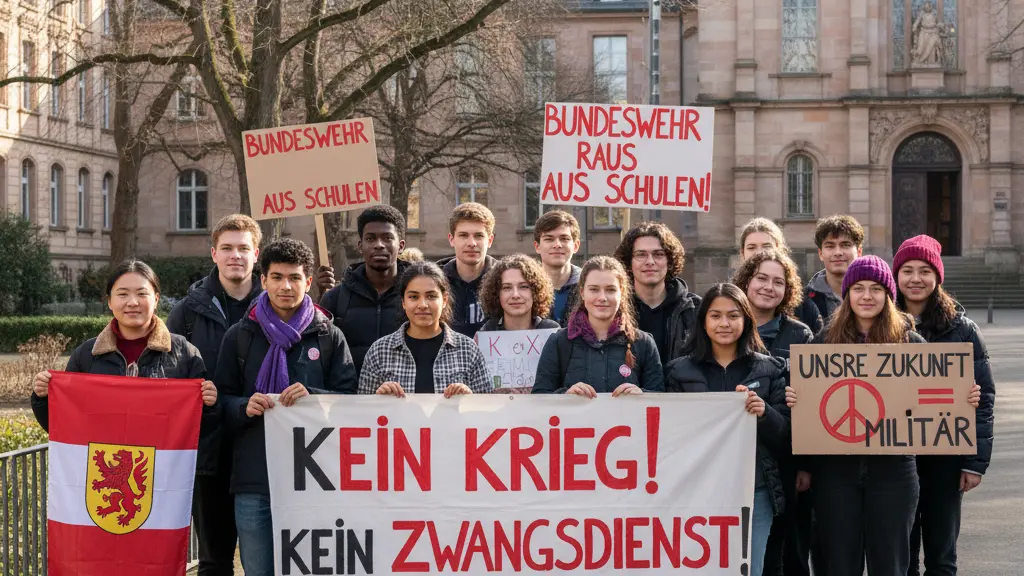
Overview of the March 5, 2026 School Strikes in Hesse
On March 5, 2026, students across Germany, including in the state of Hesse, took part in coordinated school strikes to protest recent changes and proposals related to military service and recruitment. Grassroots initiatives such as ‘Schulstreik gegen Wehrpflicht’ encouraged young people to speak out against a newly introduced mandatory questionnaire for 18‑year‑old men and against discussion of a possible new needs‑based conscription system (Bedarfswehrpflicht).
Since January 2026, 18‑year‑old men have been receiving questionnaires asking about personal details, health and willingness to serve, while participation for girls remains voluntary. The strikes aimed to raise awareness about these measures, to oppose increased military recruitment activities at schools, and to defend the right to conscientious objection.
Why Students Are Striking: Key Concerns and Demands
Students and organizers cited several main concerns that motivated the strikes. They framed their actions around defending personal freedom, resisting compulsory data collection tied to potential military service, and opposing growing military presence and recruitment efforts in educational settings.
Main demands of the student movement
- Stop mandatory questionnaires and any compulsory registration tied to potential conscription for 18‑year‑olds.
- Reject the introduction of a needs‑based conscription (Bedarfswehrpflicht).
- End or limit military recruitment and aggressive advertising at schools to protect learning environments.
- Protect and inform students about the right to conscientious objection and legal options.
The regional party Die Linke publicly supported the strikes in Hesse and criticized what it described as aggressive military advertising in schools. State chair Desiree Becker urged young people to use their right to conscientious objection and to join the March 5 actions, saying: ‘Take your right to refuse military service, join the action and go out on the streets on March 5!’
Responses from Political Parties, Authorities and Associations
Support and political backing in Hesse
Local political groups supporting the strikes emphasized student concerns about recruitment at schools and the potential expansion of compulsory service. Supporters framed the strike as a peaceful, democratic form of protest aimed at safeguarding civil liberties and the right to conscientious objection.
Official reactions and criticism
Education authorities and teacher associations in several states voiced reservations or criticism. The education ministry in one state stressed that school strikes during lesson time can violate compulsory attendance rules, noted that official leave for demonstrations is not generally provided, and warned that parental excuses for absences may not be accepted. Local consequences differed and school principals were encouraged to act responsibly and with proportion.
A teachers’ professional association in Lower Saxony welcomed democratic engagement but criticized strikes that take place during lessons, arguing that participation in civic causes should not come at the expense of class time. The association called for demonstrations to be organized after school hours, requested clear naming of organizers, and said that concerns about forced military service were misplaced because the right to conscientious objection remains protected.
Recruitment at Schools and Relevant Statistics
One of the central issues raised by protesters was the scale of military recruitment and outreach in schools. Organizers and critics pointed to a steady increase in recruitment events within educational institutions over recent years.
| Year | Reported recruitment events at schools |
|---|---|
| 2021 | 2,558 |
| 2025 | 5,527 |
| Change | More than doubled from 2021 to 2025 |
At the same time, applications and official cases of conscientious objection and related procedures have risen sharply. This trend was cited by advocates as evidence of growing unease among young people about military service and recruitment practices.
| Metric | Number | Note |
|---|---|---|
| Official conscientious objection cases | 3,900 | Increase of about 72% compared to the previous year |
| Conscientious objection applications (to Nov 2025) | 6,730 | Counted through November 2025 |
Student Rights, Legal Questions and Practical Advice
Legal and school responses to strikes varied by region. Students should be aware that compulsory school attendance rules apply in many places, and that some education authorities may not accept parental excuses for absences tied to demonstrations. At the same time, democratic participation and political expression are widely recognized values.
Practical steps for students who want to engage
- Inform yourself: Know the exact rules about school attendance and potential consequences in your state or school.
- Plan safe participation: Consider organizing or attending events after school hours if you are concerned about attendance rules.
- Document communication: Keep records of any official responses from your school or education authority.
- Know your rights: Learn about the procedures for conscientious objection and the legal protections that exist.
- Be peaceful and clear: Keep actions nonviolent, transparent, and focused on the stated goals to maintain constructive public discussion.
Where possible, students are encouraged to communicate with school staff, to seek advice from supportive organizations, and to act in ways that balance civic engagement with educational responsibilities.
Conclusion: Informed Participation and Ongoing Debate
The March 5, 2026 school strikes in Hesse were part of a broader national moment of debate about conscription, recruitment in schools, and the balance between compulsory service measures and individual rights. The actions highlighted clear concerns about mandatory questionnaires for 18‑year‑old men, the rise in recruitment activities at schools, and the growing number of conscientious objection cases.
Students, educators and policymakers continue to discuss how best to reconcile the protection of educational time with the right to political expression and how to ensure that young people are informed about their options when it comes to military service and conscientious objection. The conversation is likely to continue as authorities, parties and civil society weigh the implications of recent policy changes and the public response.
