
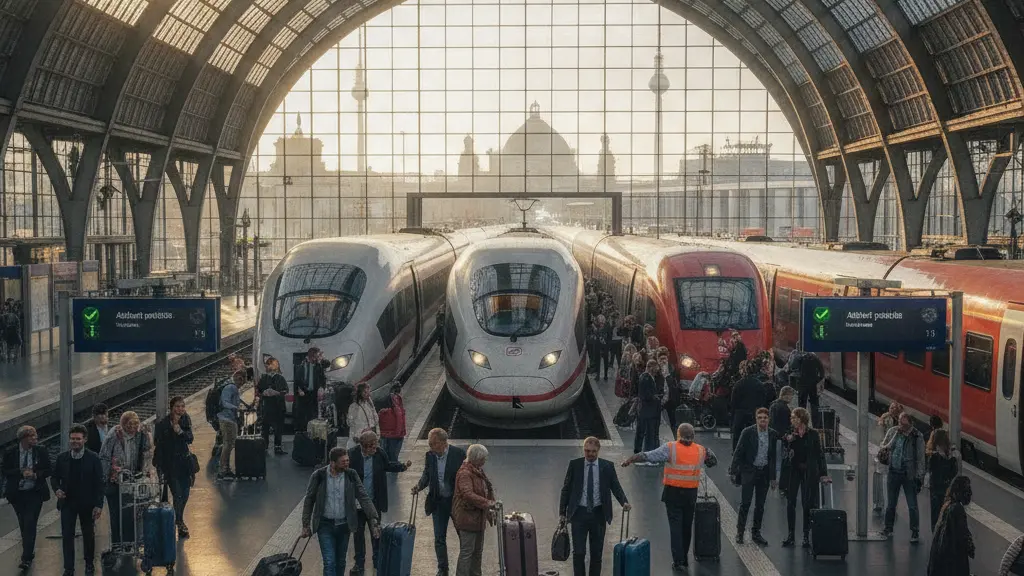
Immediate overview of the nationwide train outage
Late on Tuesday evening in 2026, train services across Germany came to an abrupt halt when the digital railway radio system GSM-R experienced a sudden total outage. The failure forced Deutsche Bahn and many regional operators to stop long-distance, regional and many S-Bahn services for safety reasons because communication between control centers and drivers depends on this system. The pause in service affected thousands of passengers and left stations unusually quiet as networks worked to restore secure communications and resume traffic step by step.
Why the system matters
GSM-R is the backbone of train-to-control communication, enabling dispatchers and drivers to coordinate movements, issue safety commands and handle emergencies. Without a functioning railway radio, safety rules require trains to stop, which is why a single outage can paralyze large parts of the rail network until a secure fallback or repair is in place.
Chronology: how events unfolded
The incident unfolded quickly. Within minutes of the GSM-R collapse late on Tuesday, Deutsche Bahn announced a nationwide hold on departures. For roughly two hours the network was effectively immobilized. From shortly after midnight regional reports and news outlets began to report that systems were being brought back online in stages; the first trains resumed running around 00:20–00:30 in some areas, and an official all-clear followed around 01:00 as the outage was declared resolved and the controlled restart continued.
Step‑by‑step recovery
- Outage detected late evening; nationwide halt of departures.
- IT teams and operations staff worked on diagnostics and emergency measures.
- Notfall (emergency) radio measures and fallback systems were engaged to stabilize communications.
- Regions and networks were reconnected gradually; first services returned at around 00:20–00:30 in some areas.
- Official confirmation that the disturbance was resolved came around 01:00, while staggered recovery continued with lingering delays.
Impact on passengers and services
Passengers experienced long waits on platforms and in some cases inside stationary trains. The suspension affected long-distance, regional and many S-Bahn lines, plus parts of freight and private operator services. Travel information channels repeatedly warned passengers not to start new journeys and to expect major delays and cancellations for hours after the outage.
Support measures for affected travelers
- Provision of taxi and hotel vouchers where appropriate.
- Deployment of so-called stay or accommodation trains in locations where passengers could not leave platforms safely.
- Clear public apologies and advice to postpone travel where possible.
Technical questions and ongoing investigation
Official statements described a total technical disruption of the GSM-R system and said investigations would follow. Public information was deliberately cautious while experts and some media reported possible causes. Early reporting and comment from cybersecurity and rail experts suggested that a faulty software update or a component change might have caused the outage, while authorities reportedly saw no immediate evidence of sabotage.
Expert perspectives on possible causes
Specialists noted two likely technical scenarios if no deliberate attack was involved: a failed software update or a simultaneous failure of central components that store key radio addressing data for locomotives. Observers called the incident a wake‑up call about redundancy, update testing and the resilience of critical infrastructure.
How the outage was resolved and what happened next
According to operators and multiple reports, IT teams worked continuously until a notfall (emergency) radio mode could stabilize communications. Using this temporary system, traffic was restarted in a controlled, regional process. The staggered ramp-up meant trains returned to service gradually rather than all at once, and operators warned commuters that high follow‑on delays and sporadic cancellations could persist into the early morning hours.
Timeline highlights
- Late evening: GSM‑R collapse and immediate hold on departures.
- ~00:20–00:30: first regions reported trains beginning to roll again.
- ~01:00: operators issued broader confirmation that the disruption had been resolved and recovery was underway.
- Following hours: phased restart continued with significant residual delays expected.
Wider implications and calls for change
The incident sparked a broader discussion about the vulnerability of rail communications and the need for stronger redundancy. Commentators and passenger representatives described the outage as a warning that a single point of failure in the railway radio can halt a whole country’s train operations. Political and technical leaders emphasized rapid investigation and measures to make the system more robust.
Key resilience themes
- Improved redundancy and parallel communication channels for critical control systems.
- Stricter testing and roll‑out procedures for software updates.
- Transparent incident reviews and faster public information during outages.
Practical advice for travelers after the outage
Even after services resume, passengers should plan for delays and cancellations. Operators recommended checking journey status before setting out, allowing extra travel time and postponing non‑urgent trips until schedules return to normal. Travelers who were stranded were advised to follow local staff instructions to use vouchers or accommodation offers where available.
Quick travel tips
- Check official travel updates and departure boards before leaving.
- Expect high follow‑on delays, possibly until early morning hours.
- Use issued taxi or hotel vouchers if you were affected.
- Postpone non‑essential trips when possible to avoid disruption.
