
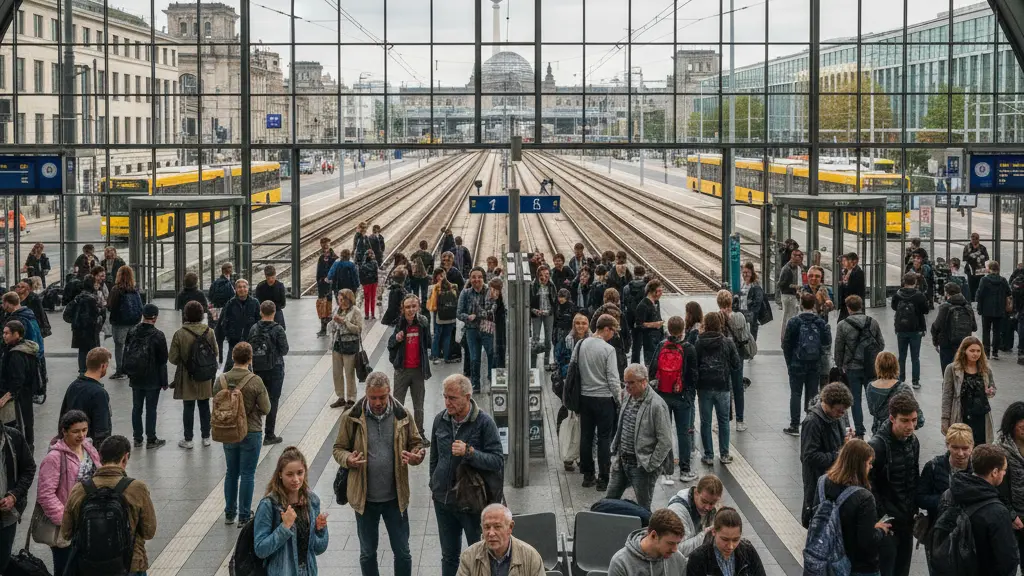
Overview: Nationwide warning strikes hit local public transport
On 2 February 2026, the trade union ver.di called for nationwide warning strikes in municipal public transport (ÖPNV). The action affects almost 100,000 employees across roughly 150 transport companies in 15 of 16 federal states. One notable exception is Lower Saxony, where a peace obligation prevents strikes until April 2026. The stoppage brought buses, trams and many urban metro services to a near standstill in numerous cities while other rail services remained largely unaffected.
Which services were disrupted and which continued
Buses, streetcars and U-Bahn networks in many cities were hit hard, with services reduced or cancelled. By contrast, S-Bahn networks, regional and long-distance passenger trains operated by Deutsche Bahn and a number of private rail providers were largely unaffected. The strike therefore caused severe disruption for short-distance urban travel, while intercity and regional rail connections remained available in most places.
Where the strike had the biggest effect
Major urban centres and regional networks reported the biggest impact. Cities and regions across the country experienced severe service reductions or no service at all on affected modes, resulting in widespread travel difficulties for commuters, students and people who rely on public transport for everyday trips.
| Affected (examples) | Unaffected (examples) |
|---|---|
| Local buses, trams and U-Bahn in many cities and regions | S-Bahn networks in many areas |
| Urban public transport in multiple federal states, excluding Lower Saxony | Regional and long-distance Deutsche Bahn services |
| Service interruptions in cities across states such as Berlin, Hamburg, North Rhine-Westphalia, Baden-Wuerttemberg, Bavaria, Hesse, Rhineland-Palatinate, Saarland and Saxony | Private rail operators in many corridors |
| Scope | Nearly 100,000 employees in about 150 companies across 15 states |
Why the strikes were called and what ver.di wants
ver.di says staff in local public transport face heavy workloads, difficult shift patterns and constant time pressure. The union demands measures to reduce physical and mental strain and to make working conditions fairer for drivers and other transport employees.
Key demands and geographical differences
The union’s core demands include shorter weekly and shift lengths, longer rest breaks between shifts and higher allowances for night and weekend work. In some federal states — for example Bavaria, Brandenburg, Saarland, Thuringia and Hamburg — ver.di has also pressed for direct wage increases as part of negotiations. The union framed the strike as a way to increase pressure after what it describes as repeated refusals by employers to agree meaningful improvements.
- Shorter weekly working hours and shorter shifts
- Longer recovery and rest breaks
- Higher pay supplements for night and weekend work
- In several states, additional demands for wage increases
Employer response and planned next steps
Employer associations criticised the strikes as disproportionate and pointed to negotiations that they describe as having produced no results so far. The full-day warning actions, sometimes beginning on Sunday evening, are intended by the union to ramp up pressure on employers. Additional strike rounds were signalled in some regions, with further actions planned after the initial day, for example in Rhineland-Palatinate on 4 February.
- Employer groups argue the measures are disproportionate given the state of talks.
- ver.di responds that employees face unsustainable working conditions and that small improvements have repeatedly been refused.
- Planned follow-up actions aim to keep pressure on employers and reopen talks.
Impact on passengers and practical advice
The strike left many commuters, pupils and workers scrambling for alternatives. People were advised to consider remote work where possible or to use carsharing and other private mobility options. Local demonstrations took place in some places and specific technical issues, such as frozen lines, meant that in a few cases vehicles ran empty for safety reasons. Travellers were urged to check local operator announcements and to allow significantly more travel time on disrupted days.
