
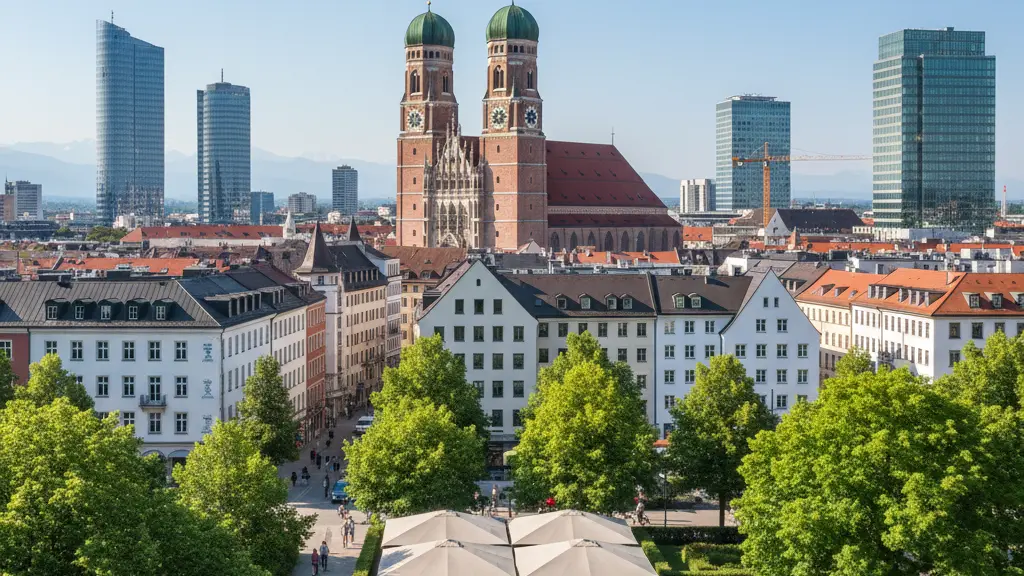
1. Overview: Germany’s most unaffordable cities for homebuyers
Munich remains the most unaffordable city in Germany for property buyers in 2026. A typical 75-square-meter apartment in Munich now costs about €617,000, down by roughly €83,000 from the peak in 2022, but still far above what many households can comfortably afford. This price level translates into a burden of around 43% of net income for buyers—well above a commonly used affordability threshold of 35%.
High apartment prices in Munich are reflected in per-square-meter figures: roughly €9,174 per square meter for apartments and about €8,777 per square meter for houses. These extreme prices are driven by persistent demand, limited supply, strong economic performance, and ongoing immigration into the region. Even luxury-market examples, such as multi‑million-euro penthouses, underline how stretched prices remain.
2. How Munich compares with other major German cities
While Munich sits in its own, most expensive league, other large German cities show a wide range of price levels. Representative 75 m² price points include Stuttgart at about €337,000, Hamburg at €447,000, and Frankfurt at €419,000. Among Germany’s seven largest cities, Düsseldorf and Stuttgart rank as the most affordable relative to income, while Hamburg, Berlin, Frankfurt and Cologne also fall below the affordability threshold used in the national index.
- Munich: €617,000 for a 75 m² apartment — burden ~43% of net income.
- Hamburg: ~€447,000 for a 75 m² apartment.
- Frankfurt: ~€419,000 for a 75 m² apartment.
- Stuttgart: ~€337,000 for a 75 m² apartment (one of the more affordable large cities).
- Düsseldorf: relatively affordable among the seven largest cities.
- Outside major metropolitan areas: average burden around 26% of net income, making suburban and regional locations notably more affordable.
3. Why Munich is so expensive
3.1 Supply and demand imbalance
Munich’s combination of sustained high demand and a shortage of available homes and building land creates intense price pressure. New construction cannot keep pace with population growth and in‑migration, which keeps competition for existing housing fierce and prices elevated.
3.2 Income versus prices and the affordability gap
Although Munich is a high-income city, rising property prices have outpaced typical household income growth. The result is a larger share of net income required to service mortgage payments and housing costs — about 43% for a standard 75 m² apartment — significantly above commonly recommended limits and placing many buyers under financial strain.
3.3 Land availability, regulations and market dynamics
Experts point to tightly constrained land availability and strong competition for centrally located plots as structural factors that keep prices high. Regulatory and planning bottlenecks, combined with high construction costs in premium markets, also limit the ability of supply to respond quickly to demand.
3.4 Luxury market and price signaling
The presence of very high‑end transactions — for example, multi‑million‑euro penthouses — helps set aspirational price benchmarks and signals investor confidence in the market, which can in turn support high valuations across other segments.
4. What this means for homebuyers and practical takeaways
High prices in Munich and other unaffordable cities mean buyers need to plan carefully. Key considerations include realistic budgeting, comparing metropolitan and regional options, and understanding how much of net income housing will consume. For many buyers, moving slightly outside major city centers or choosing smaller properties can reduce the proportion of income spent on housing.
- Assess affordability: consider the share of net income that mortgage and housing costs will require — many experts view above 35% as a warning sign.
- Compare regions: locations outside large metros often show much lower income burdens (around 26% in some regions).
- Explore alternatives: smaller homes, longer-term planning, or different financing structures may improve affordability.
- Monitor market signals: falling headline prices do not always mean affordability improves if incomes and borrowing costs remain challenging.
5. Snapshot: city price comparison
| City / Region | Approx. price for 75 m² | Estimated share of net income |
|---|---|---|
| Munich | €617,000 | ~43% |
| Hamburg | €447,000 | Below affordability threshold (varies) |
| Frankfurt | €419,000 | Below affordability threshold (varies) |
| Stuttgart | €337,000 | More affordable among large cities |
| Düsseldorf | noted as relatively affordable | More affordable among large cities |
| Outside major metropolitan areas | varies by region | ~26% average burden |
| Notes: Prices are representative approximations for a 75 m² apartment in 2026. Affordability is measured by share of net income needed for housing; common warning threshold is 35%. | ||
