
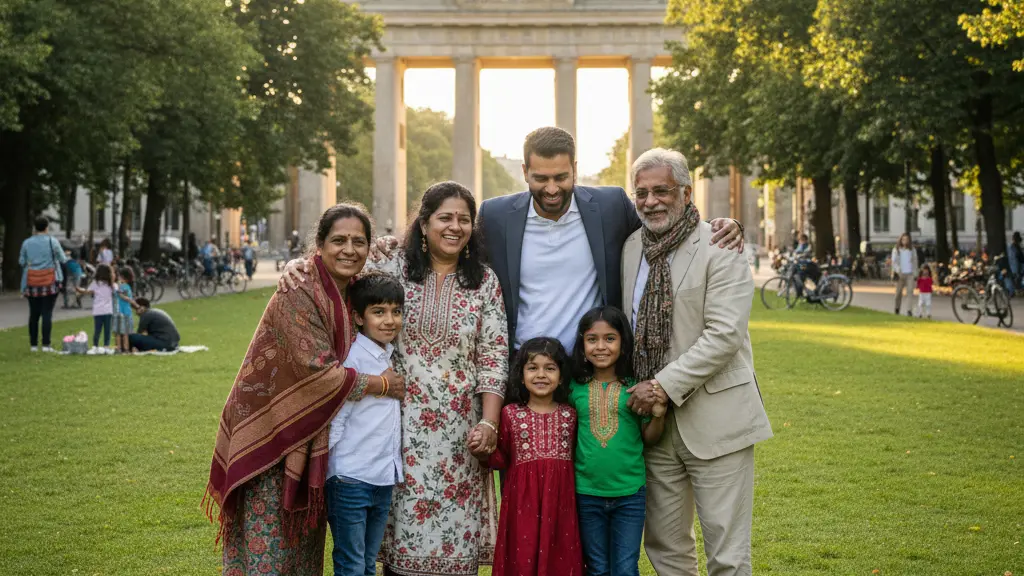
Conference overview and why family reunification matters
On 7 October 2025 the EMN Germany conference at the Europäisches Haus in Berlin brought together national and international experts to discuss family reunification of third-country nationals. Organized by the national contact point of the European Migration Network (EMN) at BAMF, the event focused on current developments, practical challenges and possible best practices at the intersection of fundamental family rights and migration management.
Context of the discussion
The conference discussion drew on varied perspectives: legal, social-policy, protection for survivors of domestic violence, integration programming and return assistance. This broad lens highlighted how family reunification intersects with welfare rules, protection obligations and targeted funding programs, and why balanced approaches are necessary.
The discussion emphasized that family reunification is both a human-rights issue and a migration policy instrument. Participants underlined the need to design family reunification policies that respect the right to family life while enabling governments to manage migration responsibly and effectively.
Legal and human-rights framework
Legal frameworks at national and EU level shape how family reunification is implemented. International instruments and EU directives set standards for protecting family life and for safeguarding vulnerable persons, while national law and administrative practice determine procedures and priorities.
EU directives and the Istanbul Convention
The conference recalled that EU instruments and the Istanbul Convention require protection from domestic violence and measures to prevent harm. These obligations affect family law and reunification procedures, for example by requiring safeguards for survivors and by informing decisions about custody and access where violence is present.
Protection in family law: concerns raised by advocacy groups
Advocacy organisations pointed to gaps between protective standards and practice. The VAMV criticised insufficient implementation of protections in family law. As Daniela Jaspers was quoted at the conference: “In cases of domestic violence, no joint custody should be ordered”, stressing that violence against a primary caregiver is harmful to the child’s welfare. Such positions highlight how family reunification and custody decisions must be informed by child protection and survivor safety.
Policy approaches and country examples
Participants compared different national approaches to family reunification, illustrating how policy choices reflect trade-offs between rights protection and migration management. Examples discussed at the conference showed concrete procedural models and pointed to broader social-policy debates.
| Approach | Example / Feature | Notes |
|---|---|---|
| Switzerland | Family reunification via written request to SEM; prioritisation of extended core family and vulnerable persons | Shows administrative prioritisation linked to protection needs |
| Germany | Debate over SGB II sanctions and family livelihood; calls for childcare before employment requirements | Highlights social-policy tensions affecting family reunification outcomes |
| AMIF | Funding for integration and return projects from 15.12.2025 | Does not explicitly address family reunification, raising coordination questions |
| Table summarises examples discussed at the EMN conference | ||
Switzerland: written requests and prioritisation of vulnerable family members
The Swiss approach for Ukrainian refugees was highlighted as an example: family reunification occurs via a written application to the State Secretariat for Migration (SEM). Priority can be given to extended core family members and to vulnerable persons, provided there are no compelling reasons to refuse. This illustrates a model where administrative procedure, prioritisation and protection considerations are combined.
Germany: social policy debates and concerns about sanctions
In Germany, family reunification debates are reflected in wider family policy discussions. Organisations such as the Zukunftsforum Familie (ZFF) warned that tougher sanctions in SGB II could threaten family livelihoods. As Prof. Dr. Susanne Baer said at the conference: “This endangers the livelihood of entire families. That means the welfare state fails in its protective mission.” Proposals discussed include securing childcare infrastructure before requiring labour market participation and reconsidering temporary household rules that affect family stability.
Funding and programmes: AMIF and return/integration initiatives
The conference also noted that migration-specific funding influences how family-related measures are supported. The AMIF fund will, from 15 December 2025, finance projects aimed at integration and return. The fund’s announced scope does not explicitly prioritise family reunification, which raises questions about aligning funding streams with family-centred integration and protection needs.
Best practices, remaining gaps and recommendations
The conference concluded that respectful, rights-based family reunification can be compatible with migration management when policies are carefully designed. Best practices combine individualised support, protection safeguards and clear administrative procedures.
Illustrative best practices
Examples discussed include individualised return support such as the ‘IntegPlan’ model, targeted prioritisation of vulnerable family members, and administrative procedures that allow clear, timely assessments of family reunification requests while safeguarding survivors of domestic violence.
Overall, the EMN conference highlighted that balancing family reunification rights and migration management is achievable if policies are guided by human-rights standards, informed by evidence, and designed to protect vulnerable family members while maintaining orderly procedures. Continued dialogue, targeted funding and improved data are essential next steps.
Key gaps identified
Speakers noted a lack of comprehensive reporting: direct evidence from at least ten sources was missing, underlining the need for further research and better data collection. Other gaps include inconsistent implementation of protective standards in family law and limited explicit consideration of family reunification in some funding streams.
Practical recommendations
- Embed clear protection safeguards into family reunification procedures, including explicit rules to protect survivors of domestic violence when assessing custody and access.
- Prioritise vulnerable family members and extended core family where protection needs justify prioritisation.
- Ensure social-protection rules do not unintentionally jeopardise family livelihoods—reconsider sanction policies that risk family stability.
- Provide care and childcare infrastructure prior to imposing employment-related conditions on family members.
- Align migration funding (including integration and return programmes) with family reunification objectives where appropriate.
- Scale up individualised assistance models, such as ‘IntegPlan’, to support dignified return or integration paths that consider family unity.
- Invest in research and data collection to fill evidence gaps, including collecting direct reports from multiple reliable sources to inform policy design.
