
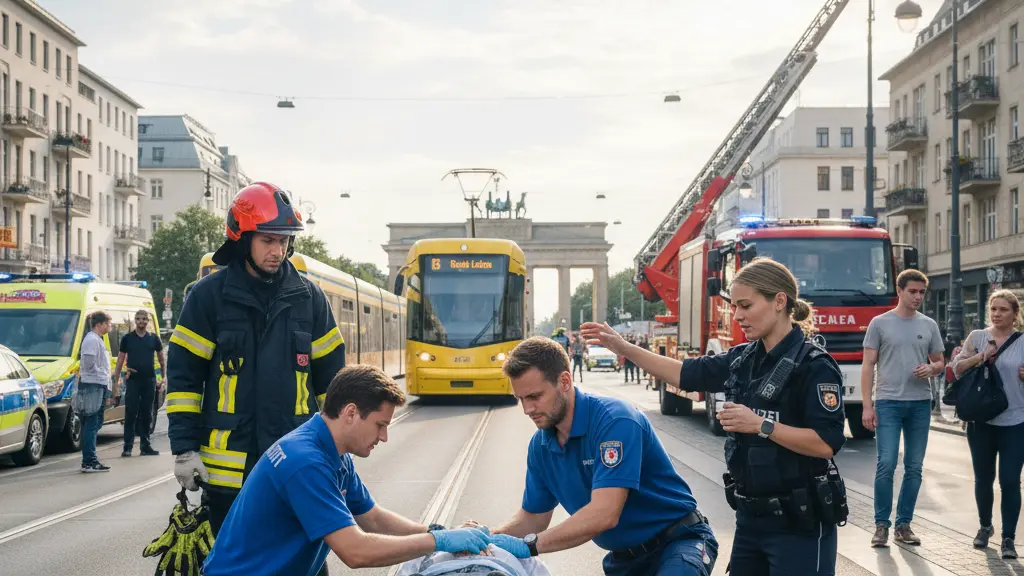
1. The emergency services are under strain
German emergency services are reaching a breaking point, according to health expert Janosch Dahmen. On the European Day of Emergency Numbers he warned that the system is structurally fragmented: roughly 300 operational areas, about 240 dispatch centers and more than a dozen different organisational forms work alongside one another with no uniform standards or reliable digital networking. This fragmentation affects ambulance services, paramedics and the wider emergency medical services (EMS) network.
Dahmen summed up the problem bluntly: whether people in an emergency are treated quickly and correctly still often depends too much on their postal code. That so-called “postcode lottery” means patients can face very different outcomes depending on location, while staff are overworked and resources are used inefficiently.
2. Causes and key challenges
Fragmented structure and unequal care
The current structure lacks harmonised standards for response, triage and follow-up care. Multiple providers and local rules can lead to inconsistent quality of care and make it hard to introduce nationwide improvements. The result is unequal emergency care and unpredictable patient journeys from call to hospital.
Dispatch, digital gaps and rising complexity
Many dispatch centres are not digitally connected to a national emergency call system like 112, and telephone reachability is often poor at night and on weekends. At the same time, case complexity is increasing: emergency helicopter services logged roughly 49,000 missions in 2025, mostly for accidents and heart‑circulatory emergencies, showing growing demand for advanced prehospital care. Seasonal flu waves and staffing shortages further worsen capacity problems.
3. Consequences for patients, staff and costs
Inefficient dispatch and a lack of alternative, case‑closing care pathways push ambulances to the wrong calls and overcrowd emergency departments. Patients suffer delays or inappropriate care, paramedics and emergency doctors face burnout, and overall costs rise when ambulances and emergency rooms are used where other services would be more suitable.
| Metric | Approximate value |
|---|---|
| Operational areas | ~300 |
| Dispatch centres | ~240 |
| Different organisational forms | More than a dozen |
| Helicopter missions in 2025 | ~49,000 |
| Estimated annual savings from reform | Up to €5 billion |
4. Expert proposals and required reforms
To stabilise emergency medicine and improve ambulance and paramedic services, Dahmen and other experts call for a comprehensive reform. Key demands include creating central hospital contact points, ensuring reliable telephone reachability—especially at night and on weekends—and establishing digital networking tied to the emergency number 112.
- Introduce unified standards across regions for triage, dispatch and patient handover.
- Digitally connect dispatch centres and emergency calls to enable faster, data‑driven decisions.
- Establish centralised hospital contact points to guide patients and ambulances to the right care setting.
- Provide direct, case‑closing alternatives so fewer patients are taken to emergency departments unnecessarily.
- Improve staffing and training to reduce burnout among paramedics and emergency personnel.
5. Practical benefits and steps to implement change
- Faster and more appropriate ambulance dispatch, reducing response times and unnecessary transports.
- More equal access to quality emergency care regardless of postal code.
- Reduced pressure on emergency departments and lower overall healthcare costs.
- Improved working conditions for paramedics and emergency personnel through clearer processes and better digital tools.
Practical steps include piloting regional digital integration projects, rolling out interoperable IT standards, consolidating or coordinating dispatch centres where sensible, and expanding telephone triage services and telemedicine options so fewer cases require an ambulance or ER visit.
6. What the public can do and the political outlook
Citizens can help by using the emergency number 112 appropriately, learning basic first aid, and knowing local alternatives (on‑call doctors, telemedicine lines, case‑closing first response teams). Better public awareness of when to call an ambulance versus seeking other care can reduce strain on ambulance services and emergency departments.
Politically, Dahmen has publicly criticised Health Minister Nina Warken for what he calls negligence: a draft reform from November 2025 had not yet received cabinet approval, leaving urgent changes delayed. Experts warn that without clear political action to unify standards and invest in digital networking, the system will remain overstretched and costly—while a coordinated reform could save billions and improve care for everyone.
