
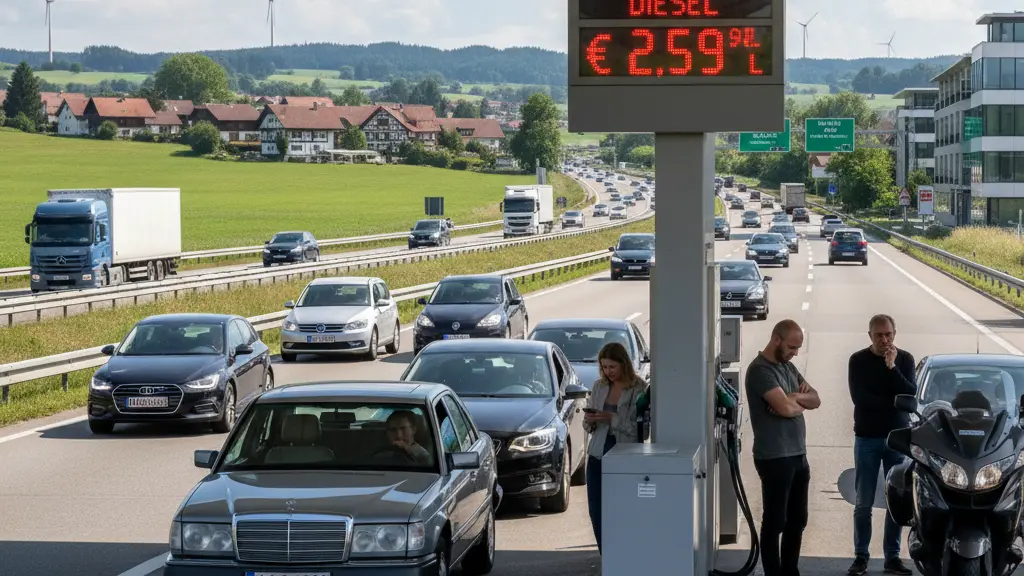
1. The current diesel price shock: what is happening
Fuel markets in Germany have reacted sharply after geopolitical tensions linked to the Iran conflict. Diesel prices have already exceeded the €2 per liter mark in many places and are approaching the €2.50 threshold. The tank station association (TIV) and consumer groups report averages and local peaks that signal sustained pressure on households and businesses that rely on diesel.
- Cause: Geopolitical tensions tied to the Iran conflict are a main factor.
- Average prices reported: approximately €2.171 per liter (ADAC average).
- Local peaks reported near €2.237 per liter.
- Warnings from industry: TIV says €2.50 and above are possible; experts warn of asymmetric price reactions.
Market numbers and immediate signals
According to available price measures, the ADAC average stood at about €2.171 per liter, with local peaks seen near €2.237. The TIV warns that even €2.50 or more per liter is conceivable given current market behavior. Experts also describe a ‘rocket-and-feather effect’ where price rises are passed on to consumers quickly, while price decreases arrive more slowly.
2. Political and economic reactions
The sudden rise in diesel prices has triggered political responses and economic concern. SPD Finance Minister Lars Klingbeil has called for measures to limit opportunistic price hikes, proposing that price increases at stations be restricted to once per day. SPD politician Esra Limbacher called current price jumps ‘plain and simple rip-off’ (schlicht und ergreifend Abzocke), arguing that stocks bought more cheaply should not be used as an excuse for sharp retail increases.
| Source | Projection / Note |
|---|---|
| Ifo (Timo Wollmershäuser) | Inflation around 2.5%; economic growth slowed by approximately 0.2 percentage points |
| IW (Samina Sultan) | At $150 per barrel: GDP -0.5% in 2026; up to -1.3% through 2027 with estimated losses around €80 billion |
| These projections underline macroeconomic risk from sustained higher oil prices. | |
The CDU has pushed a different response mix: instead of blanket fuel discounts, it recommends making the recently raised commuter allowance (Pendlerpauschale) of 38 cents per kilometer—up from 30 cents—effective from the first kilometer to reduce tax burdens for commuters. CDU representatives also point out the high share of tax on fuel: roughly 65 cents in energy tax per liter plus 19% VAT on top in the current tax structure. CDU General Secretary Carsten Linnemann warned that higher energy costs could bring a ‘hot summer’ with inflationary pressure and further central bank rate moves. Financial markets reacted nervously, with the Dax dropping by up to about 2.5% in early reactions.
3. Practical steps for drivers and households
When diesel costs rise sharply, households and commuters can take practical measures to reduce fuel spending and exposure. Below are short-term and medium-term actions that are straightforward to implement.
Short-term measures (immediate savings)
- Combine trips and plan routes to reduce mileage—group errands and avoid empty return trips.
- Adopt economical driving habits: smooth acceleration, steady speeds, and early gear changes in manual cars.
- Keep tyres properly inflated and perform basic maintenance to preserve fuel efficiency.
- Carpool with colleagues or neighbours where possible to split costs.
- Use public transport for commutes or key journeys if it is practical and cost-effective.
Medium-term measures (structural adjustments)
- Use the increased commuter allowance to reduce tax burden: evaluate whether claiming the allowance from the first kilometer helps your situation.
- Negotiate flexible working arrangements where possible—more remote work or adjusted hours can cut fuel use.
- Consider switching to more fuel-efficient vehicles or alternative mobility options when it makes financial sense.
- Support and lobby for targeted help for regular commuters rather than general fuel discounts that may not reach those most in need.
4. How to make the most of commuter relief and other financial measures
One immediate policy lever discussed is the commuter allowance: it was recently raised from 30 to 38 cents per kilometer and is recommended by some political actors to be applied from the first kilometer. This measure aims to lower taxable income for regular commuters and reduce the net burden of higher fuel costs. Policymakers are debating targeted support for workers rather than blanket tank rebates.
- Check whether and how the increased commuter allowance applies to your taxable income—using it from the first kilometer increases the immediate benefit for many commuters.
- Track fuel expenses and commuting distances so you can assess the benefit of claiming relief or asking your employer about support.
- Favor targeted, needs-based support if policymakers offer options, as this tends to help regular commuters more effectively than universal discounts.
5. Outlook and key takeaways
Higher diesel prices driven by geopolitical risk can have broad effects: rising consumer prices, slower growth, and market volatility. Economic analysts warn of meaningful impacts on inflation and GDP if oil remains at high price levels, and stock markets have already shown sensitivity.
What you can do now: monitor prices, adopt short-term fuel-saving habits, use available tax relief like the commuter allowance where it helps, and consider medium-term changes to reduce dependence on diesel. Policymakers continue to debate the best mix of measures—watch for targeted aid aimed at commuters rather than blanket discounts. Staying informed and adjusting travel and budgeting choices will help households and businesses navigate higher fuel costs.
