
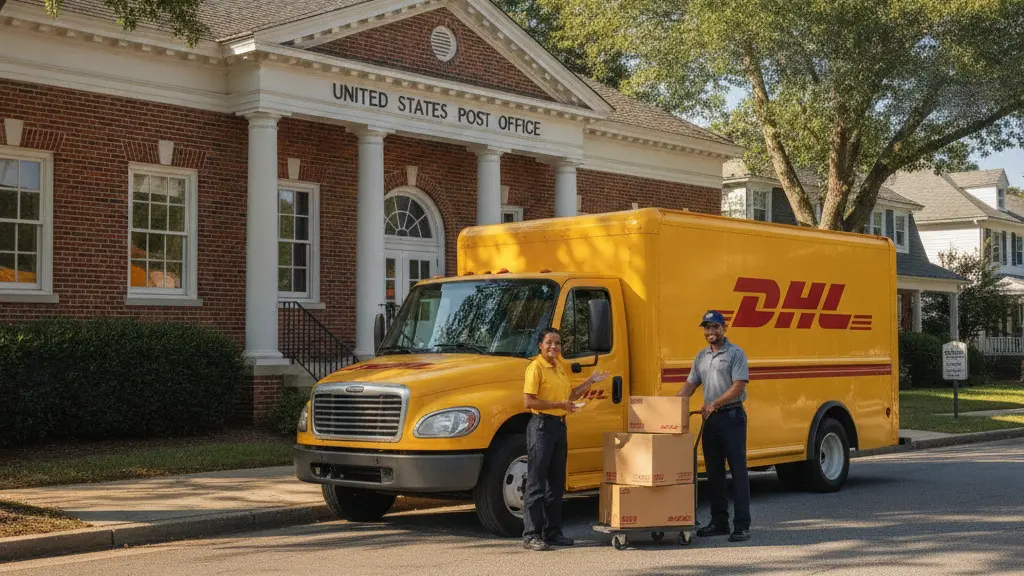
Deal overview: a multi‑year, exclusive last‑mile agreement
In late May 2026, DHL eCommerce and the US Postal Service (USPS) announced a new, exclusive multi‑year agreement worth well over $10 billion. The partnership focuses on last‑mile package delivery in the United States and deepens a relationship the two organizations have maintained for decades. Under the arrangement, DHL eCommerce handles parcel pickup, sorting and long‑haul transport, while USPS takes over the final doorstep delivery to consumers.
Described publicly as an unprecedented step in their 25‑year collaboration, the deal is positioned as a strategic way for DHL to scale its US e‑commerce business quickly without building an expensive national delivery network, and for USPS to generate predictable parcel revenue that better uses its existing infrastructure.
How the partnership works in practice
The operational split is straightforward and emphasises each partner’s strengths: DHL eCommerce will focus on upstream logistics — pickup from sellers, international and domestic transport, and automated sorting in its network of US centres — while USPS covers the last mile from local post offices to customers’ homes.
Operational steps
- DHL eCommerce collects parcels from merchants and online sellers.
- Parcels are routed to DHL’s 19 US logistics centres and automated hubs for sorting and consolidation.
- DHL transports sorted shipments across its network to destination regions.
- USPS receives the parcels locally and completes final‑mile delivery to recipients’ addresses.
This clear division — pickup, sorting and transport by DHL; final‑mile delivery by USPS — aims to increase efficiency, make use of automation, and reduce redundant investment in duplicate delivery networks.
Why DHL chose this path
Building a nationwide, door‑to‑door delivery network in the US is capital‑intensive and labor‑heavy. By partnering with USPS for the last mile, DHL eCommerce can expand its footprint and capacity in the US e‑commerce market without spending billions to recreate an already extensive delivery infrastructure.
Growth and scalability goals
DHL leaders have framed the agreement as a lever to scale the US business rapidly, with public comments suggesting the move could roughly double DHL’s US e‑commerce operations by 2030. The model allows DHL to focus investment on international logistics, sorting automation and network control while relying on USPS for the labor‑intensive doorstep work.
Why USPS agreed: revenue and utilization
USPS has faced long‑standing financial challenges, including declining mail volumes and sizable cumulative losses over many years. Additional, stable parcel volumes from a major customer such as DHL offer new revenue streams and better utilization of postal facilities and delivery personnel.
Financial context
For USPS, predictable parcel business is attractive because it helps monetize an existing nationwide workforce and network. The agreement is presented by USPS leadership as a way to position the service for long‑term competitiveness while improving operational efficiency and potentially lowering emissions through more consolidated transport and routing.
Market context and competition
The US parcel market is fiercely competitive. Major private carriers like UPS and FedEx, along with Amazon Logistics, put constant pressure on price, speed and flexibility. The DHL–USPS deal should be read as part of a broader trend toward bilateral alliances and specialization: companies concentrate on core strengths and form partnerships to achieve scale and cost advantages.
Strategic implications
- Exclusive access to USPS last‑mile services gives DHL scale in the US parcel market without duplicating infrastructure.
- USPS benefits from steady parcel volumes but becomes more dependent on a large private partner.
- Competitors will continue to push innovation in delivery speed, routing and urban logistics, making the competitive environment dynamic.
Benefits, risks and critical perspectives
Industry and media reactions are mixed: many outlets highlight the win‑win aspects — efficiency gains, better use of infrastructure, and a large contract that strengthens both organisations — while critics caution that the deal is not a cure‑all for structural challenges.
Key benefits
- Faster market expansion for DHL eCommerce without massive capital outlay.
- Additional, predictable revenue for USPS and improved utilization of delivery capacity.
- Potential efficiency gains and lower emissions through optimized sorting and consolidated transport.
Main risks and concerns
- Increased dependency: DHL relies on a state‑run, politically sensitive partner for a critical part of customer experience.
- USPS becomes more exposed to the commercial success of a single large customer, which can create revenue concentration risk.
- Competitive pressures from UPS, FedEx and Amazon Logistics remain strong and could limit the long‑term payoff.
- Operational and labor challenges at the last mile are not fully solved by contract size alone.
Outlook: what to watch next
The agreement will be closely watched across the logistics and retail sectors. Metrics to follow include how quickly DHL scales US volume, whether USPS achieves the anticipated revenue and efficiency gains, and how competitors respond with pricing, service offerings or their own partnerships.
Ultimately, the deal illustrates a strategic choice common in global logistics: partner to leverage complementary strengths rather than replicate costly networks. If implemented smoothly, the arrangement could be a model for similar alliances. If not, it may underscore the limits of single‑partner solutions in a fast‑moving parcel market.
