
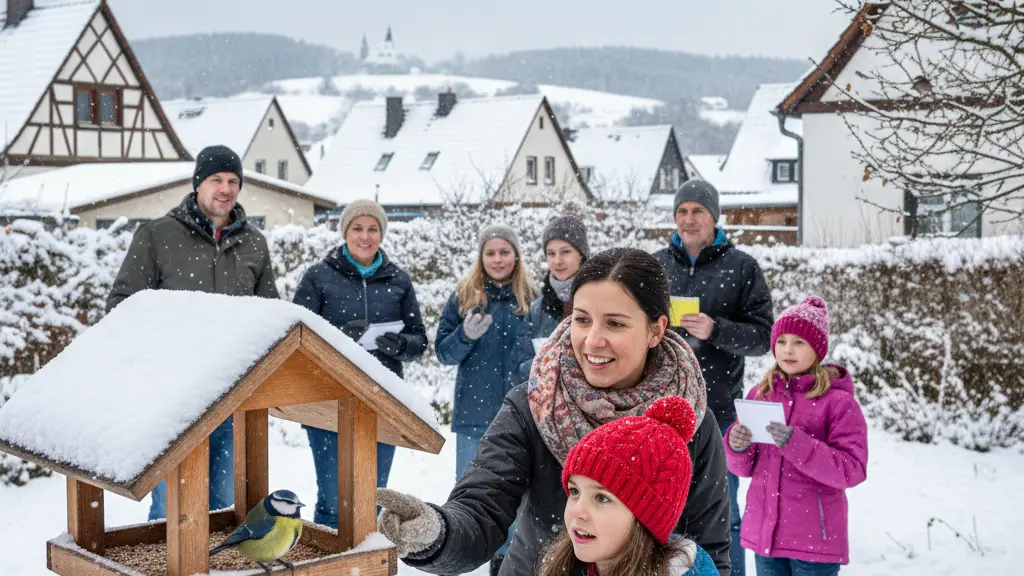
1. What is the Winter Bird Count in Rheinland-Pfalz?
The “Stunde der Wintervögel” is a simple, scientific citizen-science bird count inviting everyone in Rheinland-Pfalz to take part. Held as part of a nationwide action in early January 2026, participants spend one hour counting birds from their garden, balcony or at a local park. The count is low-threshold and designed for families, beginners and experienced birdwatchers alike.
When and where
The 2026 nationwide action runs from 9 to 11 January. Each count lasts exactly one hour. In Rheinland-Pfalz you can count from home or join guided local excursions led by volunteers. Locations in the Ahrweiler area include meeting points in Bad Neuenahr, Sinzig and Remagen-Oberwinter.
Who can join?
Everyone can participate: families, school groups, older people and single observers. There is also a dedicated “School Hour of Winter Birds” for children and classes the following week, with materials and rally activities that make learning about species and observation fun and accessible.
2. Why your count matters
This action is more than a weekend activity — it is part of long-term monitoring of common urban and garden birds. The organisers describe it as one of the country’s largest scientific citizen projects. Data collected over many years show trends in species like the house sparrow, great tit, blue tit, blackbird and tree sparrow, and help researchers understand population changes across regions.
What the counts reveal
Counts reveal both short-term effects (for example, weather-driven shifts in where birds gather) and longer-term trends such as declines in some species. The 2026 interim results show mixed signals: strong participation and more reports from snow-affected states, but on average fewer birds per garden than the year before. Some species increase at feeders during snow and frost while others show worrying declines linked to habitat loss and other pressures.
Reasons for population changes
Experts link declines in several species to factors like land sealing, loss of natural habitat, insect declines, intensive agriculture and pesticide use. Disease and region-specific issues can also affect numbers. The count helps separate weather effects, disease events and long-term trends by providing repeated, comparable data.
3. How to count — step by step
To make your data useful and comparable, follow the official counting rules. The process is straightforward and suitable for first-timers.
Basic rules
- Choose one hour between 9 and 11 January and stay in one place (garden, balcony, park) for that hour.
- For each species, record only the highest number of individuals you see at the same time to avoid double counting.
- You may visit several locations in sequence, but submit a separate report for each site and hour.
- Submit your results online or via the official app; telephone or postal reports are no longer accepted.
What to record
Record species you can identify and the highest simultaneous count per species. Typical species to expect include house sparrow, great tit, blue tit, blackbird, tree sparrow and other common garden birds. Note unusual observations as well; the count has documented surprising winter guests in past years.
4. Feeding and welfare during cold weather
The 2026 count takes place during pronounced winter weather in some regions, with snow cover, prolonged frost and even storm events. Cold, deep snow can push more birds to feeders, making counts more interesting but also highlighting the animals’ dependence on supplementary food when natural food is covered by snow.
Practical feeding advice
- Offer high-quality seed and fat-rich foods, especially during frost — energy-rich mixes and suet or fat balls help birds survive cold nights.
- Prefer feed labelled of good quality; organic options are recommended where available.
- Do not use plastic netting on fat balls: birds can get entangled and nets add plastic waste to nature.
- Remember that feeding cannot substitute for habitat: hedges, old trees and insect-friendly gardens are essential for long-term bird survival.
Balance help and dependence
Supplementary feeding can save energy for birds in severe weather but should be paired with measures that improve natural food and shelter. The organisers stress that feeding alone will not reverse long-term declines — structural habitat protection is equally important.
5. Local events in Ahrweiler and school activities
In Rheinland-Pfalz, local volunteers run guided counts that are ideal for families and beginners. In the Ahrweiler district, meeting points include Bad Neuenahr (Behelfsbrücke Uhlandstraße), Sinzig (entrance to the castle park) and Remagen-Oberwinter (old town hall). Experienced volunteers help with species identification and collect data for submission.
School Hour and educational materials
Following the public count, there is a “School Hour of Winter Birds” for children and classes, usually held 12–16 January. Schools and youth groups can access activity booklets, posters and a winter bird rally to teach species recognition, observation techniques and basic conservation ideas in a playful way.
6. After the count: reporting results and what they tell us
Once you have recorded your highest simultaneous counts, submit them online or through the official app. The organisers aggregate the data and make results available on interactive maps so participants can see species distributions and regional trends, including in Rheinland-Pfalz.
Common winter garden species
| Species (English) | Typical observation |
|---|---|
| House Sparrow (Haussperling) | Often among the most frequent species, but showing regional declines. |
| Great Tit (Kohlmeise) | Regularly near feeders; may increase at feeders during snow. |
| Blue Tit (Blaumeise) | Common at feeding stations, especially with fat and seed mixes. |
| Blackbird (Amsel) | Common in gardens; numbers can fluctuate by region and year. |
| Tree Sparrow (Feldsperling) | Another frequent garden species, often among the top-ranked in counts. |
| Use the interactive maps to compare local observations with regional and national trends. | |
Quick checklist after your count
- Check your recorded highest simultaneous numbers for each species.
- Submit results online or via the app — no phone or postal reports.
- Note any unusual species or behaviors in a comment field if available.
- Share your experience with family, school or community and consider habitat measures at home (hedges, native plants).
