
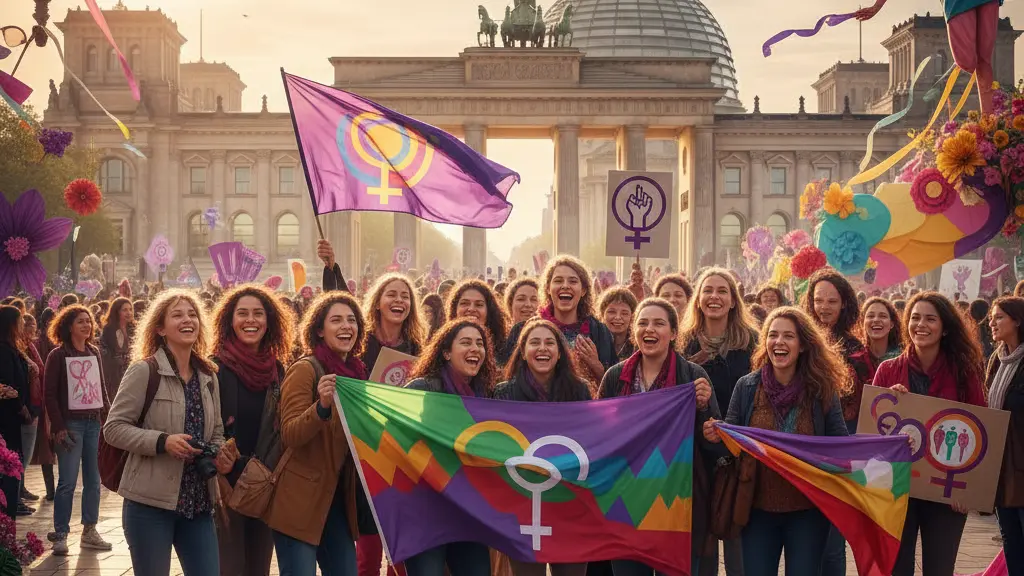
1. What to expect on International Women’s Day in Berlin
International Women’s Day in Berlin turns the city into a large stage where political protest, culture programming and nightlife meet. As a public holiday, the day is marked by feminist demonstrations, cinema programs, museum events and parties that often call themselves FLINTA-only or prioritize safer spaces. Choosing to go to a demo, a film screening or a party is itself a political act: many Berlin tips frame the day as a mixture of resistance, remembrance, learning and celebration.
2. Demonstrations, protests and neighborhood actions
Protests dominate many event calendars: a large central feminist demonstration usually draws mass participation, while a star-shaped convergence of smaller neighborhood actions feeds into the main route. Intersections of gender, race, class and migration are increasingly emphasized, and decentralized actions in local neighborhoods often include walks, street theatre and targeted rallies.
Main central demonstration and logistics
The central demonstration is typically the biggest visible expression of the day. Expect concentrated crowds, staged speeches, banners and a mix of militant and festive atmospheres. Authorities and organizers advise planning for street closures and transport changes; arriving early and agreeing on meeting points helps if your group splits up.
- Arrive early to join your bloc and avoid congestion.
- Bring water, snacks and a charged phone; wear comfortable shoes and weather-appropriate clothing.
- Follow safety guidance from organizers and respect designated safer-space areas.
- Avoid glass bottles and bring a small first-aid kit if you can.
Decentralized neighborhood actions
Alongside the main march, many neighborhoods host local actions: Kiez-spaziergänge (neighborhood walks), performances in public space, and targeted protests in front of institutions like clinics or employment offices. These formats make the political demands local and visible, and are often more accessible for people who prefer smaller gatherings.
Trade unions and workplace actions
Trade unions often use International Women’s Day to highlight pay equality, working conditions in care and education, and demands for better working-time models. Organized workplace actions and rallies connect street protests with concrete labor demands and encourage workers to combine demonstrations with local workplace activities.
3. Cinema, readings and cultural highlights
If you prefer cultural programming to street politics, Berlin offers dense cinema lineups, curated film series and post-screening discussions, plus library talks and museum tours focused on women’s histories and contemporary feminist themes.
Films and cinema programs
Many independent cinemas present film programs that center female directors, strong female leads and the ‘female gaze’. Expect retrospectives, new releases curated for the day and audience Q&A sessions that deepen conversations about representation, gender and filmmaking.
Museums, theaters and performances
Museums and performance spaces often lower admission or offer special guided tours to highlight women artists and historical movements. Theatrical and performative formats may address body politics, reproductive rights and care, using dance, spoken word and interdisciplinary staging to provoke reflection.
Libraries, readings and talks
Public libraries and cultural centers typically host readings and discussions with authors and activists on topics such as care work, violence against women and feminist economic critiques. These events are a good place for quieter, in-depth engagement with the issues that shape the day.
4. Parties, nightlife and safer spaces
As evening comes, many choose to celebrate. Nightlife offerings often include FLINTA-first or FLINTA-only parties and events that emphasize safer-space policies, queer-friendly lineups and a party culture free from the constant male gaze. These nights mix joy, solidarity and political expression.
What to expect at FLINTA events
FLINTA events tend to curate lineups and spaces to prioritize marginalized genders and to create an atmosphere where participants can express anger, desire and community without harassment. Organizers frequently publish house rules and invite attendees to look out for one another.
- RSVP or check capacity—some parties sell out or limit entry.
- Read and respect house rules; consent and no-tolerance policies are common.
- Buddy up and look out for friends; report issues to staff if something happens.
- Consider accessibility needs and check for venue provisions like quiet rooms or accessible entrances.
5. Practical tips: transport, safety and planning
Because International Women’s Day is a public holiday with major demonstrations, expect significant transport and traffic changes. Plan your route, allow extra travel time, and be prepared for crowded public transport and some street closures.
Safety, accessibility and day-of planning
Make a simple plan before you leave: choose a meeting point, share your route with someone you trust, and agree on a check-in time. Wear comfortable clothing, bring essential medications, and carry a form of ID. For accessibility, check event listings for wheelchair access, quiet spaces and support contacts.
- Select a clear meeting point in case groups separate.
- Inform a friend about which demonstration bloc or event you will join.
- Bring basic supplies: water, snacks, a small battery pack and sanitary items.
- Follow instructions from event marshals and respect safe-space stewards.
6. Politics, critiques and how to participate meaningfully
Public debate around the day often oscillates between celebration and critique. Some voices warn of commercialization and festivalization: when parties and branded events get more attention than strikes and demands for structural change, activists ask who benefits. Many remind participants that the day is intended as a day of struggle and collective action, not only celebration.
Beyond celebration: demands and long-term work
Meaningful participation can include joining demonstrations, supporting campaigns for wage equality and better conditions in care work, amplifying calls for protection from violence, and advocating for fair residency rights. Long-term change requires organizing beyond a single day—using the visibility of the day to push for concrete political commitments.
7. Suggested itineraries for the day
Here are a few sample plans depending on how you want to spend the day: prioritize protest, culture, family-friendly activities or an evening out.
- Protest-focused: Join a neighborhood action in the morning, converge into the central demonstration in the afternoon, and attend an evening assembly or radical reading group to debrief.
- Culture-focused: Morning museum tour highlighting women artists, afternoon film screenings with a Q&A, and an evening talk or book reading at a public library.
- Family-friendly: Take a daytime feminist city walk or street-art tour designed for mixed-age groups, visit a child-friendly exhibition, and end with an early-evening community event.
- Evening-first (nightlife): Spend the day on a relaxed self-guided cultural itinerary, rest in the afternoon, then attend a FLINTA-first club night that emphasizes safety and solidarity.
