
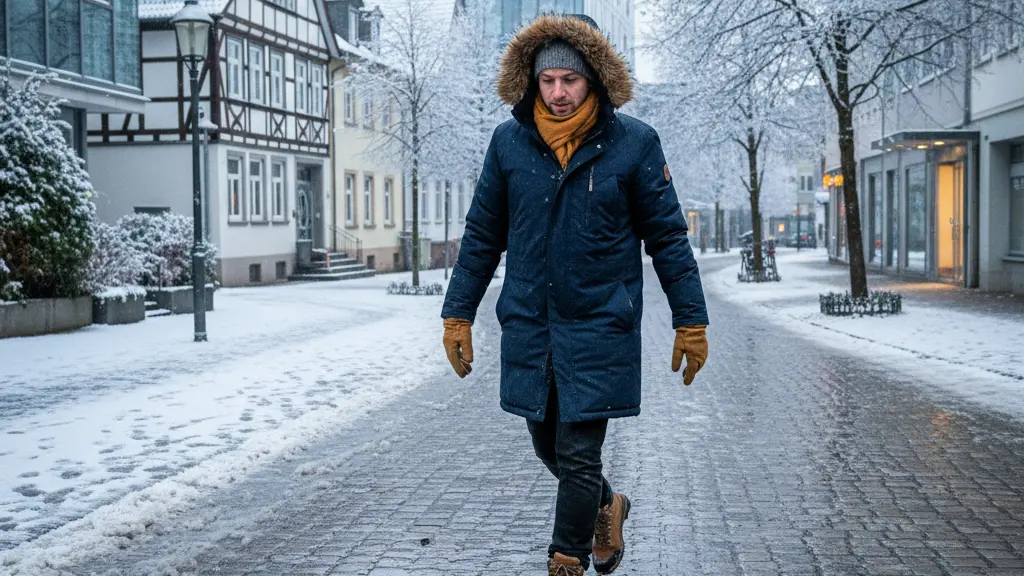
Current icy alert and immediate overview
The German Weather Service (DWD) has issued a renewed warning for dangerous icy conditions today in parts of Germany. A mix of rain, freezing rain and snow can turn roads into mirror-smooth surfaces, especially in areas already affected by recent severe accidents. Climatologist Karsten Brandt described the situation vividly as an ‘Eisregen-Banane’ spreading over the country, and experts urge everyone to be extremely careful.
Regions most at risk
The highest risk areas named by authorities and meteorologists include the Münsterland, Emsland, Osnabrücker Land, Ostwestfalen and the western low mountain ranges. The hazardous precipitation band is moving into Münsterland, Westphalia, western and southern Lower Saxony and northern Hesse.
Why this is happening
Forecasters link the overregional, storm-like freezing-ice situation to the low-pressure system ‘Gunda’, which brings snow and freezing rain. DWD meteorologist Oliver Reuter and other experts explain that temperatures around minus one to minus eight degrees make falling precipitation likely to freeze on contact, forming patches of black ice and widespread slipperiness.
Recent impacts and evidence
The seriousness of today’s warning is underscored by dramatic incidents from the previous day: a multi-vehicle crash on the A44 near Paderborn killed three people and left eleven injured. Police reported hundreds of accidents across several districts, large numbers of mostly minor injuries, and severe disruptions to daily life.
- Osnabrück: roughly 400 accidents reported.
- Cloppenburg: more than 100 accidents.
- Kreis Steinfurt: over 60 accidents.
- Authorities in Osnabrück and Vechta described the situation as ‘massive problems’ and ‘catastrophic’, advising people to stay home if possible.
- School closures and suspended local bus services occurred in several districts where safe routes to school could not be guaranteed.
How to stay safe: travel and personal precautions
Given the continuing cold and the potential for freezing precipitation, everyone in affected areas should take extra precautions. Authorities and experts emphasize caution, reduced travel, and planning for delays.
Road travel
- Consider staying home if your trip is not essential; police urged residents to remain off the roads when possible.
- Allow significantly more travel time — experts specifically advise planning much more time than usual for journeys.
- Drive cautiously and be prepared for mirror-smooth surfaces where rain has frozen on the road.
Public transport and rail
Rail operators are taking preventive measures to limit the effects of icy conditions on train services, so expect slower journeys and localized speed restrictions on key routes.
- Deutsche Bahn has reduced speeds on routes such as Hannover–Frankfurt, Wolfsburg–Berlin and Köln–Frankfurt to minimize delays caused by icy tracks.
- Despite speed reductions, there was no major service collapse reported this morning; nevertheless, passengers should expect possible delays and plan accordingly.
- While some rail managers are cautiously optimistic that the worst will not repeat, all official sources still stress the need for vigilance.
Pedestrians, schools and local services
Local authorities have already closed some schools where safe travel for children could not be guaranteed. Pedestrians and local service users should be aware of the danger of black ice on sidewalks and paths.
- If possible, stay at home; this was the explicit advice from police in the most affected areas.
- Expect school closures and public transport interruptions in affected districts; follow local announcements.
- Take care on footpaths and avoid shortcuts that are not cleared.
Official actions and expert statements
Multiple agencies and experts are actively monitoring the situation and issuing guidance. Their steps aim to reduce the risk to people and to keep essential transport running as smoothly as possible under difficult conditions.
What authorities are doing
The DWD is issuing warnings and meteorologists are explaining the meteorological cause. Police forces are responding to large numbers of accidents and advising the public to avoid travel where feasible. Rail operators are proactively cutting speeds on several long-distance lines to reduce the chance of weather-related delays.
Expert comments to note
Key expert remarks underline the seriousness of the situation while offering context:
- Karsten Brandt (climatologist): called the phenomenon an ‘Eisregen-Banane’ that can blanket large areas in freezing precipitation and advised drivers to plan much more time for journeys.
- Jürgen Schmidt (diplom-meteorologist): said the precipitation band with rain, snow and locally occurring freezing rain is moving into several western and central regions.
- Oliver Reuter (DWD meteorologist): described an ‘overregional unwetterartige Glatteis-Lage’ linked to low ‘Gunda’.
- Philipp Nagl (DB InfraGo chief): expressed hope that the extreme problems of the past days would not repeat, but rail services are still taking precautionary speed restrictions.
Quick checklist and final note
To summarize: the weather situation can produce dangerous black ice and widespread slippery conditions. Recent deadly accidents and hundreds of collisions show the real risk. Follow official warnings and prepare for delays and closures.
- Stay home if you can; this is the strongest and most repeated advice from police and local authorities.
- If you must travel, plan significantly more time and expect slippery roads and slower trains.
- Monitor local warnings from the DWD and follow police or school authority announcements about closures and transport changes.
- Take particular care in the named risk regions: Münsterland, Emsland, Osnabrücker Land, Ostwestfalen, western low mountain areas, western and southern Lower Saxony and northern Hesse.
Authorities continue to monitor the situation closely. With temperatures between about minus one and minus eight degrees and the threat of freezing precipitation, remain cautious and follow updates from official sources throughout the day.
