
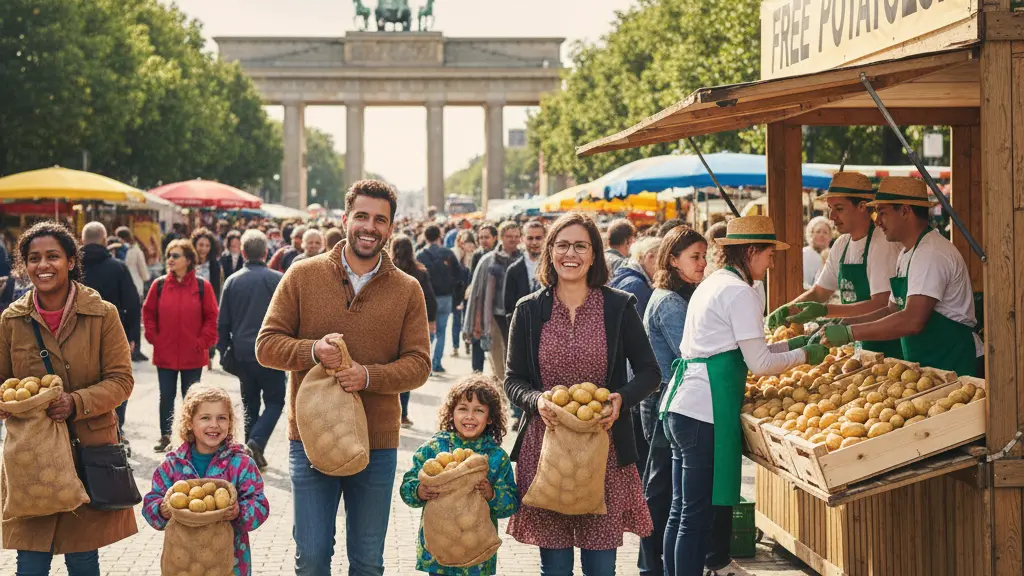
Overview of Berlin’s potato giveaway
In early 2026 an initiative in Berlin announced the free distribution of up to 4,000 tonnes (about 4 million kilograms) of conventional potatoes. The campaign, organised by an agricultural company together with media and a search-planting partner, aimed to rescue a massive potato surplus that a trader refused to take despite being offered payment. Without the giveaway these tubers would have been sent to a biogas plant and destroyed. The move highlights themes of food rescue, potato surplus, and how market oversupply can collide with social needs and regional farming interests.
Who organised the distribution?
The distribution was carried out by a coalition including a large agricultural supplier, a local newspaper and an online partner focused on tree-planting and environmental causes. The potatoes were conventional produce that had been rejected by a buyer because of a market glut. Organisers framed the action as food rescue, saving edible potatoes from being used for biogas or otherwise wasted.
How the distribution worked in practice
Several Berlin districts and social organisations helped hand out the free potatoes. Local governments and community partners set up collection points and distributed the tubers to families, schools, daycare centres (Kitas) and food banks. For example, the Neukölln district distributed two tonnes at the town hall on 22 January 2026, giving each person about 4–5 kilograms free. The operation required logistics for transport, storage and orderly hand-out to avoid waste and crowding.
Who benefited from the giveaway?
- Parents and families seeking affordable food
- Kindergartens and schools that received supplies for meals
- Charitable organisations and food banks (Tafeln)
- Community centres and neighbourhood initiatives
Reactions: Praise and sharp criticism
The giveaway drew both applause and sharp criticism. Social organisations praised the rescue of edible food and argued that ‘potatoes belong on the plate — not in the biogas plant.’ At the same time, regional organic farmers and farmer associations called the action a problematic market intervention. The criticism focuses on how a large, free distribution can depress prices and compete unfairly with small, local producers who depend on sales to survive.
Farmers’ concerns
Organic farmer Johann Gerdes described the campaign as a ‘marketing gag’ that ‘kicks regional producers in the shins.’ He noted that the 4,000 tonnes equals the annual output of all organic farms around Berlin and that the giveaway — with an estimated market value of about two million euros — further depresses already low prices. Gerdes and others suggested alternatives such as feeding the potatoes to livestock or using them for biogas rather than distributing them free in ways that undercut the local market.
Social organisations and public support
At the same time, social welfare groups in Brandenburg and Berlin welcomed the distribution. They emphasised that edible food should go to people in need, to schools and to food banks instead of being destroyed. For supporters, the giveaway was an example of practical food rescue, reducing waste while helping vulnerable households through direct distribution.
Wider context: record harvests and market pressure
The giveaway reflects a broader structural issue: a record potato harvest in Brandenburg in 2025 (403,100 tonnes) created a ‘potato flood’ that crashed market prices and left traders and farmers scrambling. Large agricultural holdings can absorb shocks by redirecting produce, but smaller farms often cannot, leading to protests and tensions during events like the Green Week. The situation exposes conflicts between food waste prevention, market fairness and the survival of regional producers.
Possible alternatives and policy considerations
- Use surplus potatoes as animal feed where appropriate, supporting local livestock systems.
- Redirect excess to biogas plants with clear compensation mechanisms for growers.
- Strengthen food-processing and storage infrastructure to add value and extend shelf life.
- Coordinate better market planning and crop forecasting to avoid large oversupply swings.
- Create compensation or purchase schemes that protect small farmers from price collapses.
- Encourage local food networks and short supply chains to prioritise regional producers.
Conclusion
The Berlin potato giveaway saved millions of kilograms of food from immediate destruction and provided short-term relief for communities and institutions. Yet it also highlighted painful trade-offs: food rescue and social solidarity versus the economic realities facing regional and organic farmers. The episode underlines the need for long-term solutions — from better market coordination and storage to fair compensation — so that rescuing food does not unintentionally harm those who grow it. In the meantime, the public love of potatoes continues to shape the debate over food waste, agriculture and fair markets.
