
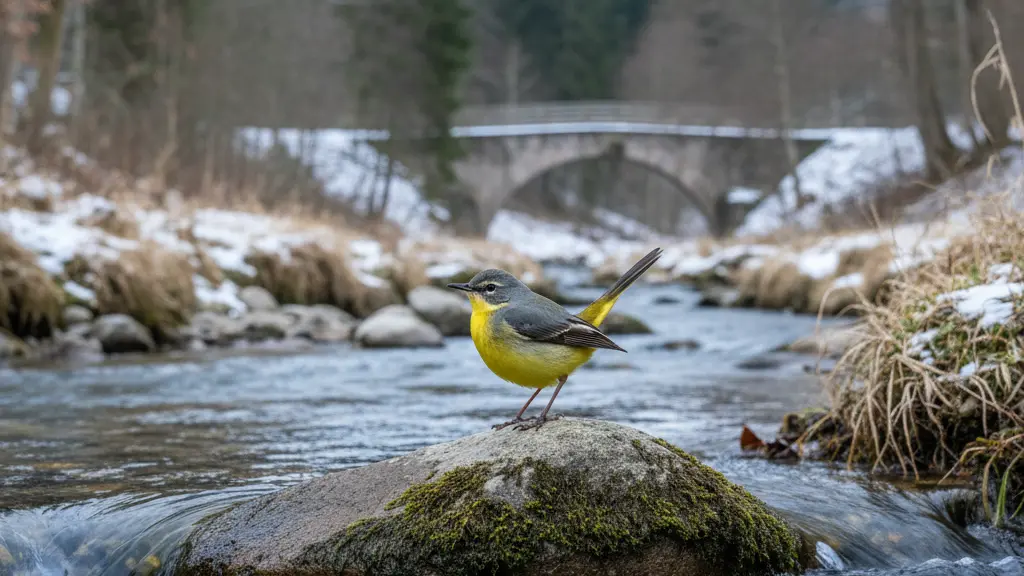
1. Winter birdwatching and the Mountain Wagtail (Gebirgsstelze)
Winter birdwatching is a simple, rewarding way to connect with nature close to home. During the annual winter bird count, many observers record familiar garden species such as house sparrows, great tits, blue tits and blackbirds. But if you move your walk from the backyard or balcony to a nearby stream or weir, you increase your chances of spotting a more specialised winter visitor: the Mountain Wagtail (Gebirgsstelze).
Why this wagtail is special
The Mountain Wagtail is not a typical garden bird. It prefers clear, fast-flowing water with stony banks and is therefore recorded only rarely in standard garden counts. That rarity makes each winter sighting memorable: for the individual observer who sees it, the bird stands out among otherwise common winter species.
2. Where to look: best habitats and spots
To find a Mountain Wagtail, head to flowing water rather than staying at the feeder. Look along small rivers, streams, canalised city brooks, mill races, weirs and spillways. These places provide the stony or concrete edges the species favours, and even in winter the birds will use urban water channels if conditions are suitable.
Practical places to search
- Small rivers and fast-flowing streams with stony banks
- Weirs, spillways and dam edges where water is turbulent
- Mill channels, concrete-lined city brooks and Mühlgräben
- Parks with streams that stay ice-free in mild winters
3. Identification: what to look for
The Mountain Wagtail is recognisable in winter by a few clear features. Key field marks include a grey-green back, a striking lemon-yellow underbelly toward the rump and vent, and a long tail that is almost constantly wagged up and down. These features help separate it from other wagtails if you watch carefully at the water’s edge.
How to tell it apart from similar wagtails
Behaviour is often the best clue: unlike more generalist wagtails that run across open fields or even parking lots, the Mountain Wagtail stays tightly bound to flowing water. If the bird is always on stones or concrete by the stream and shows the lemon-yellow underparts and persistent tail-wagging, it is very likely the Mountain Wagtail.
4. Behaviour and seasonal patterns
In winter the Mountain Wagtail remains close to water, feeding on aquatic insects and other small prey along the current and the edges. In milder winters it can be seen more often in settled areas where streams are channelled or kept ice-free. Its constant tail-wagging and quick, darting movements over rocks or concrete steps are characteristic behaviours to watch for.
5. How to take part in the winter bird count
The winter bird count usually runs on set weekend dates in January. For example, one recent count asked observers to record birds during a one-hour period from 9–11 January 2026. You can use that one hour either at your feeding station, garden or balcony or by walking a stretch of water to look specifically for species like the Mountain Wagtail.
Simple checklist for your one-hour count
- Choose one location (feeder/garden or a stretch of stream) and a clear 60-minute period.
- Record every species you see and the highest number of each species seen at the same time.
- Note habitat details: was the bird on water, on stones, or in vegetation?
- Submit your counts to the organisers of the winter bird count following their instructions (online or by app) after your hour.
6. Feeding and hygiene: tips for safe winter feeding
Feeding birds in winter can bring many species together and makes observation easy, but there are important hygiene and safety rules to follow. Choose feeding methods and foods that keep birds healthy and reduce disease risk and avoid items that can harm them.
Practical feeding recommendations
- Use feed silos or dispensers that protect seeds from moisture and prevent birds from walking through the food.
- Offer sunflower seeds and mixed seed blends — sunflower seeds are a universal favourite and keep many species at the feeder.
- Provide fat-based foods (fat balls or fat blocks mixed with seeds) for extra energy in cold weather, but never use plastic nets.
- For ground-feeding species, offer raisins, apple pieces or oats in a clean, dry tray close to the ground.
- Clean classic birdhouses daily with hot water and only refill with small amounts to prevent contamination.
- Keep feeders at least two metres away from glass to reduce collision risk and place them where cats cannot easily ambush birds.
- Never feed bread: it is too salty, swells in the bird’s stomach and spoils quickly.
7. Habitat improvements: help birds year-round
Feeding helps in the short term, but long-term support comes from improving habitat. A garden with native shrubs, hedges, wildflower patches and left leaf litter will provide year-round food, shelter and nesting sites. Berry-bearing shrubs, seed-producing perennials and structural diversity attract more species than feeding alone and create better conditions for observation over the whole year.
8. Rarity, data and why every record matters
The Mountain Wagtail is a rare entry in many large winter counts. For instance, in a recent summary it appeared low on the list with only 16 reported individuals and recorded in about 0.11% of gardens. That low frequency shows it is not a regular garden visitor but a species that requires targeted searches at water. Each report from an observer helps build long-term data on distribution and trends and can reveal changes in winter behaviour or local abundance.
9. Quick field checklist and final observation tips
Before you go
- Plan a one-hour slot and choose whether you will watch a feeder or walk a water stretch.
- Bring binoculars and something to record sightings (notebook or phone).
- Dress for the weather and keep a low profile to avoid disturbing birds.
When you are watching
- Scan stones and concrete edges near flowing water for a slim bird with a long, constantly wagging tail.
- Look for the grey-green back and lemon-yellow underparts near the rump and tail.
- Record behaviour: is it staying right at the water edge or moving away into open ground?
- If possible, take a photo to help confirm rare sightings and to document exactly where you saw the bird.
10. Conclusion: combine feeder watches with water walks
For the best winter birdwatching experience, combine a one-hour feeder watch at home with a short walk to nearby flowing water. You will count the familiar garden species and also give yourself a good chance to find a Mountain Wagtail, a striking and unusual winter visitor. Whether you see many common birds or one rare wagtail darting over the stones, your observations contribute valuable information and make winter birdwatching a memorable activity.
