
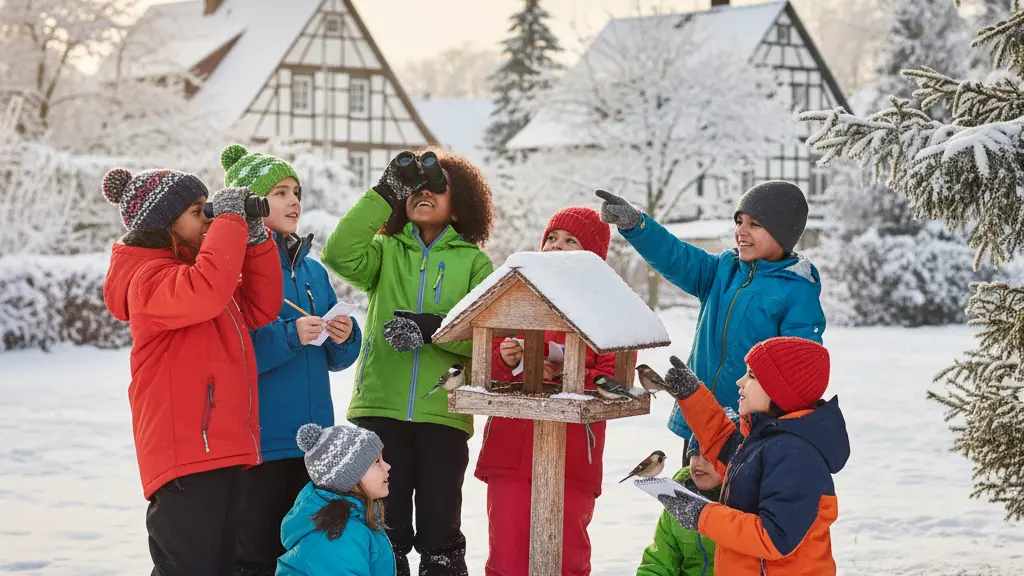
Overview of the Winter Birds Hour 2026
The Winter Birds Hour 2026 is a nationwide citizen science event coordinated in Germany from 9 to 11 January 2026. For one hour during that weekend, people are invited to count the birds they see at feeders, in gardens, on balconies or in parks and to report their observations online or via the dedicated bird app. The action is run nationally with strong regional support, and it is designed to be easy for everyone to join.
Key facts
- Dates: 9–11 January 2026; choose one hour during the period to count.
- Focus: human-near habitats such as gardens, balconies and parks.
- Counting rule: note the maximum number of individuals of each species present at the same time to avoid double counts.
- Reporting: observations are submitted digitally through the official online form or the free app.
- Participation: in previous years many tens of thousands of people took part, making this one of the largest citizen science projects in the country.
How to take part: step-by-step
Taking part is simple and suitable for families, schools, and individuals. You don’t need to be an expert—basic identification skills are enough, and many helpful materials are available to make bird recognition easier.
Practical steps
- Pick a one-hour period between 9 and 11 January 2026 when you can watch without interruption.
- Choose a fixed location: a garden, balcony, window view or a nearby park are ideal.
- During your hour, count the maximum number of each species present at the same time.
- Use binoculars or identification aids if you have them, and note tricky groups like finches carefully.
- After counting, submit your results via the official online form or the free bird app.
- Do not use telephone or postal reporting—submissions are digital only for 2026.
Counting rules to remember
To keep data consistent, count only once per individual group: record the maximum number seen at any one time for each species. This prevents double-counting as birds come and go. Focus the count on species in human-near habitats rather than trying to survey remote or wild areas.
Which species to look for
The event highlights a set of common winter birds that are regularly found in gardens and parks. Observers should pay attention to familiar species but also watch for occasional winter visitors that can appear in larger numbers during cold spells.
Common winter birds to watch
- Tits (for example great tit and blue tit)
- Finches and small seed-eaters (chaffinches, siskins and related species)
- Robins
- Sparrows
- Occasional winter guests such as siskins and bramblings that move south in harsh winters
Materials and help for identification
The national campaign provides accessible materials to help with species identification, including print and digital aids that cover the most frequent winter birds. These resources are particularly useful for newcomers, families and school groups taking part.
Local events, education and children’s activities
Regional partners organize guided counts, family events and school activities alongside the national campaign. These local events help build identification skills and make participation a social experience for all ages.
Examples of local involvement
- Many towns and cities host guided counts and family-friendly meetings on one of the campaign days.
- Nature education stations run special projects for children; for example, youth groups learn to use binoculars and identification aids and then submit their results online.
- Regional nature conservation groups offer excursions, information about feeding and care, and support for beginners.
School participation
Schools and youth groups are encouraged to take part, with a dedicated school week following the main weekend. These school activities introduce children to bird identification, counting methods and the idea that small actions contribute to long-term scientific data.
Why the Winter Birds Hour matters
Beyond being a fun and educational activity, the Winter Birds Hour collects long-term data that help experts track trends in bird populations in human-dominated habitats. Because the method is consistent year after year, the results support reliable analysis of how species are doing over time.
Weather and scientific value
Weather strongly affects bird behavior in winter. Frost, snow and frozen ground can drive more birds to feeders and make them easier to observe, while milder conditions can disperse birds and reduce detections. By repeating the survey annually, researchers can separate short-term weather effects from longer-term population changes.
Scale and impact
Each year tens of thousands of participants contribute observations, making the project one of the largest scientific citizen science efforts in the country. Every observation is valuable: even common species counts feed into long-term monitoring and conservation planning.
Practical tips for a successful counting hour
Preparation helps make your counting hour accurate and enjoyable. Follow a few simple tips to get the best results whether you are counting alone, with family, or in a group.
Before the count
- Choose a comfortable viewing spot with a good view of feeders, bushes or trees.
- Prepare a notebook or use the app to record species and numbers.
- Dress warmly and bring hot drinks if you will be outside.
- If children are involved, explain the simple counting rule (maximum number seen at once) and keep sessions short and fun.
During the count
- Stay quiet and minimize movement to avoid scaring the birds.
- Count the highest number of each species you see at any one time rather than tallying every individual that appears over the hour.
- Use binoculars and identification aids for tricky groups like finches.
- Note unusual or rare species—these can be important even if they appear in small numbers.
After the count
Submit your observations digitally through the official online reporting channel or the recommended app. If you participated with a local group or at a guided event, share your notes with the event leader so local organizers can compile regional results.
