
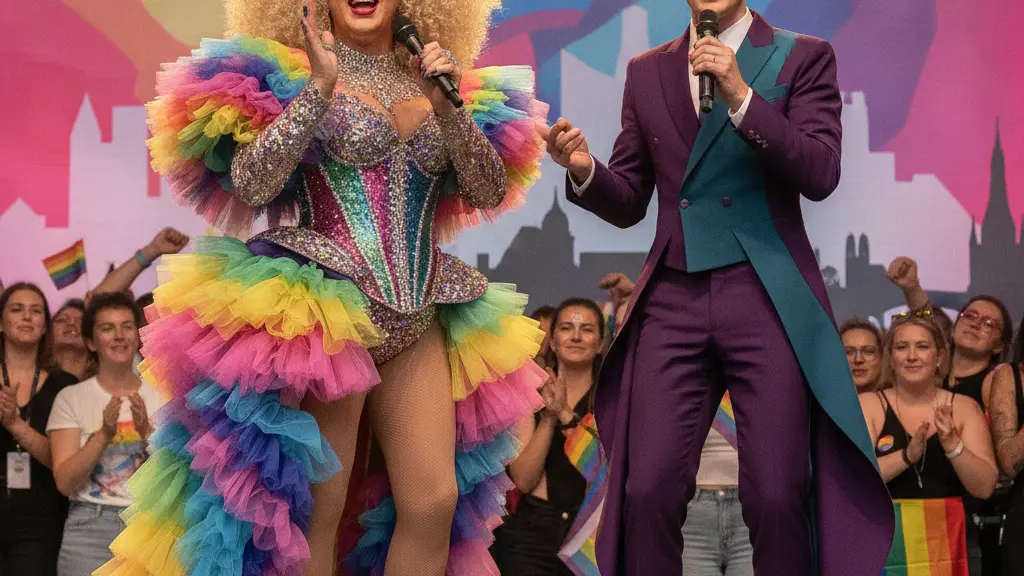
1. Frankfurt Pride 2026: Drag Queen and Trans Artist Take the Stage
Frankfurt Pride 2026 is a four-day Christopher Street Day (CSD) festival that stretches from Thursday to Sunday across the city center and the Main riverfront. With the clear political motto “Democracy needs no alternative!”, the event mixes a lively street festival atmosphere with an unmistakable political demonstration and a packed stage program.
At the heart of this year’s program are two artists who represent different facets of the queer community: Drag Queen Kelly Heelton and trans artist Luca Pfeiffer. Their appearances — one at the street festival and one on the main stage — highlight how drag performance and transgender visibility operate simultaneously as cultural celebration and political statement.
2. The Artists: Stories of Visibility and Resilience
Kelly Heelton — drag, performance and response to violence
Kelly Heelton performs at the CSD street festival and uses drag art as more than entertainment. Her presence on public stages is explicitly political: in previous years she experienced a violent attack while in costume on her way to a hotel in Frankfurt. Returning to perform in the same city, Heelton frames her public visibility as an answer to that violence — a deliberate reclaiming of public space so queer life is seen, not driven out.
Luca Pfeiffer — a trans artist on the main stage
Luca Pfeiffer will appear for the first time on the CSD main stage after applying with a short biography and a YouTube link. He represents a new generation of trans artists who view stage presence as both a career step and a contribution to political and cultural normalization. For Pfeiffer, singing on the main stage is visibility in action: it signals representation and helps make transgender lives part of public cultural life.
3. Program, Demonstration and City Impact
The festival program runs wide and deep: alongside drag shows and main-stage performances there are live music acts, poetry slams, religious services, panel discussions and format-driven competitions that push performance, comedy and political statements to intersect. The CSD program intentionally places political demands next to nightlife and community celebration, creating spaces for both protest and party.
| Time | Event | Location / Notes |
|---|---|---|
| 09:00 | Assembly | Willy-Brandt-Platz and Römerberg |
| 11:00 | Rally | Römer (approx. until 11:30) |
| 12:00 | Demonstration march | Route via Braubachstraße, Roßmarkt, Goetheplatz, Eschenheimer Turm, Konrad-Adenauer-Straße; crosses the Alte Brücke |
| 16:30 | Dissolution | Schaumainkai on the southern Mainufer |
| Schedule is a full-day public demonstration with associated festival programming. | ||
- Expect traffic and public transport adjustments during the march; some bus lines run reduced services.
- Plan extra time to reach stages and festival sites; program items run in parallel across the city.
- Festival areas include official program stages and many unofficial nightlife events that extend visibility into clubs and queer venues.
4. Visibility, Politics and Cultural Context
Visibility is central to the CSD’s purpose: for artists like Kelly Heelton and Luca Pfeiffer, being seen on stage is both outcome and engine of personal and collective emancipation. Their performances connect to the festival’s political message: that democracy must include and protect sexual and gender diversity. The presence of drag queens and trans artists on main stages and in parade columns is intended as a symbolic assertion that representation matters in public life.
Safety and inclusion
Safety is a recurring concern. The memory of past attacks makes visible performances a courageous act for some. Organizers and community guides emphasize safer spaces, information on event accessibility and solidarity measures. Ensuring that public spaces are safe for queer people is part of why the demonstration and stage programming continue to matter.
At the same time, the festival sits in a tension between protest and celebration. A strong festival and club scene around Pride can feel highly commercial and party-oriented, while organizers and artists insist the demonstration component remains necessary. This balance — between activism and event — shapes how performances are read: as entertainment, as community-building, and as a form of political speech.
5. What to Expect and How to Take Part
If you plan to attend Frankfurt Pride, expect a mix of political demonstration and festival celebration: arrive early for main-stage acts, check the day-by-day program for drag shows and special competitions, and be aware of route and time details for the demonstration. Supporting performers, respecting safety guidelines and joining both the march and the cultural program are all ways to participate.
- Arrive early for main-stage performances and the rally.
- Attend both demonstration and festival events to support visibility and political demands.
- Respect local guidance on safer spaces and accessibility.
- Celebrate queer culture in public and in nightlife moments, knowing both are part of visibility work.
The appearances of Kelly Heelton and Luca Pfeiffer at Frankfurt Pride 2026 are more than showpieces: they are acts of resilience and representation that sit within a decades-long struggle for public recognition. Their performances remind visitors that Pride is simultaneously a parade, a protest and a platform for queer voices.
