
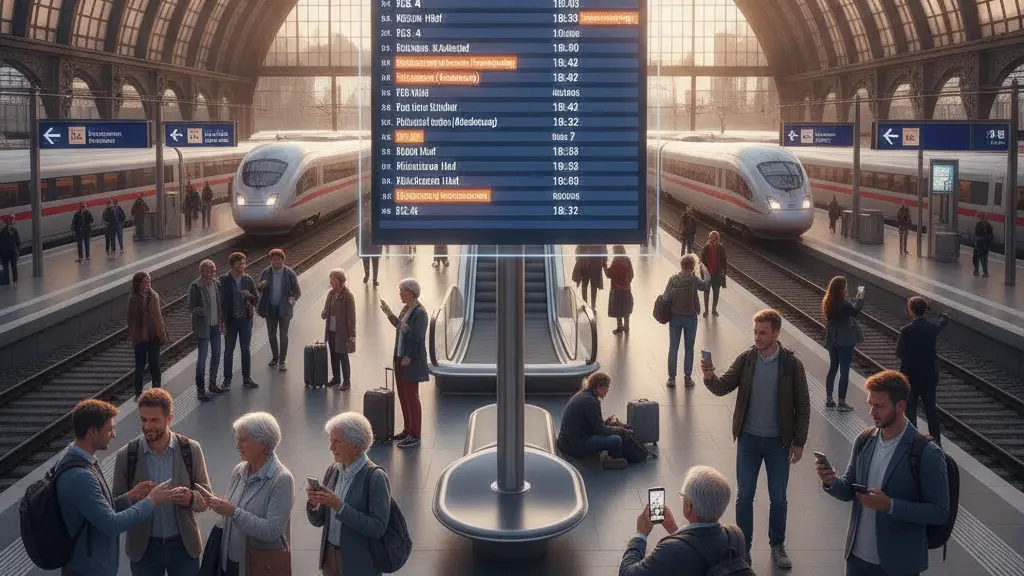
1. Overview: AI-powered train updates for faster delay information
For years the national rail operator has struggled with overcrowded trains, aging infrastructure and persistent delays. To help passengers cope with that reality, the company is rolling out a focused customer communication program that uses artificial intelligence to deliver faster, more precise and more consistent information about delays, cancellations, platform changes and connections.
Called a Sofortprogramm for better customer communication, this initiative does not promise instant punctuality. Instead, it aims to raise the quality of delay predictions and to synchronize those predictions across apps, onboard monitors, announcement systems and station displays so travelers get the same reliable message everywhere.
2. How the AI system improves delay information
| Input data | What AI produces |
|---|---|
| Train telemetry and signals | Current speed-based arrival estimates |
| Planned engineering works | Expected delays and reroute suggestions |
| Historical patterns | Probabilistic confidence levels for arrival times |
| Total effect | Faster, more precise and consistent passenger information |
2.1 Data sources powering real-time predictions
The AI combines many inputs to produce delay estimates. Important data sources include signalling and interlocking systems, live train telemetry, maintenance and construction schedules, reported disruptions, and historical pattern data. By fusing these inputs the system can detect emerging problems faster and estimate their likely impact on arrival and connection times.
- Signalling and control center data
- Live train location and speed telemetry
- Planned engineering works and temporary speed restrictions
- Operational incidents and service disruptions
- Historical delay patterns and seasonality
2.2 Real-time predictions and consistent messaging
One key goal is to reduce sudden swings in arrival-time estimates and to serve consistent messages across channels. The AI continuously updates probabilistic delay forecasts and pushes synchronized information to mobile apps, station displays and onboard systems so passengers can rely on a single source of truth while the situation evolves.
- Gather live and historical data streams
- Run probabilistic models to estimate arrival times and connection risks
- Prioritise clarity and consistency across customer channels
- Update passengers in real time with concise, actionable information
3. New passenger tools: apps, AI bot and assistants
Alongside backend prediction improvements, new digital tools are planned to make the information useful in everyday travel. A redesigned app and an AI-driven chat assistant will allow travelers to ask plain-language questions about their journey and receive tailored, real-time answers.
3.1 What these tools can do
The assistant is designed to react to changing operational conditions and to give situational advice: whether a connection is still likely, whether an alternative route is faster, or whether a sprint across a large station is worth the effort. The goal is clarity and actionable guidance rather than generic status updates.
- Personalized connection risk assessments
- Alternative route suggestions in real time
- Plain-language alerts and recommendations
- Consistent messages across app, onboard displays and announcements
These assistants are meant to help passengers make better decisions when delays happen: change plans proactively, choose another connection, or notify contacts. They are not a substitute for long-term improvements to infrastructure, but they increase transparency and planability for travelers today.
4. AI beyond delay information: safety and operations
The communication program is part of a broader push to use artificial intelligence across operations. That includes AI-supported video surveillance and wearable cameras for staff to improve security and to respond more quickly to incidents. Investments in personnel presence at stations are paired with technological measures to increase passenger safety and order.
Framing AI as part of a wider modernization effort helps the operator position these tools not only as customer-facing features but as elements of a comprehensive operational upgrade covering safety, crowd management and passenger information.
5. Limitations, criticism and practical benefits
Critics warn that better information cannot fix the root causes of poor punctuality. When an important connection is missed, knowing five minutes earlier that it will be missed does not change the outcome. Some commentators call this a symptom therapy: it helps manage dissatisfaction but does not immediately improve the number of on-time trains.
5.1 Practical tips for passengers
- Enable push notifications in your rail app for real-time alerts.
- Check connection risk messages before deciding to wait for a delayed train.
- Use alternative route suggestions when the assistant flags a high chance of missed connections.
- Keep arrival estimates in mind as probabilistic rather than absolute guarantees.
Supporters counter that reliable, transparent information is itself a key quality metric for public transport. If passengers receive consistent, real-time updates and confidence levels for predicted arrivals, they can make informed choices: take an alternative route, inform colleagues or reschedule appointments. This transparency can restore some trust and reduce wasted time and uncertainty.
6. Takeaway: AI as a tool for transparency, not an instant fix
Artificial intelligence will not instantly make every train punctual. What it can do is provide faster, more precise and more consistent delay information across channels, and offer situationally useful advice to passengers. Over time, as infrastructure investments continue, these AI systems can become a foundation for a more modern and predictable rail experience, but for now their main value is clearer communication and better planability.
In short, AI brings improved delay predictions, synchronized messaging and helpful passenger tools that reduce uncertainty. Travelers should welcome clearer information while keeping realistic expectations about how quickly overall punctuality will improve.
