
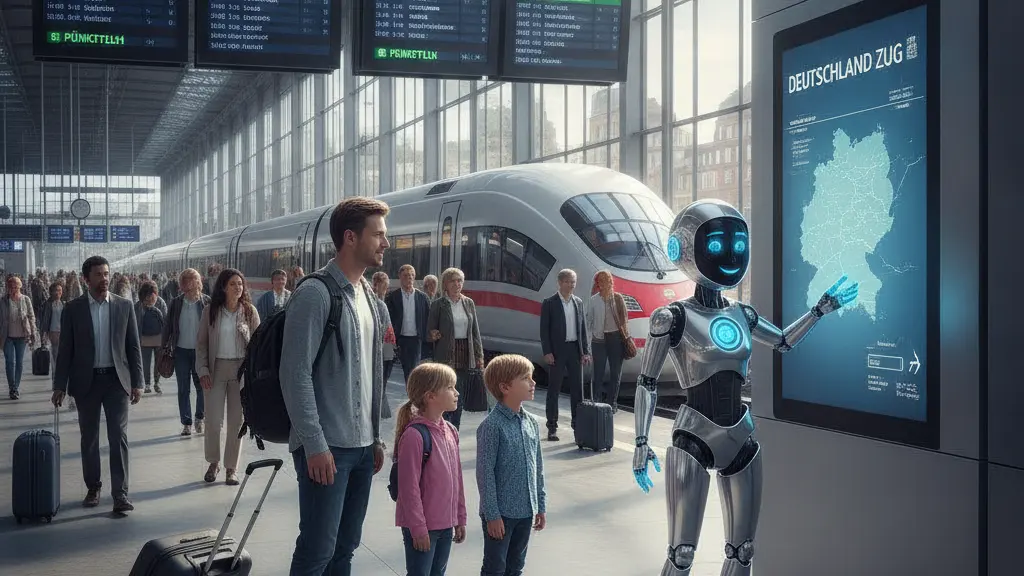
1. Quick overview: why AI for train delays matters
Train delays affect millions of passengers and strain operational resources. Artificial intelligence (AI) and machine learning can improve delay prediction, streamline customer communication, and support maintenance decisions. The available context indicates that Deutsche Bahn has initiatives to use AI for better real-time information and customer-facing communications, while the wider rail ecosystem is focused on data integration and AI roadmaps. At the same time, issues in core digital systems such as GSM-R underline that infrastructure reliability remains a major constraint for any AI solution.
2. How AI can help reduce and manage delays
AI can contribute across several areas of rail operations. By combining predictive analytics with operational data, AI systems offer more accurate delay forecasts, support proactive decisions, and improve the passenger experience through timely, tailored notifications.
2.1 Predictive delay forecasting
Machine learning models can analyze historical timetables, live train positions, weather, crew availability, and infrastructure events to estimate likely delays. These models help produce probabilistic arrival forecasts rather than single-point estimates, which improves planning for connections and resource allocation.
2.2 Real-time information and customer communication
AI-powered systems can automatically generate clear, contextual messages for passengers and staff. Natural language generation and segmentation enable personalized alerts about transfer options, platform changes, or expected delays, improving the passenger experience and reducing confusion during disruptions.
2.3 Infrastructure monitoring and predictive maintenance
Predictive maintenance uses AI to detect anomalies in equipment and signalling systems before they cause service interruptions. Integrating sensor data, maintenance logs, and operational patterns supports targeted interventions that reduce unplanned downtime and improve operational reliability.
2.4 Data integration and multi-source fusion
Combining disparate data sources—timetable systems, rolling stock telemetry, infrastructure status, and external factors—enables richer models for delay prediction and decision support. A robust data integration strategy is necessary for AI to deliver accurate, actionable insights.
3. Key challenges and current limitations
While AI has strong potential, practical deployment faces several challenges. The context highlights that public information on concrete AI usage is currently limited, and that operational issues in core systems hamper progress. Recognizing these limitations is essential for realistic expectations.
3.1 Data quality and availability
- Incomplete or inconsistent data feeds reduce model accuracy.
- Legacy systems can block real-time access to critical operational metrics.
- Standardization across multiple suppliers and regions is often lacking.
3.2 Digital infrastructure reliability
Disruptions in core communication systems, such as GSM-R in the rail context, reveal how dependent AI-driven services are on stable infrastructure. Without resilient communications and signalling, AI outputs may be delayed or unavailable when they are most needed.
3.3 Integration, governance, and transparency
- Integrating AI into operational workflows requires clear governance and responsibilities.
- Passengers and staff need transparent explanations when AI affects decisions or communications.
- Privacy and data protection must be managed carefully when personalizing notifications.
4. Practical roadmap for deploying AI solutions
Successful AI adoption combines technical readiness, organizational alignment, and a staged rollout. Based on the context, prioritizing reliability and data integration will create a solid foundation for meaningful AI capabilities.
- Assess and stabilize core digital infrastructure: prioritize reliability of communication and signalling systems so AI inputs remain available during incidents.
- Build a unified data platform: integrate timetable, rolling stock telemetry, maintenance logs, and external factors to feed predictive models.
- Start with pilot projects: deploy AI for specific, measurable tasks (e.g., short-term delay prediction on busy corridors) and evaluate performance.
- Adopt human-in-the-loop workflows: keep dispatchers and customer service teams in control while AI provides decision support and recommendations.
- Measure impact and scale: use passenger experience metrics, on-time performance, and operational cost indicators to guide broader rollout.
5. What passengers can realistically expect
AI-driven improvements are likely to be incremental and focused on communication and prediction before full operational automation. Passengers should see clearer and more personalized information, but core reliability gains depend on parallel upgrades to infrastructure.
- Better, more personalized delay notifications and alternative travel options.
- More accurate estimated arrival times and probabilistic information about likely disruptions.
- Faster, more consistent customer communication during incidents.
6. Conclusion and the need for more primary sources
AI holds promise to improve delay prediction, customer communication, and maintenance planning for railway operators. The provided context makes clear that some initiatives exist, but publicly available, detailed evidence about concrete AI deployments and their results is limited. To create a fully sourced, journalistic account with validated claims and direct evidence, further primary research and up-to-date references are necessary. In the meantime, focusing on data integration, infrastructure resilience, and transparent pilots will make AI solutions more reliable and beneficial for passengers.
