
Why the End of the Tank Discount Shifts the Debate to a Fuel Price Cap
The recent end of the two‑month “Tankrabatt” (tank discount) did not end the public debate about fuel prices — it changed the focus. With the tax reduction no longer in effect, discussions in political Berlin and among the federal states have shifted from temporary tax relief toward direct state intervention in fuel price formation, including the idea of a legally defined price cap for gasoline and diesel.
That shift is driven by a mix of short‑term public reaction — long queues at filling stations just before the tax cut expired — and longer‑term concerns about market behaviour, supply security and the interaction of taxes, regulation and company margins in determining retail fuel prices.
What the Tank Discount Was and What Changed
The Tankrabatt was a temporary cut in the energy tax on motor fuels, roughly 17 cents per litre for gasoline and a similar reduction for diesel, introduced to cushion the impact of geopolitical tensions in the Middle East. It lasted two months and ended at midnight on the announced date, after which the former, higher tax rates returned for deliveries from refineries and tank depots.
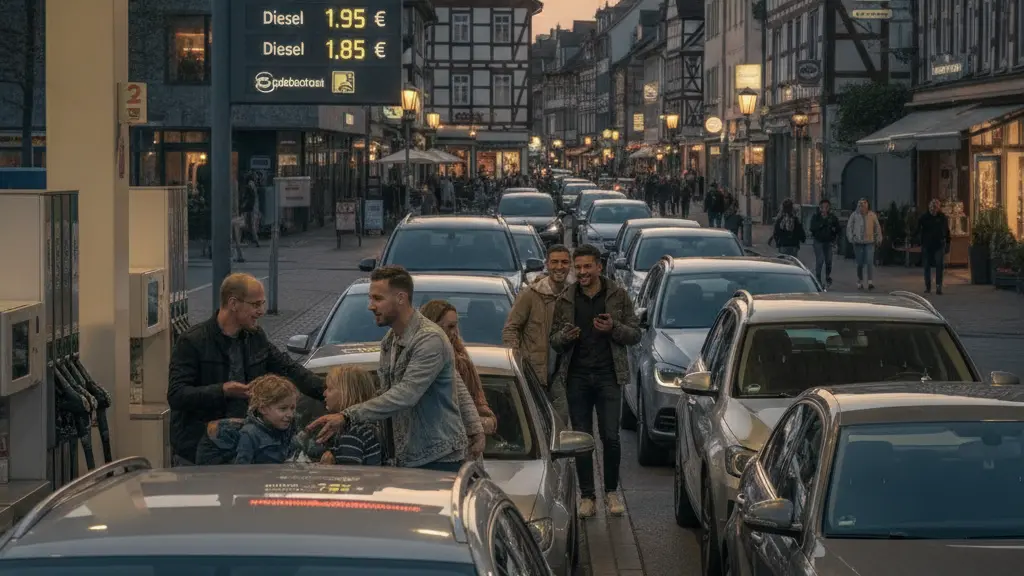
In the final hours before the measure ended, many motorists filled up, creating long lines at some stations. This consumer behaviour highlighted how visible and immediate the effect of fiscal measures on pump prices can be — and how sensitive drivers are to changes in fuel tax and retail pricing.
Political Reactions and New Initiatives
Following the expiry of the discount, several states moved quickly to propose follow‑up measures. The Saarland put forward a resolution explicitly asking that state measures to limit fuel prices be considered and implemented. That initiative has since received support from the Bundesrat’s Economic Committee, which cleared the way for a possible state‑led price cap for gasoline and diesel.
Bundesrat and the July Decision Point
The Economic Committee’s backing is not a law, but it is a strong political signal. The Bundesrat could adopt the recommendation in its plenary session on 10 July. If the Bundesrat formally approves the initiative, political pressure on the federal government to draft a legal framework for a price cap would rise significantly.
State leaders such as Manuela Schwesig have called for a price cap modelled on Luxembourg’s system and link it to broader demands for relief for commuters and businesses as well as targeted tax relief for middle and lower incomes.
Luxembourg as a Reference Model
Supporters of a price cap point to Luxembourg, where the economics ministry sets maximum retail prices for fuels and updates them regularly — typically about twice a month or more frequently during market turbulence. Backers say this model keeps consumer prices in check and limits excessive margins for oil companies.
In Luxembourg’s approach the state defines a ceiling above which a product cannot be sold, and adjusts the ceiling to reflect market conditions. Proponents in Germany argue this could protect consumers from sharp price spikes while critics warn that transplanting the model to a larger, more integrated market like Germany raises practical and legal questions.
Arguments For and Against a Fuel Price Cap
The debate brings together social, economic and climate policy arguments. Supporters frame a price cap as consumer protection: it would limit perceived “overcharging” and provide predictable, more consumer‑friendly prices for gasoline and diesel, especially for commuters and small businesses.
- Pros: Protects consumers from sudden price spikes; limits excess margins; provides predictable pump prices.
- Cons: May discourage investment and threaten supply security; could distort market signals; raises questions about compatibility with EU market rules and competition law.
Opponents — including some industry voices and economists — warn of risks. A rigid price cap could reduce incentives for investment, harm supply security if prices fall below market costs, and conflict with wider budgetary policies that aim to reduce subsidies and make polluting transport more expensive.
Evidence and Mixed Assessments
Industry associations point to studies suggesting that retail price behaviour during the Iran crisis was not unusually aggressive compared with other European countries. One short analysis cited by trade groups argues that high price levels are largely driven by taxes, levies and climate regulation rather than pure corporate mark‑ups.
Meanwhile critics stress that tax cuts like the Tankrabatt can blunt incentives to save energy and undermine climate protection goals if they are absorbed into company margins rather than passed fully to consumers. This clash of interpretations is central to ongoing policy discussions.
Next Steps, Timeline and Political Choices
The immediate timeline focuses on the Bundesrat. If the plenary follows the Economic Committee’s recommendation on 10 July, the federal government will face pressure to craft a legal pricing mechanism. Policymakers will then need to decide three core questions: whether to introduce a price cap, how long it should run and how its formula would be constructed — and how it would interact with targeted tax relief or income‑based support measures.
At the same time, cross‑party task forces are evaluating the Tankrabatt’s effects and looking at alternatives such as targeted travel relief, public transport incentives, or income‑linked measures. Some political groups propose strengthening support for public transport — for example a temporary low‑fare ticket — to encourage a shift away from car use while avoiding further subsidisation of fossil fuels.
Practical Advice for Consumers and Closing Thoughts
For drivers, the immediate practical implication is that fuel taxes have returned to previous levels and pump prices may reflect that change. Beyond short‑term responses, the broader lesson is that fuel price policy sits at the intersection of consumer protection, fiscal policy and climate objectives. Any move toward a price cap will need to balance these sometimes competing goals.
Whether the Bundesrat’s “green light” turns into a nationwide price cap remains uncertain. What is clear is that Germany is moving closer to direct regulation of fuel prices, and that the coming weeks will be important for shaping how consumer relief, market functioning and climate policy are reconciled.
