
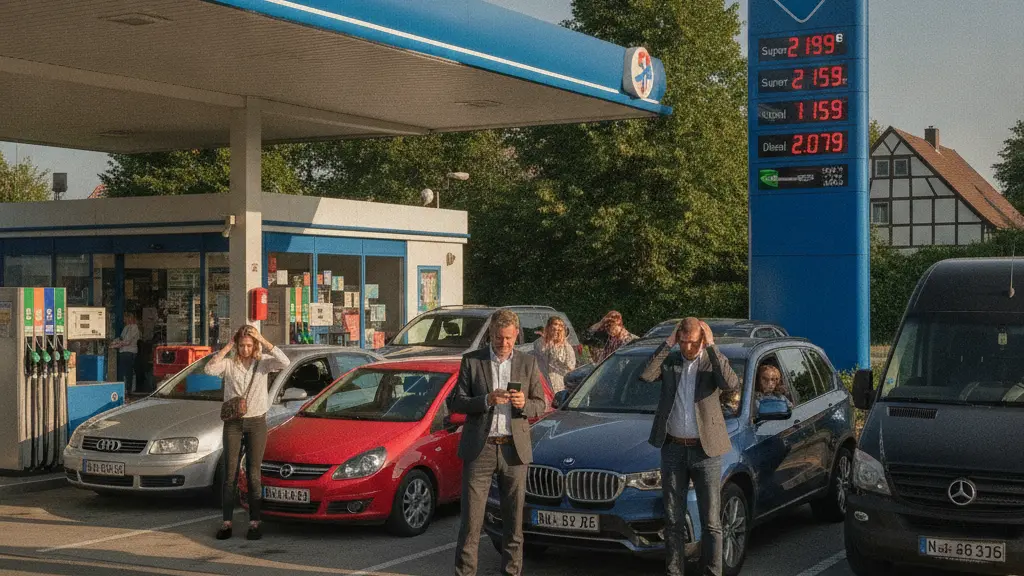
1. Quick overview: tax relief ends and fuel prices surge
At the end of a two-month, temporary energy tax cut, the tax relief on gasoline and diesel expired on the night of June 30 / early July 1. The relief had lowered fuel costs by about 16.7 cents per liter (often rounded to 17 cents) and was funded with roughly 1.6 billion euros from the federal budget. When the reduced tax rate ended, fuel prices in Germany rose sharply within hours — a movement that highlighted how taxes, market expectations and legal price rules interact.
2. Timeline and the immediate price surge
Price data show two distinct moves: an initial rise in the days before the formal end of the relief and a second concentrated jump around the first midday after the relief expired. In the final days of June, average prices already increased noticeably: one national price tracker recorded diesel rising by about 24 cents per liter and a type of gasoline (Super E10) by about 20.3 cents even while the relief was still formally in effect. For example, average prices on Monday, 29 June were reported around 1.861 euros for Super E10 and 1.784 euros for diesel.
| Fuel | Late June (approx.) | Early July (approx., midday) | Approx. change |
|---|---|---|---|
| Super E10 | 1.861 € | 2.15 € | +0.289 € |
| Diesel | 1.784 € | 2.11 € | +0.326 € |
| Notes: Figures are rounded averages reported by price monitors and media; local variations were larger. | |||
Why the spike was concentrated at midday
- Legal timing rule: a recent regulation allowed fuel retailers to raise prices only once per day at 12:00 noon while permitting price reductions at any time. This concentrated increases around that hour.
- Stock and tax timing: stations could still take fuel out of storage at the lower tax rate until midnight on June 30, creating a narrow window for cheaper supply.
- Expectation effects: anticipation of the tax return prompted retailers to raise prices in advance to avoid a single large jump.
On the first day without the reduced tax, many reports described a pronounced midday increase: average national rises around 18 to 22 cents per liter were common in summaries, with some local stations showing jumps of up to 30 cents. Depending on the measurement and the exact baseline, the observable change varied, but the pattern was consistent: prices concentrated their biggest move around the deadline.
3. Market dynamics: expectations, rules and consumer behavior
The observed price behavior was shaped by both the technical tax mechanics and market psychology. Fuel tax is applied when product is taken out of a depot or refinery, so purchases made before midnight on June 30 could still be sold under the lower tax. At the same time, the midday price-change rule encouraged drivers to fill up before noon and led to long queues at many stations shortly before 12:00.
Data on daily price patterns
Analysis of a large sample of fuel stations showed that the lowest prices of the day tended to occur shortly before 12:00. In May, pre-noon prices were about 3.7 cents lower for Super E10 and about 4.3 cents lower for diesel than the daily average, reinforcing the perception of a sharp jump immediately after the allowable price increase at midday.
4. How much of the relief reached drivers and who gained
Independent assessments reached slightly different conclusions about pass-through. One economic research group found that the tax cut was passed on to drivers almost fully for petrol (Super E5 and Super E10 at about 16–17 cents per liter) while diesel saw a smaller average reduction of around 12 cents. Competition authorities and other reviewers were more critical, concluding that the relief was only partly passed on and that a share — estimated at roughly 100 to 200 million euros of the total 1.6 billion euro cost — remained at wholesale and refinery levels.
Different expert readings of the same facts
Some analysts argued that a big, single-day price spike would be unlikely because many retailers had already increased prices in the days prior to the deadline. Others pointed to the concentrated midday increases and average jumps of about 19 to 22 cents (with local peaks near 30 cents) as evidence that drivers felt most of the tax reversal, amplified by market behavior and the legal price-timing rule.
5. Practical advice for drivers and final takeaways
When temporary tax reliefs are introduced or withdrawn, timing rules and market expectations can amplify price swings in the short term. Motorist organizations advised drivers to fill up before the relief ended and to compare prices rather than refuel at the first available station. Where possible, choosing the slightly cheaper fuel grade (for example, Super E10 instead of Super E5) can also lower cost.
- Fill up before a known tax change deadline if you want to avoid a potential immediate price spike.
- Compare prices across nearby stations — small differences per liter add up over a full tank.
- Consider using the fuel grade that is appropriate for your vehicle and often cheaper (e.g. Super E10 instead of Super E5 where suitable).
- Expect longer queues around known price-change times, especially shortly before noon if a once-daily increase rule applies.
- Be aware that broad policy measures can help many drivers but may also benefit higher-income households and some market players — the effects are rarely perfectly targeted.
In short, the end of the temporary energy tax cut illustrated how fiscal policy, legal price rules at fuel stations and market expectations interact. The roughly 16.7-cent-per-liter tax effect formed the core of the price rise, but pre-deadline pricing and localized market behavior magnified the impact for drivers. The episode has renewed debate about how to design targeted relief and how price-timing rules shape consumer experience at the pump.
