
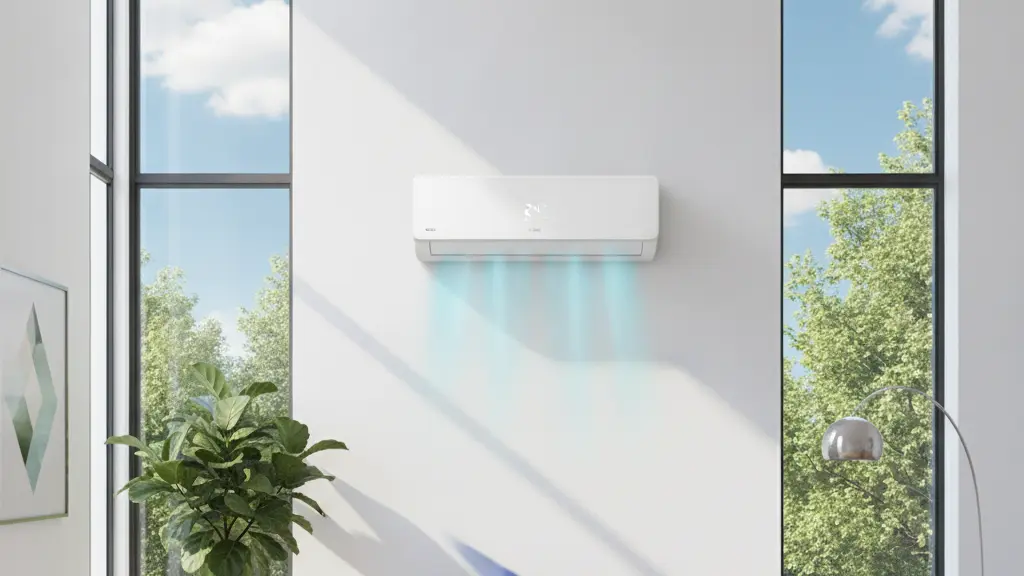
Quick Summary: What Really Cools Your Home
Short version: for durable, efficient cooling, permanently installed split air conditioners are usually the best choice. Mobile monoblock units are a cheap, short-term compromise. Fans, evaporative air coolers sometimes marketed as “air conditioners without a hose”, and simple air coolers provide only perceived cooling or work only in certain conditions.
How Different Cooling Systems Work
Air conditioning devices fall into a few clear categories: split (fixed) systems, mobile monoblocks, evaporative/”no-hose” coolers, and fans. The main technical difference is whether the system actively moves heat out of the room (compressor-based systems) or only moves or humidifies air. This difference determines real cooling performance, energy use, noise and suitability for long-term use.
Key efficiency terms and labels
Look for energy-efficiency ratings and seasonal efficiency numbers: SEER (cooling) and SCOP (heating) tell you real-world efficiency. Energy labels such as A+++ indicate the most efficient models. Higher SEER/SCOP means lower running costs over the device lifetime.
Split Air Conditioners: The Efficient Long-Term Choice
Split systems consist of an indoor unit and an outdoor unit; the system actively transports heat outside. Modern split units achieve high SEER/SCOP values (often around 4–5, with top models up to about 5.2 or higher) and can be very quiet and efficient. They typically live 10–15 years when professionally installed and maintained.
Advantages of split systems
- High cooling capacity even in strong heat
- Good energy efficiency and lower long-term electricity bills
- Many models are reversible and can heat in winter (air-to-air heat pump)
- Quieter indoor operation because noisy components sit outside
Drawbacks and practical notes
- Higher upfront costs (simple mono-split installations typically in the mid thousands including installation)
- Requires wall penetration and outdoor unit mounting—may need landlord approval in rentals
- Installation must be done by certified refrigeration and air-conditioning professionals for safety, tightness and warranty reasons
Mobile Monoblock Air Conditioners: Flexible but Costly to Run
Mobile monoblock units are single cabinets that sit in the room and exhaust heat through a hose—often routed through a tilted window. They are affordable and immediately usable but have important limits: the heat extraction happens close to the space and exhaust routing is imperfect, which reduces efficiency.
Typical performance and lifetime
Price can start around a few hundred currency units, with many models between 200 and 800. Expect higher electric consumption—roughly 30–50% more than a good split system for the same nominal cooling. Noise levels are typically 45–65 dB and useful service life is often only 3–5 years.
When a mobile unit makes sense
- Occasional use: a few very hot days per year
- Mietwohnungen or temporary situations where permanent installation is not allowed
- When low initial cost and immediate availability matter more than efficiency
“Air Conditioners without a Hose” and Evaporative Coolers
Many products advertised as “no-hose air conditioners” are actually evaporative coolers or water-based air coolers. They work by evaporating water into the air, which can make you feel cooler but does not actively remove heat from the room like a compressor-based system.
Limits and appropriate use
- Give a pleasant cooling sensation in dry, hot climates and small spaces
- Increase indoor humidity, which can be uncomfortable in humid conditions
- Cannot reliably lower room temperature from, for example, 30 °C to 24 °C — compressor systems are necessary for that
Fans: No Cooling, But Highly Efficient for Comfort
Fans do not cool air; they increase air movement so perspiration evaporates faster and your body loses heat more effectively. Because fans draw very little power, they are an energy‑efficient first step against heat and are recommended where possible before installing a cooling system.
When to rely on a fan
- Mild heat or when you need to improve comfort cheaply
- Use in combination with window shading, ventilation at cooler times of day, and heat-reducing measures
- Switch to air conditioning when night temperatures remain high and ventilation is not enough
Choosing by Room Type: Living Room, Bedroom, Small Rooms
Different rooms require different priorities: cooling capacity, noise, installation footprint and airflow direction are important criteria. Bedrooms demand especially quiet operation; small rooms need compact units and well-matched cooling capacity so the system isn’t oversized.
Practical criteria for each room
- Bedroom: prioritize very low noise (<25 dB in silent mode), night mode and gentle airflow that doesn't blow directly onto the bed.
- Living room: balance cooling power with design and low indoor noise—split systems are often best.
- Small rooms: compact split units or high-quality mobile units that match the room’s BTU/kW requirements; avoid oversized systems that short-cycle.
Tests, Efficiency and Price-Performance
Independent tests consistently show that running costs over years often exceed purchase costs, so energy efficiency pays off. Look beyond the sticker price: check SEER/SCOP, energy class (A+++ being the most efficient), noise levels, ease of use and useful extras like timers, Wi‑Fi control and dehumidification modes.
Simple comparison table
| Type | Typical upfront cost | Running cost | Noise (typ.) | Lifetime |
|---|---|---|---|---|
| Split (fixed) | High (mid-thousands incl. install) | Low (best SEER/SCOP) | Low inside (~20–30 dB) | 10–15 years |
| Mobile Monoblock | Low (200–800) | Higher (30–50% more than good split) | High (45–65 dB) | 3–5 years |
| Evaporative / No‑hose | Low | Very low | Low | Varies |
| Fan | Very low | Minimal | Minimal | Varies |
Cooling and Heating: Using an Air Conditioner as a Heat Pump
Many modern split systems are reversible and work as air-to-air heat pumps. With a good SCOP (for example around 4.0), the cost of delivered heat can be much lower than direct electric heating and can even be cheaper than gas or oil in some cases.
Cost example and benefits
With an electricity price of 30 ct/kWh and a SCOP of about 4.0, effective heating costs can be around 7.5 ct/kWh. Over a heating season this can produce substantial savings compared to oil or gas, particularly in well insulated homes. Using one device year-round increases its value by combining summer cooling and winter heating functions.
Decision Checklist and Installation Advice
To decide what fits your household, ask practical questions about frequency of use, room location, noise sensitivity, and whether you prefer low upfront cost or low running cost. For split and multi-split systems, involve certified refrigeration and air-conditioning professionals for correct sizing, refrigerant handling and safe installation.
Quick decision checklist
- How often will you cool? A few days a year → fan or mobile; frequent/long heat waves → split.
- Can you modify the building? No → mobile monoblock or portable solutions; yes → consider fixed split or multi-split.
- Which matters more: low purchase price or low running cost? Low purchase price → monoblock; low running cost and quiet operation → split.
- How noise-sensitive are you? Bedrooms need very quiet indoor units (look for silent/sleep modes).
- Have a certified installer size the system and check refrigerant and mounting needs before buying.
Final tip: energy efficiency, correct sizing and professional installation usually pay off over the device lifetime. If you want both comfort and reasonable running costs, a high-quality split system is the strongest long-term solution; mobile units and fans remain useful alternatives for temporary or limited needs.
