
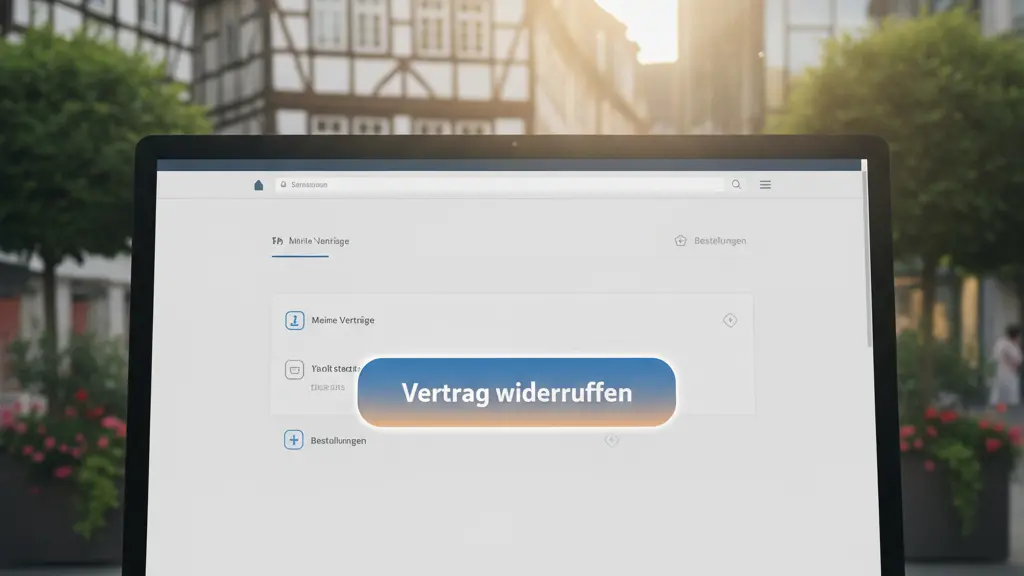
1. What the new “Click to Cancel” rule means for online contracts
From 19 June 2026, a new EU-driven rule requires businesses that sell to consumers via online user interfaces (websites, apps, platforms) to offer a clear, prominent withdrawal button — often called the “withdrawal button” or “widerrufsbutton”. The change implements the amended EU Consumer Rights Directive (EU 2023/2673) and national provisions such as a new § 356a BGB in Germany and a corresponding § 13a in Austria.
The basic idea is simple: consumers should be able to revoke an online contract just as easily as they concluded it. The button provides an additional, standardized channel to exercise the existing legal right of withdrawal, making online contracts more transparent and easier to cancel within the statutory withdrawal period.
2. How the withdrawal button works in practice
Placement and visibility requirements
The withdrawal button must be easy to find and clearly labeled (for example, “Withdraw contract” or an equivalent formulation). It should be visible on the main site or app area related to the contract and accessible both to registered users and guest customers, typically without requiring a login.
- Clearly labeled and prominent on the relevant page
- Accessible without mandatory login wherever possible
- Available for the entire withdrawal period
What happens when a consumer clicks the button
A click should lead directly to an online form that collects only the necessary contract data (name, contact, product or service, order or contract date, order number if applicable). Consumers do not have to give a reason for withdrawal. The form should include a second clear action (for example, “Confirm withdrawal”).
- Click the withdrawal button.
- Complete the short form with required details.
- Click a clearly labelled confirmation button (e.g. “Confirm withdrawal”).
- Receive an immediate confirmation on a durable medium (usually an email with date and time).
Business obligations after the withdrawal is submitted
After a consumer submits a withdrawal through the button, the entrepreneur must promptly confirm receipt on a durable medium (text, PDF, or email) and record the date and time. The moment the withdrawal is sent before the end of the legal withdrawal period is decisive for timeliness.
- Send an immediate confirmation on a durable medium.
- Include content of the declaration, date and time of receipt.
- Ensure backend logging for proof of timely submission.
3. Which contracts are covered — and which are excluded
The obligation to provide a withdrawal button applies to consumer sales concluded via an online user interface — this includes webshops, booking sites, apps, marketplaces and other B2C online platforms where a statutory right of withdrawal exists.
Covered contracts
- Standard online purchases of goods and services concluded on websites and apps
- Bookings and reservation services bought through an online interface
- Marketplace purchases and online B2C contracts where withdrawal rights apply
Not covered or excluded from withdrawal
Contracts concluded without an online user interface are not subject to the button requirement. Existing statutory exclusions to the right of withdrawal remain unchanged, so some types of contracts still cannot be revoked and therefore do not require a button.
- Agreements concluded by phone, individual email exchanges, fax or paper mail
- Contracts excluded under the existing exclusion list (e.g. bespoke goods, perishable goods, unsealed hygiene items, certain financial market transactions)
- Digital content where the consumer has expressly waived the withdrawal right and the service began immediately with their acknowledgment
4. Practical consequences for consumers
The new withdrawal button does not create a new right; it simplifies the exercise of the existing right of withdrawal. For consumers, three main benefits stand out.
- Greater transparency and uniform access: A standardized button replaces disparate company procedures and makes cancellation pathways predictable.
- Better proof of timing: Electronic confirmation with date and time improves the consumer’s ability to prove a timely withdrawal.
- Clearer information: Consumers must be explicitly informed about the online withdrawal option before concluding the contract; failure to do so can extend the withdrawal period.
5. Practical steps for businesses
Technical and organizational implementation
Implementing a compliant withdrawal button requires coordination between design, order flow, backend systems and legal text. The technical solution should link the visible button to an easy form, log submissions with timestamps and trigger automated confirmations.
- Design and place a prominent withdrawal button on the relevant pages.
- Provide a short, user-friendly form that requires only essential data.
- Ensure reliable logging of submission time and automated confirmation delivery.
- Update terms and withdrawal notices to reference the online withdrawal option.
Compliance risks and potential penalties
Failure to provide the withdrawal button or to meet the visibility and functionality requirements can lead to enforcement actions, fines and private enforcement such as warnings. National rules may impose significant penalties in serious cases.
- Risk of administrative fines for non-compliance.
- Liability through enforcement or private legal actions for misleading presentation of withdrawal options.
- Operational impacts from increased return handling or disputed timing of withdrawals if systems are not robust.
Tips for smaller merchants and platforms
Smaller shops and platforms using simple shop builders should plan early and use standardized, low-cost solutions where possible. Focus on clear placement, simple forms and automated email confirmations to reduce legal risk and customer service load.
- Start integration early and test the customer flow end-to-end.
- Use templates for confirmation messages that record time and content of withdrawal.
- Document technical and organizational measures to show good-faith compliance.
6. Frequently asked questions
Common consumer and merchant questions
- Is the withdrawal button a new right? — No. It is a new, standardized way to exercise the existing statutory right of withdrawal (usually 14 days).
- Does the button apply to all online purchases? — It applies to B2C online contracts concluded through an online user interface where the statutory right of withdrawal exists; some contract types remain excluded.
- Can businesses ask for a reason? — No. Consumers may withdraw without giving a reason.
- Do consumers still need proof? — The electronic confirmation provided after clicking creates stronger proof of timely withdrawal.
- What if the business does not provide a button? — Consumers may have extended withdrawal periods and businesses can face enforcement actions or fines.
7. Final summary
The new “click to cancel” requirement brings online withdrawals into line with how digital purchases are made: simple, visible and verifiable. It strengthens consumer protection by removing hidden hurdles while leaving the substantive rules of withdrawal — such as the 14-day basic period and the established exclusions — intact. For businesses, timely technical and procedural updates are essential to comply and to avoid enforcement risks. Overall, the change advances the goal that digital contracts should enjoy at least the same practical protection as offline contracts.
