
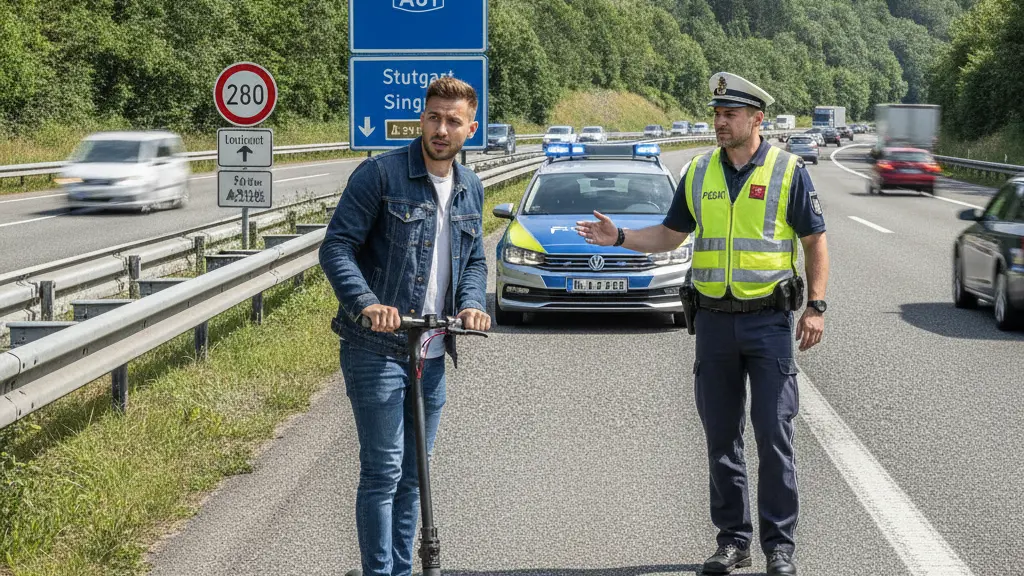
1. Overview of the A81 incident
On a stretch of the A81 in Baden-Württemberg a single traffic stop turned into a surprising double intervention. A 26-year-old man was first stopped while driving a small van and showed signs of drug use. After a positive roadside test and a hospital blood test, officers believed the case was closed. About 90 minutes later, witnesses reported an e-scooter being ridden on the hard shoulder of the same autobahn. Police found the same man on an e-scooter, stopped him again, secured the scooter and took another blood sample. Authorities now face a cluster of possible offences: driving under the influence, using an e-scooter on the autobahn, and suspicion that the scooter may have been stolen.
Timeline at a glance
- About 10:15 – Stop of a small van on a motorway parking area; driver shows signs of drug use.
- Shortly after – Positive rapid drug test; driver taken to hospital for blood sampling and banned from driving.
- Around 12:00 – Witnesses report an e-scooter on the hard shoulder of the A81.
- Police locate the rider near a service area and realise it is the same man; e-scooter secured, second blood test taken.
- Follow-up – Investigations consider charges for drugged driving, illegal motorway use, and potential theft or handling of stolen goods.
2. What the police did and evidence collected
The responding officers followed standard procedures for suspected drug-impaired driving. They conducted a roadside screening test, prohibited further driving, and arranged a medically supervised blood draw. When the man reappeared on an e-scooter, they repeated the process, secured the vehicle as evidence and started inquiries into its ownership. Statements from witnesses who reported the e-scooter on the hard shoulder also form part of the case file.
Testing, seizure and follow-up measures
- Roadside drug screening followed by hospital blood samples to confirm impairment.
- Immediate prohibition to continue driving after the first stop.
- Seizure of the e-scooter pending ownership checks and possible theft investigation.
- Documentation of witness statements and location (hard shoulder near service area).
3. Legal framework and possible charges
In Germany e-scooters are classed as small electric personal vehicles and fall under traffic regulations that restrict where and how they can be used. They are limited to a maximum speed of 20 km/h and may not be used on autobahns or motorways, which are reserved for vehicles that can reach at least 60 km/h. Riding an e-scooter on a motorway breaches traffic rules and can lead to substantial fines and administrative penalties.
| Offence | Possible legal consequences |
|---|---|
| Driving under the influence of drugs | Criminal charges, fines, driving ban, medical-psychological assessment, possible imprisonment in severe cases |
| Using an e-scooter on the autobahn | Significant fines, points on record, administrative measures |
| Possession of a stolen e-scooter or handling stolen goods | Criminal investigation, charges for theft or receiving stolen property, possible fines or imprisonment |
| Total | Multiple concurrent procedures possible depending on evidence |
When driving under the influence of drugs is suspected, criminal and administrative procedures can follow. Confirmed drug-impaired driving may result in fines, driving bans, criminal charges and compulsory medical-psychological assessment. If the scooter proves to be stolen or there is evidence of handling stolen goods, additional criminal charges such as theft, unlawful appropriation or possession of stolen property may apply.
4. Risks, context and related incidents
Riding an e-scooter on a motorway is extremely dangerous. The vehicle is lightweight, low to the ground and not designed for high-speed traffic. On a hard shoulder, visibility is reduced, reaction times are short and the chance of a serious collision with fast-moving vehicles is high. The combination of drug impairment and risky positioning multiplies the danger.
Other recent e-scooter safety incidents
- Severe e-scooter crash in a town that led to hospitalisation.
- Accidents involving young riders losing balance with passengers on board.
- Falls and serious injuries among older riders in nearby regions.
- Multiple checks across regions revealing riders under the influence of alcohol or drugs.
Authorities and local communities are responding with awareness campaigns and targeted checks. In some places, visible reminders and memorials have been used to communicate the potentially fatal consequences of risky e-scooter behaviour. The broader message from road safety professionals is consistent: e-scooters expand mobility but must be used with the same legal care and safety awareness as any other vehicle.
5. Practical advice for riders and the public
Whether you own an e-scooter or simply share the road with them, there are clear steps to reduce risk and stay on the right side of the law.
Tips for safe and legal e-scooter use
- Use e-scooters only where permitted: bike lanes, cycle paths or suitable roads in built-up areas — never on motorways.
- Never ride under the influence of alcohol or drugs; impairment greatly increases crash risk and carries legal consequences.
- Wear visible clothing and a helmet where possible to protect yourself in a fall.
- Know local rules, insurance obligations and speed limits (e-scooters are typically limited to 20 km/h).
- If you see an e-scooter on a motorway or otherwise endangering traffic, do not attempt to intervene; contact the police and provide clear location details.
If you rent or buy a second-hand e-scooter, check the vehicle’s provenance and documentation carefully. Handling or using a scooter that turns out to be stolen can lead to criminal complicity, even if you were unaware of the theft.
6. Conclusion — clear rules, serious consequences
The A81 case illustrates how quickly minor offences and poor decisions can escalate into multiple criminal and administrative procedures. Riding an e-scooter on a motorway is both illegal and dangerous, especially when combined with drug impairment. The safest course is to follow traffic laws, avoid riding while impaired, and treat e-scooters as real vehicles that require responsibility and respect for other road users.
Authorities continue to emphasise prevention, education and enforcement. For riders, the takeaway is simple: know the rules, stay sober, and choose safer routes — and if you witness dangerous behaviour, report it to the police to help prevent unnecessary injuries and tragedies.
