
1. Incident overview
On a section of the A81 near Großrinderfeld in Baden-Württemberg, police officers stopped the same 26-year-old man twice within a few hours. The first stop took place at about 10:15 on a rest area parking lot, where the man was checked while driving a small van and was found to be under the influence of drugs. He was forbidden to continue driving and taken to a hospital for a blood test.
2. Timeline of events
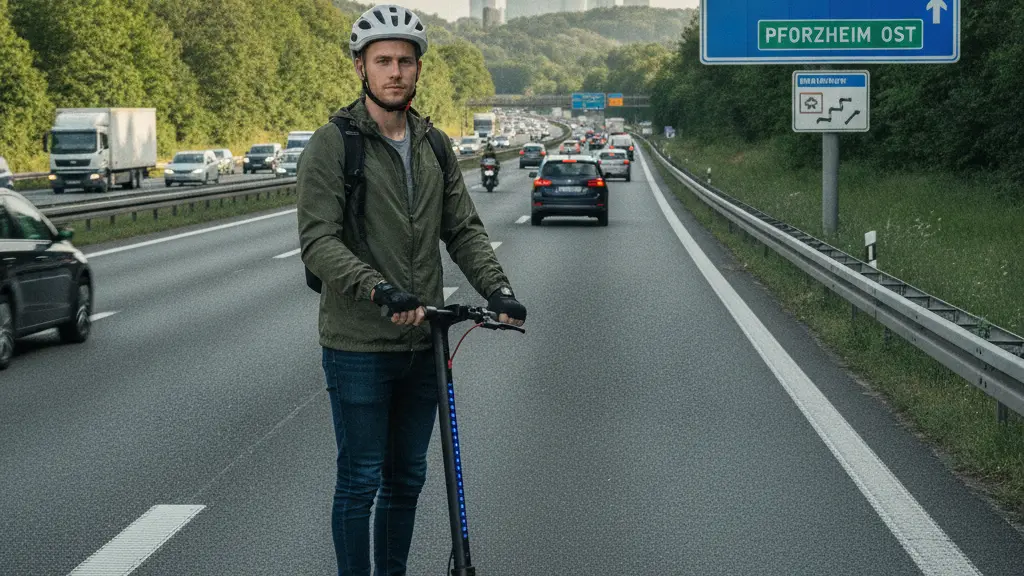
Only around two hours after the first intervention, witnesses reported an unusual traffic participant on the A81 in the direction of Würzburg. This time the man was on the hard shoulder and riding an electric scooter. Police met him again shortly before the Spitalwald rest area.
Second stop and immediate measures
At the second encounter, officers again escorted the man to a hospital for a blood sample and the e-scooter was seized. Authorities treated the situation seriously because riding an e-scooter on an Autobahn is explicitly forbidden and creates a major safety hazard for the rider and other road users.
3. Legal and safety context in Germany
In Germany, e-scooters are categorised as small electric vehicles used for micromobility. They are generally allowed on cycle paths or cycle lanes and — if no cycle infrastructure exists — on the carriageway inside towns. Riding on sidewalks is prohibited except where expressly permitted, and using e-scooters on Autobahns and motorways is explicitly forbidden.
Where e-scooters belong and why
- Cycle paths and cycle lanes are preferred for e-scooter use.
- If no cycle path exists, e-scooters may use the road within urban areas.
- Sidewalk riding is generally prohibited unless signs allow it.
- Autobahns and high-speed roads are off-limits for e-scooters due to the extreme danger posed.
- Operating any vehicle under the influence of drugs or alcohol increases crash risk and is subject to legal sanctions.
4. International context: recent changes in Austria (2026)
Other countries have tightened rules for e-scooters as well. A traffic law update in Austria in 2026 set clear technical and behavioural rules: e-scooters are legally defined with limits such as single-track design, no seat, a maximum speed of 25 km/h and a maximum motor power. The update also introduced measures like a 0.5 per mille limit for impaired riding, protective requirements for younger riders, and compulsory equipment such as a bell and blinkers in some cases. Like in Germany, Autobahns are not an option for e-scooters.
5. Possible legal and practical consequences
The man in this case faces several potential consequences. Police treated the incidents as more than a curiosity because multiple violations may be involved: driving under the influence, ignoring an official ban on further driving, using a forbidden vehicle type on the Autobahn, and an additional suspicion that the e-scooter might be stolen. The scooter was confiscated and authorities are examining whether criminal and administrative sanctions apply.
- Criminal proceedings for drug-impaired driving where applicable.
- Administrative fines and traffic bans for using an e-scooter on a motorway.
- Possible theft or handling-stolen-goods charges if the scooter is proven to be stolen.
- Measures such as compulsory medical or traffic-psychological assessment, depending on findings.
6. Safety takeaways and practical advice
This double police stop is a reminder of the limits and responsibilities that come with micromobility. E-scooters are useful for many short urban trips, but they must be used where they are allowed and in a safe condition. Riding on high-speed roads or under the influence of drugs or alcohol dramatically increases the risk of serious accidents.
Key messages for e-scooter riders
- Never ride an e-scooter on Autobahns or motorways — these roads are unsuitable and illegal for such vehicles.
- Avoid riding under the influence of alcohol or drugs; legal limits and safety risks apply to e-scooter users just as to other road users.
- Use cycle paths or the carriageway where legally required, follow local traffic rules, and respect official instructions from police.
- Make sure your e-scooter is legitimate and properly equipped; suspicious or unsecured vehicles can lead to additional legal trouble.
- When stopped by police, cooperate and follow procedures such as medical checks or blood tests — noncompliance can worsen the situation.
Observing these rules protects riders and others. The episode on the A81 shows how quickly a simple mobility choice can turn into a complex enforcement and safety case when laws and safety norms are ignored.
