
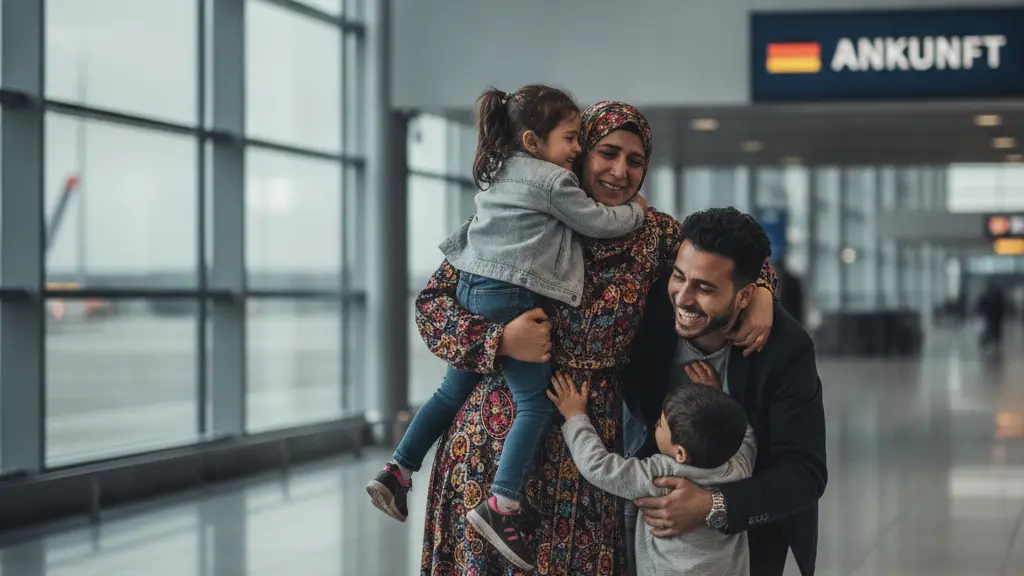
1. Overview: Family Reunification and the Small Share of Refugees
Between the start of 2025 and 23 April of the same year, authorities processed a total of 177,382 visa decisions in the family reunification area. Of those, only about 13 percent — exactly 23,273 decisions — involved family reunification to people who live in the country with refugee, asylum or another protection status. The largest single groups of decisions instead concerned spousal reunification: roughly 27,000 decisions were for spouses of citizens and 67,097 for spouses of other foreign residents such as workers. Thousands more decisions affected family members from other countries of origin, including around 9,000 spouses from one country of origin and nearly 9,800 nationals of another.
Public debate has often focused loudly on family reunification to specific groups of protection holders, especially those from countries affected by prolonged crises. Yet the data paint a different picture: family reunification visas are issued primarily in other constellations — to spouses and children of citizens, and to relatives of people who reside for work, study or other non-protection reasons. This mismatch between public attention and the numbers has shaped policy responses and political arguments in recent years.
2. Legal Status and Practical Barriers
Whether someone can bring relatives to join them depends largely on their legal status. People who are recognized as refugees under international law or who hold a fully protected asylum status generally have stronger, more clearly defined rights to bring spouses and minor children. By contrast, people with subsidiary protection — a status granted when return would present serious risks but does not meet the full refugee definition — face much tighter limits in practice.
Administrative hurdles and common procedural requirements
Families often face long waiting periods to even submit a visa application: some relatives wait more than a year for an appointment. Consulates and visa sections may require birth and marriage certificates, certified translations, DNA tests in contested parentage cases, and evidence of income, health insurance and adequate housing. These procedural demands, combined with backlogs at processing centres, make family reunification slow and uncertain for many applicants.
Since the summer of 2025, family reunification for many people with subsidiary protection has been largely suspended for a two-year period, with only narrowly defined “hardship” exceptions. The hardship route has been used extremely rarely: as of 15 May 2026, only seven visas had been granted under that exception while several hundred cases remained under extended review. At the same time, administrative hurdles such as long waits for consular appointments, complex documentary requirements and additional proof checks multiply the practical barriers to reunification.
3. European Comparisons
Across Europe, family reunification is treated differently but remains an important migration channel. In some neighbouring countries, official guidance explains that family members are examined individually and may receive similar protection status when one family member is granted asylum, though additional conditions such as proof of income, health insurance and adequate accommodation can be required. Some states have also created temporary rules allowing suspension of family procedures when systems are overloaded.
In other countries, family reunification represents a large share of regular immigration flows. For example, family reunification can account for roughly 30 percent of annual immigration in certain states, making it the second-most important reason for migration after labour moves. These differences show that family migration is a structural part of modern migration systems, not solely a side effect of forced displacement.
4. Civil Society Concerns and Legal Developments
Civil society groups and refugee advisory bodies have documented how legal changes and administrative practice have narrowed access to family reunification for protection holders. Legislative amendments introduced in mid-2025 added new restrictions and tightened eligibility rules, while court rulings in some cases have limited who can claim reunification rights — for example by finding that parents of a person who was once a minor but later became an adult and naturalized no longer have a direct right to join.
Human rights organizations warn that public rhetoric portraying protection-linked reunification as a major driver of migration risks legitimizing measures that strip rights from vulnerable groups. Comparable policy shifts affecting people from other crisis-affected countries also show how suspension of family pathways and resumed returns can leave families separated and legal protections hollow in practice.
5. Data vs Public Narrative
The available figures underline a clear mismatch: while media attention and political debate often single out family reunification to protection holders as a key migration issue, most family visas are not issued for that purpose. Instead, the bulk of family reunification decisions concern spouses and children of citizens and of people living in the country for employment, study or similar reasons. This means that policy measures aimed specifically at protection-linked reunification affect a relatively small share of the total flow but have disproportionately severe consequences for those families.
At the same time, planned reforms at the European level — including proposals that would change how asylum claims are processed and where they are examined — could indirectly reduce the number of people who obtain statuses that permit family reunification. Stricter recognition practices and wider use of third-country procedures may mean fewer people become eligible for family reunification in the future.
6. Human Impact and What Could Change
Impact on children and families
Prolonged separation places heavy emotional and developmental burdens on children and on adults who wait for spouses, parents or siblings. Unaccompanied minors and young people who were separated from their families face particular challenges: each additional month apart can increase trauma, hinder integration and limit the social supports that help recovery. Delays and denials of family reunification therefore have consequences beyond migration statistics — they affect everyday family life, mental health and the long-term prospects of integration.
Policy directions and practical recommendations
- Restore and clarify access: Re-open family reunification routes for those with limited protection where possible and clarify the criteria for exceptional hardship so the clause is usable in practice.
- Reduce delays: Invest in consular capacity and case processing to shorten waiting times for appointments and decisions.
- Simplify documentation: Where identity documents are hard to obtain, allow alternative proof mechanisms and more flexible evidence rules.
- Increase transparency: Publish clear, disaggregated statistics on family reunification so public debate matches the underlying data.
- Protect children and vulnerable people: Give priority processing to children, unaccompanied minors and clearly vulnerable family cases.
- Avoid symbolic targeting: Ensure migration policy focuses on measures that address real flows and protection needs rather than singling out small groups for political effect.
