
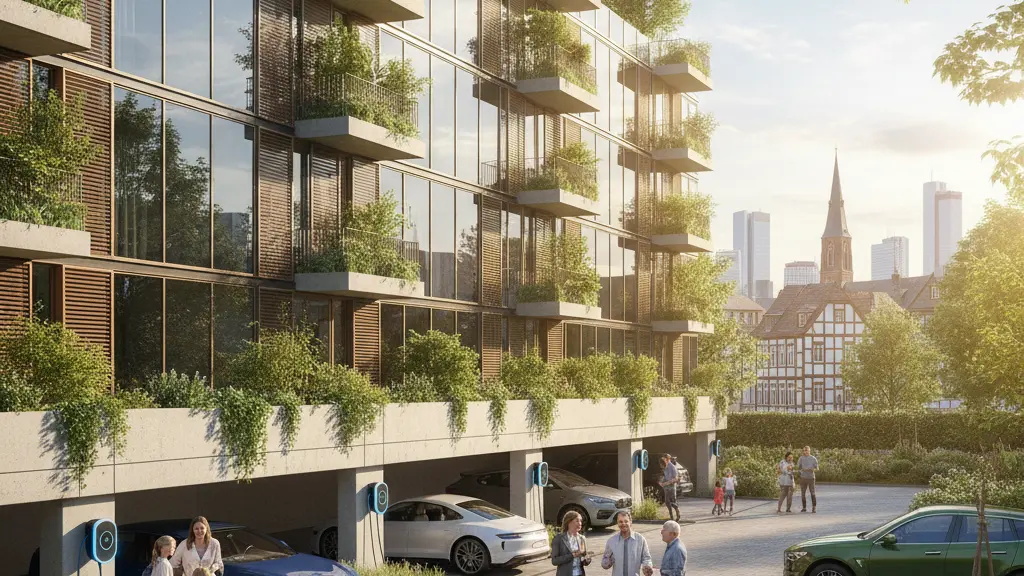
1. Overview of the new federal funding for EV charging at apartments
In 2026 the federal government announced a major funding program to expand EV charging infrastructure for multi-family homes and apartment buildings. The program provides up to 500 million euros to help implement the national charging infrastructure masterplan through support for private, non-public charging points at residential properties. This funding aims to tackle the shortage of charging stations at shared parking areas, making everyday electric vehicle charging more accessible for residents of apartments and multi-family housing.
The measure recognizes that a large share of people live in multi-unit buildings and that those parking spaces have been under-equipped for charging. The program targets on-site solutions such as wallboxes and grid connections for charging points up to 22 kW per spot, focusing on non-publicly accessible charging infrastructure for tenants and owners.
2. What the funding covers
The funding supports essential components to install reliable EV charging at apartments and multi-family properties. Eligible costs include acquisition and installation of charging hardware, necessary electrical upgrades and grid connections, and related construction work for parking areas that are not publicly accessible. Charging points are supported up to a maximum output of 22 kW per point.
| Type of support | Maximum grant per charging point (EUR) |
|---|---|
| Network/installation without wallbox | 1,300 |
| With wallbox | 1,500 |
| Bidirectional charging (V2G capable) | 2,000 |
| Note | Grants apply to non-public charging points up to 22 kW |
3. Who can apply and eligibility requirements
Eligible applicants include homeowner associations for multi-unit buildings, small and medium landlords who rent out units, and housing companies managing residential portfolios. The program is designed to support those responsible for parking areas and property decisions at apartment buildings.
Key eligibility conditions
- Minimum electrification: at least 20% of the parking spaces in the project must be prepared for charging.
- Minimum project size: projects must cover at least six parking places.
- Supported charging: non-public charging points only, with each point up to 22 kW.
4. Application timeline and procedural notes
Applications open from 15 April 2026 and run until 10 November 2026. There is a separate deadline of 15 October 2026 for larger entities that are required to follow a competitive procurement procedure. Applicants should check their eligibility early and plan the required documentation and technical specifications before submitting.
Practical application tips
- Start planning early: coordinate with tenants, the homeowner association, or landlords to define desired number of charging points.
- Contact the local grid operator to assess connection capacity and timeline for grid work.
- Collect quotes for wallboxes, installation and civil works to prepare the cost estimate required for the application.
5. Technical and project preparation guidance
Preparing a successful project requires both technical planning and stakeholder coordination. Key topics include choosing suitable wallboxes (single-phase or three-phase, smart features), planning for cabling and distribution boards, and ensuring adequate grid capacity. Consider future needs such as the option for bidirectional charging when selecting hardware and planning electrical upgrades.
Technical considerations
- Wallbox selection: balance cost, smart charging features, and expandability; bidirectional-capable devices are eligible for higher support.
- Electrical upgrades: include potential distribution board upgrades and meter installations in your cost planning.
- Load management: for many sites, intelligent load management reduces the need for expensive grid upgrades by sharing available power between chargers.
Stakeholder coordination
- Engage tenants and owners early to secure approval and agree usage rules.
- Work with property managers to plan installation windows and access to parking areas.
- Coordinate with the distribution grid operator to confirm connection options and timelines.
6. Benefits, impact and financial outlook
The funding is expected to speed up deployment of charging stations at apartments, lower barriers for residents to switch to electric vehicles, and reduce local emissions. Experts estimate that effective subsidies can cover a high share of eligible costs in many projects, with typical subsidy shares reaching up to around 60% depending on specifics. This reduces upfront investment for owners and landlords and accelerates market uptake.
Some regional or local programs may pause or adapt while the federal funding is available, so applicants should check local funding landscapes to avoid overlap and to choose the best funding path for their project.
7. Practical checklist for apartment EV charging projects
Use this checklist to move from idea to funded installation:
- Confirm eligibility: verify that your organization type and project size meet program rules.
- Define scope: calculate number of parking spots to electrify (minimum 20% and at least six spots).
- Obtain technical assessments: grid capacity check, preferred wallbox specifications, and required civil works.
- Gather cost estimates: equipment, installation, and necessary electrical upgrades for the application.
- Register and apply within the application window starting 15 April 2026, adhering to any specific procurement rules for larger entities.
- Plan tenant and owner communications: decide on usage rules, billing, and access control for chargers.
- Prepare for installation: schedule contractors, coordinate with grid operator, and plan handover and user instructions for residents.
