
1. A long-awaited return: Parsifal at the Semperoper
After more than sixteen years without a staged production, Richard Wagner’s Parsifal has returned to the Semperoper Dresden. The new production by director Floris Visser premiered on 22 March 2026 and immediately set audiences talking. This revival reconnects the house with a work that was last represented in a long-running staging inaugurated by the legendary Theo Adam in 1988 and performed until 2010.
The road back to Dresden’s stage was not straightforward: earlier hopes for a transfer from Salzburg failed because of technical and financial obstacles. The Semperoper has now placed Parsifal back on its schedule through 2026, offering a fresh, contemporary take on Wagner’s late masterpiece.
2. Musical leadership and orchestral achievement
Under the baton of chief conductor Daniele Gatti, in his second new production for the house after Falstaff, Wagner’s score is rendered with striking precision and depth. Gatti’s approach reaches from stretched tempi in the Vorspiel to luminous, almost magical textures in the Karfreitagszauber. The Sächsische Staatskapelle displays its renowned Wagner competence, delivering a performance that supports singers without forcing them and that highlights the score’s inner architecture.
Orchestra, dynamics and interpretation
Critics praise Gatti’s personal interpretation, which references historic readings while asserting its own dynamic contours. Thoughtful tempo changes, moments of exquisite pianissimo and carefully shaped climaxes let the orchestra carry dramatic weight. The overall result is a sound world that feels both historically informed and freshly alive.
3. Principal cast and vocal highlights
The production gathers a strong cast whose members bring distinct vocal profiles and dramatic presence. Soloists are able to inhabit Wagner’s demanding roles with clarity of text and musical beauty, matching the orchestra’s refined support.
| Role | Performer | Notes |
|---|---|---|
| Gurnemanz | Georg Zeppenfeld | Sovereign, textually lucid, with warm beauty of tone |
| Parsifal | Eric Cutler | Naïve yet powerful; captures the role’s awakening |
| Amfortas | Oleksandr Pushniak | Dark, desperate, intensely felt |
| Klingsor | Scott Hendricks | Diabolical and threatening |
| Kundry | Michèle Losier | Earthy, dramatic and vocally assured |
| Titurel | Albert Dohmen | Grave character presence |
| Curious pupil / cast member | Leander Wilde | Acts as an imaginative catalyst and alter ego for Parsifal |
Vocal impressions and ensemble balance
Reviewers noted especially the clarity of diction and the gorgeous vocal colors among the principals. The singers never have to push to be heard because the orchestra and conductor keep a sensitive balance, allowing long vocal lines and dramatic moments to unfold naturally.
4. Staging, design and the director’s concept
Floris Visser’s staging is visually bold and meticulously crafted. Together with stage designer Frank Philipp Schlößmann and video and costume designers Jon Morell and Will Duke, Visser creates an opulent ruin of the Abbey of St. Parsifal, inspired by Tuscan architecture and realized on a rotating stage. Time layers are deliberately mixed and videos are used to simulate rain, producing a strong visual idea of “time becoming space.” The production seeks to fuse mythic scope with a contemporary sensibility.
The child’s perspective at the centre
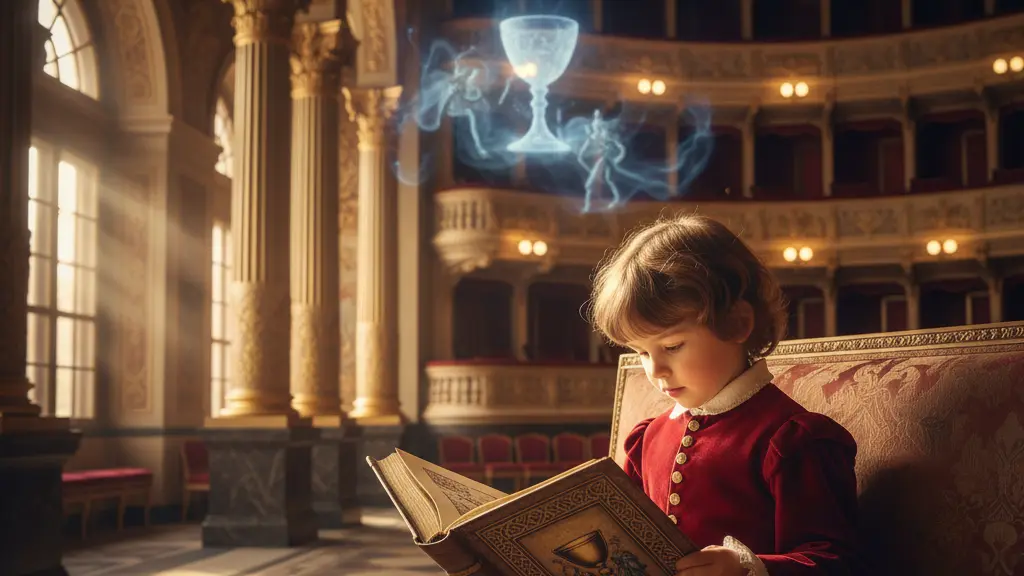
A central conceit is the childlike gaze: a curious pupil, played by Leander Wilde as a chorister in a principal function, discovers an old book and imagines the Parsifal saga. He becomes an alter ego of Parsifal, commenting on and intervening in the action. This framing device brings immediacy and wonder to the narrative while inviting audiences to view Wagner’s mystery through an inquisitive, modern lens.
Controversial imagery and dramatic excess
Visser’s visual choices also push boundaries. The staging includes reenacted seduction of Amfortas, Klingsor’s self-castration, Adam and Eve tableau, heavy use of incense and blood imagery, a crucifixion scene and even a newborn presented as a sacrificial blood image. This dense religious symbolism and theatrical excess have divided opinion: some view it as an honest, provocative engagement with Wagner’s themes, others find it overstated or even kitschy.
5. Reception: musical unanimity, staging debate
The premiere provoked a marked split between musical praise and staging controversy. Most critics and audience members agreed on the musical achievement: Gatti and the Sächsische Staatskapelle were widely celebrated, as were many of the principal singers. The production’s dramaturgy and imagery, however, produced polarized responses.
- Some critics hailed the production’s detailed direction and the director’s sincere engagement with the work and its contemporary resonances.
- Others condemned the staging as overblown, overloaded with pathos and kitsch, arguing that the visual rhetoric sometimes undermines Wagner’s open-ended mystery.
- Another view praised the ambition and originality but warned that the concept occasionally overreaches and dissolves into ambiguous utopian gestures.
Despite the debates over imagery, the production fills more than five hours with rich theatrical and musical substance. Official channels have gathered press reactions and rehearsal insights, and the production’s presence on the house schedule underscores its importance for the coming season.
6. Why this production matters
The return of Parsifal to Dresden is significant on several levels. Musically it reaffirms the Semperoper’s and the Sächsische Staatskapelle’s deep connection to Wagner’s repertoire, brought vividly to life under Daniele Gatti. Dramaturgically and visually, Floris Visser’s concept transforms the work into a contemporary meditation on curiosity, redemption and a world in crisis. The result is a production that reconciles Wagner’s multifaceted mystery with pointed modern commentary.
Practical note and final thoughts
The production premiered on 22 March 2026 and remains part of the Semperoper’s playing schedule through 2026. For those interested in Wagner’s late masterpiece, this staging offers an opportunity to experience a powerful musical interpretation and a staging that will stimulate discussion long after the curtain falls.
