
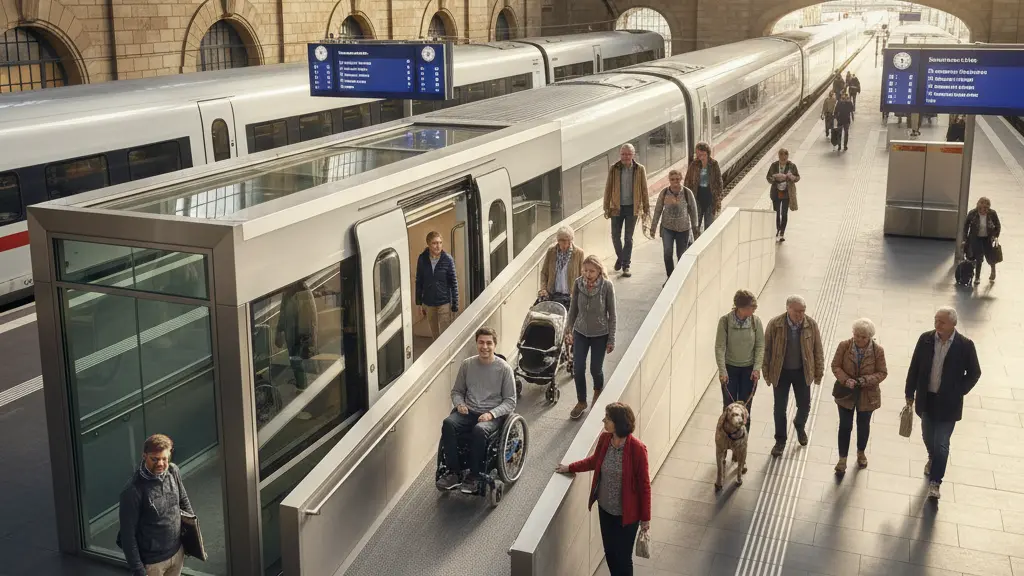
1. A widening gap between promise and practice
In recent years, governments have promised full accessibility at train stations, referencing international commitments made more than a decade ago. Yet the reality on the ground often looks very different: the national rail system is frequently mocked as an “I-don’t-care” railway because a large share of stations remain hard to use for people with reduced mobility.
This article looks closely at the facts, the political debate, the human consequences and practical measures that could make the transport network truly inclusive for everyone.
2. The numbers: what the data show
The latest station accessibility data in 2026 show that just over half of all stations are fully accessible. Progress since 2020 has been limited, and public auditors have criticized the slow prioritization of investments. These figures expose a large gap between ambitious targets and on-the-ground progress.
| Metric | Value |
|---|---|
| Approximate total stations and stops | ~5,300 |
| Fully accessible stations (2026) | 54% (~2,862) |
| Not fully accessible | 46% (~2,438) |
| Progress since 2020 | +10 percentage points |
| Government target | 100% by 2027 |
| Estimated upgrade cost | ~45 billion EUR |
| People depending on accessible transport | ~1.2 million |
| Key takeaway | Significant investment and faster implementation are required to meet targets. |
3. Politics, promises and delays
3.1 Different political voices
Politicians on the one hand demand faster action and even threaten penalties to speed up accessibility projects. At the same time, coalition agreements emphasize “consequent implementation,” creating expectations that are hard to meet without clarified funding and timelines.
3.2 The operator’s stance and financial constraints
The national rail operator argues that a later target date is more realistic and points to high projected costs and budget limits. Management has described a multi-year timeline as necessary, citing tens of billions in investment needs and the practical challenge of carrying out complex construction work without disrupting services.
3.3 Accountability and split responsibilities
Responsibility for station upgrades is affected by disputes between national and regional authorities, and by the realities of long-running construction projects. Auditors have faulted planners for not prioritizing investments efficiently, deepening the political disagreement over who should move first and how to share costs.
4. Real human impact
Accessibility is not an abstract policy goal: it determines whether people can work, access healthcare, attend school, visit friends or simply travel independently. Around 1.2 million people rely on accessible transport, and many more are affected when trains, ramps or elevators are missing or broken. Cases such as long-term elevator outages at major stations highlight how a single failure can block travel for months.
- No ramps or portable solutions at low-use platforms
- High steps between platform and train without ramps
- Elevators and lifts out of service for extended periods
- Insufficient staff assistance or unclear assistance processes
- Inaccessible toilets and station facilities
Advocates call every inaccessible station a form of discrimination, noting that daily exclusion harms jobs, education and social life. Reports also show that refugees, older people and travelers with luggage are among those regularly excluded from using rail services because of physical barriers.
5. Practical steps and recommendations
- Prioritize upgrades for busy stations and those serving vulnerable communities to maximize immediate impact.
- Adopt universal design standards from the start for all new construction and refurbishments.
- Agree clear, realistic timelines with binding milestones and public monitoring.
- Secure joint funding agreements between central and regional governments to avoid stop-and-go financing.
- Provide interim measures such as portable ramps, reliable assistance services and rapid repair protocols for broken lifts.
- Increase transparency on progress, costs and decision rules so citizens can hold authorities accountable.
- Train staff across the network in accessible travel assistance and communication.
Experts recommend combining strong planning with quick interim fixes. Universal design prevents repeated retrofit costs and makes travel easier for everyone, not only people with disabilities. Prioritization and clear funding decisions will determine whether promises turn into tangible improvements.
6. Conclusion: accountability and common-sense progress
Meeting accessibility goals is both a moral obligation and a practical necessity. Closing the gap between political promises and daily realities requires realistic timelines, honest cost-sharing, stronger project prioritization and immediate measures to reduce exclusion today. When accessibility is treated as a central design principle rather than an afterthought, the rail network can become more inclusive, reliable and useful for all travelers.
